
Failing the NCLEX is common enough that there is a well-worn path out of it, and most people who fail once pass on the next attempt. What determines that is not how hard you study in between — it is whether you study the right thing. Your result comes with a document that tells you what that is, and most candidates never really read it.
The rules, first
- You must wait 45 days between attempts. This is the NCSBN retake policy and it is not negotiable.
- You re-register with Pearson VUE and pay the fee again, and your board of nursing must issue a new Authorization to Test before you can schedule.
- Your board sets how many attempts you get and over what period — this varies by state, so check yours rather than assuming.
Read your Candidate Performance Report properly
Every candidate who fails receives a CPR. It reports each test-plan category as Above, Near, or Below the passing standard. It is the single most useful study document you will ever be handed, and it is routinely skimmed and filed.
How to act on it:
- Below the standard — this is where your time goes. Not proportionally. Disproportionately.
- Near the standard — these are the cheapest marks available. A category sitting just under the line usually needs technique, not knowledge.
- Above the standard — leave it alone. Re-studying what you already passed is the most common way a second attempt is wasted.
If you ran out of questions at the maximum rather than ending early, that tells you something too: you were hovering near the line the whole way, and small improvements across several categories will move you over it.

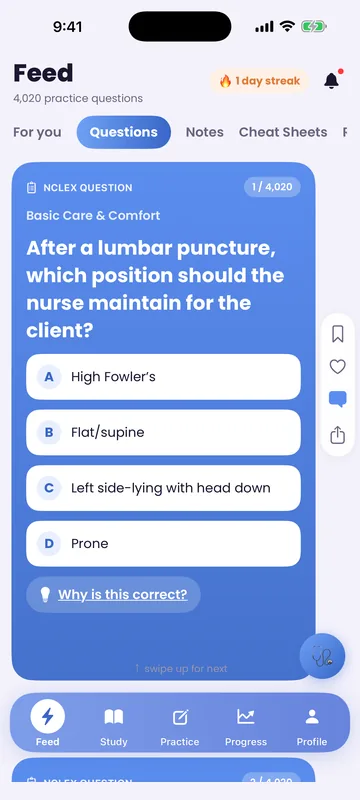
A 45-day plan that is not just "study harder"
| Days | What you do |
|---|---|
| 1–3 | Rest, then read the CPR and write down every Below and Near category. This list is your plan — do not add to it. |
| 4–14 | One Below category at a time. Questions first, content only where a wrong answer exposes a gap. |
| 15–28 | The Near categories. These usually fail on technique — SATA strategy, priority frameworks, reading the actual question. |
| 29–38 | Mixed practice, timed. Build back the stamina; review every rationale, including the ones you got right. |
| 39–45 | Light mixed review. Taper. Sleep properly the two nights before, not just the one. |
The two honest reasons people fail twice
Doing the same thing again. If the first attempt was built on reading review books, reading them again more carefully will produce the same result. The exam tests applied judgement; the practice has to be applied judgement.
Not reading rationales for correct answers. On an adaptive test you need to be right for the right reason — getting there by elimination works once and does not generalise. Reading why the other three options were wrong is where the reasoning actually gets built.
Start with prioritisation questions — it is the category most often sitting Near the line — and read our prioritisation and delegation guide.