
Roughly 8 out of 10 first-time, US-educated candidates pass the NCLEX-RN — but the ones who fail rarely fail because they didn't know enough facts. They fail because the exam asks them to apply knowledge to an unfamiliar patient, under time pressure, and their study plan trained recognition instead of reasoning. This guide fixes that.
First, understand what you're actually up against
The NCLEX is a computerized adaptive test (CAT). It is not a fixed exam where everyone answers the same questions. After each answer, the algorithm re-estimates your ability and serves a question matched to it. Get one right, the next is a touch harder; get one wrong, the next is a touch easier. The test ends when it is 95% confident you are consistently above (pass) or below (fail) the passing standard.
The single biggest mindset shift: study questions, not chapters
Reading a content review cover-to-cover feels productive, but it builds recognition ("I've seen this") rather than retrieval ("I can produce the answer under pressure"). The NCLEX rewards retrieval and clinical judgment. So flip your ratio:
- ~70% of your time in practice questions — and read the rationale for every option, including the ones you got right.
- ~30% targeted content review — but only on the topics your wrong answers expose. Let your mistakes write your study list.
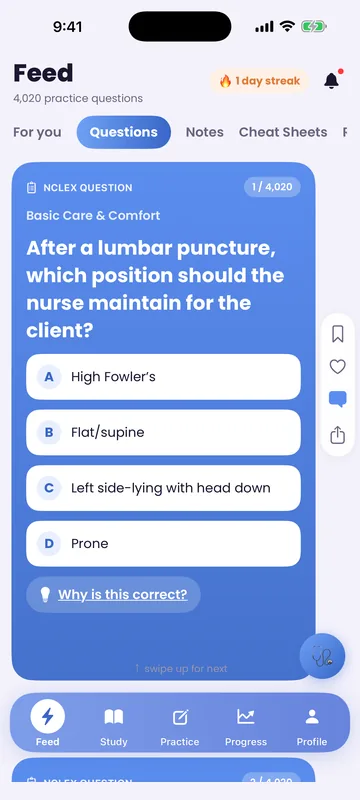
This is why apps that put a question bank and cheat sheets in front of you beat passive re-reading: the reps are the point.

A realistic 6-week plan
| Week | Focus | Daily target |
|---|---|---|
| 1 | Diagnose. Take a ~75-question baseline across all categories. Note weak areas. | 50 Q + review |
| 2–3 | Weak-area drills. Med-surg and pharmacology usually carry the most weight — hit them hard. | 75 Q + 2 cheat sheets |
| 4 | Next Gen NCLEX (NGN) case studies + SATA. These are where scores quietly leak. | 60 Q + 3 NGN cases |
| 5 | Full-length timed practice. Build stamina; practice pacing (~1–1.5 min/question). | 1 mock + review |
| 6 | Mixed review + confidence. Re-drill only what still trips you. Taper, sleep, arrive rested. | 50 Q + rest |
Working adults: compress to what you can sustain, but protect the question volume and the rationale reading above all else. Consistency beats cramming — 90 minutes a day for six weeks outperforms a frantic final weekend.
Learn the frameworks the exam quietly grades you on
A huge share of NCLEX items are "what do you do first / which client do you see first" priority questions. Memorize the decision order:
- ABCs — Airway, Breathing, Circulation. A patent airway beats everything.
- Maslow — physiological needs before psychosocial before self-actualization.
- Safety & infection control — when physiology is stable, the safe/least-restrictive/infection-preventing action wins.
- Acute over chronic; unstable over stable; unexpected over expected.
We break these down with worked examples in NCLEX Prioritization & Delegation Made Simple.
Don't get ambushed by NGN
The 2026 test plan leans harder on Next Gen NCLEX clinical-judgment items — bow-tie, matrix, trend, and unfolding case studies scored with partial credit. If your practice has been all multiple-choice, you're not ready for the format. Read the NGN question types explained and practice real cases before test day.
The week of the exam
- Taper, don't cram. New material 48 hours out rarely sticks and raises anxiety.
- Sleep is a study tool. Two good nights beat two more Qbank sets.
- Plan the logistics. Know your Pearson VUE site, ID requirements, and travel time.
- Pace yourself. You have up to 5 hours. Don't rush the first 20 questions — they carry weight.
Frequently asked
How many practice questions should I do before the NCLEX?
There's no magic number, but most confident first-time passers do 2,000–4,000+ questions with rationales across their prep. Quality of review matters more than raw count — a question you got wrong and fully understood is worth ten you rushed.
Is content review a waste of time?
No — but it should be targeted. Use it to patch the specific gaps your practice questions expose, not as your primary activity.
How long should I study for the NCLEX?
Four to eight weeks of consistent daily practice suits most new grads. Shorter is possible with heavy daily volume; longer risks burnout and forgetting.