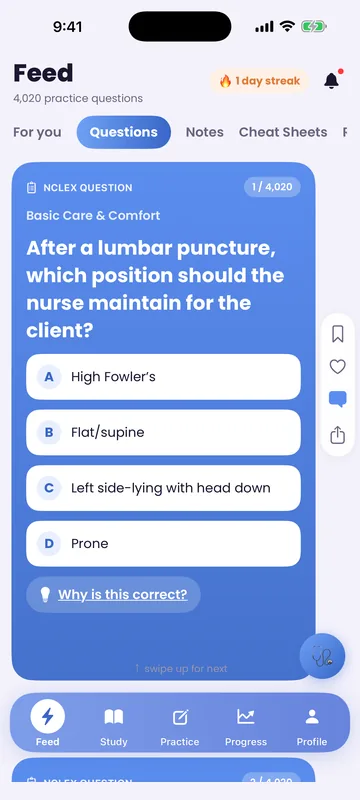
The Next Gen NCLEX introduced item types that don't look like the multiple-choice questions you grew up with. They exist to measure clinical judgment — not just recall — and once you understand the shape of each, they're far less scary. Here's the field guide.
How NGN scoring differs
Most NGN items use partial credit, unlike classic all-or-nothing multiple choice. Common scoring models:
- +/− scoring: right selections earn points, wrong selections lose them (you can't just select everything).
- Rationale scoring: you only get credit if a linked set of choices is internally consistent.
- 0/1 scoring: each blank or cell is scored independently.
The item types
1. Extended Multiple Response
Like SATA on steroids — choose all correct options from a longer list, sometimes with a cap ("select up to 4"). Tests recognize- and analyze-cues.
Example: "Which findings require immediate follow-up? Select all that apply." Then a mix of expected and concerning cues.
2. Matrix / Grid
A table where you mark each row (finding, action, or parameter) against columns like Anticipated / Non-essential / Contraindicated, or Effective / Ineffective / Unrelated. Each cell is scored.
Example: for a patient with heart failure, categorize each nursing action as indicated or contraindicated.
3. Bow-Tie
The signature NGN item. A center box holds the condition/priority problem; you drag the correct actions to take (left) and parameters to monitor (right) from option banks. One item captures the whole judgment model — recognize, act, evaluate.
4. Cloze (Drop-Down)
Fill-in-the-blank within a sentence using drop-down menus: "The nurse determines the client is experiencing [drop-down] as evidenced by [drop-down]." Tests whether you can complete accurate clinical reasoning in prose.
5. Highlight (in Text / Table)
You click to highlight the relevant words or values in a chart or nurses' note — e.g., highlight the findings that indicate a complication. Pure recognize-cues.
6. Unfolding Case Study
A single patient scenario across six linked questions, one per step of the clinical-judgment model. The case evolves as you go. We walk a full one in the sepsis case study.
How to practice them
- Don't over-select. On +/− and matrix items, only choose what you're confident is correct.
- Practice in the real format. Reading about bow-tie isn't the same as doing one under time. Use a bank with true NGN items.
- Think in the model: cues → hypotheses → actions → evaluation. Every NGN type maps to a step.
CinnaRN's feed includes matrix and cloze items plus 51 interactive NGN cases, so you practice the real shapes, not just descriptions of them.