
On this page
The official answer from NCSBN
NCSBN's NCLEX FAQ answers this directly: items that contain a numeric lab value include the corresponding normal reference range. The same FAQ notes that items currently use a combination of SI (international) and imperial measurement, in units candidates will recognize. So you won't be expected to recall that potassium runs 3.5 to 5.0 mEq/L just to know a value is low.
Read the units every time. A glucose shown in mmol/L looks very different from one in mg/dL, and the reference range printed beside it is your anchor. In case studies, results often sit in a table next to vital signs and nurses' notes, so build the habit of checking the range column before you judge a number.
Why you still need to know your labs
The 2026 NCLEX-RN test plan lists laboratory values under Reduction of Risk Potential, with tasks such as comparing client lab values to normal values, monitoring results (for example, glucose in a client with diabetes), notifying the primary health care provider about results and teaching clients about ordered tests. None of those tasks end at 'this number is out of range.'
Lab questions usually ask one of three things: which result needs action first, what the nurse should do about it, or whether a result shows that treatment is working. To answer, you must connect the value to the client's condition and medications. A potassium of 3.3 mEq/L is only mildly low on paper, but in a client taking digoxin it raises the risk of toxicity and moves up the priority list.
Knowing the core ranges also saves time. With up to 150 items in five hours, recognizing a dangerous value at a glance frees your attention for the clinical reasoning the item is really testing.
Check yourself
4 quick questions on this topic
Question 1 of 4
A client receiving digoxin has a serum potassium level of 2.9 mEq/L. Why is this lab value a concern for the nurse?
Answer: A. Hypokalemia (normal potassium 3.5 to 5.0 mEq/L) increases the myocardium's sensitivity to digoxin and predisposes the client to digoxin toxicity and dangerous dysrhythmias even when the digoxin level appears therapeutic. The nurse should report the low potassium. Hypokalemia does not protect against toxicity or simply raise blood pressure.
Question 2 of 4
A client with CKD and anemia is prescribed epoetin alfa. Which laboratory value should the nurse monitor to evaluate the therapeutic effect?
Answer: A. Epoetin alfa stimulates red blood cell production to treat the anemia of CKD (caused by reduced erythropoietin). Hemoglobin and hematocrit are monitored to evaluate effectiveness; the target hemoglobin is generally about 10 to 11 g/dL to avoid thrombotic risk from over-correction. Potassium, sodium, and platelets do not measure this drug's effect.
Question 3 of 4
A client is admitted with a serum creatinine of 4.2 mg/dL and a urine output of 200 mL over the past 24 hours. Which prescribed order should the nurse clarify with the provider?
Answer: A. With AKI and oliguria, the kidneys cannot excrete potassium, so an order to add potassium chloride to IV fluids should be clarified because it risks dangerous hyperkalemia. Strict intake and output, a renal-dose adjustment of medications, and a low-potassium diet are all appropriate and consistent with the plan of care for AKI.
Question 4 of 4
A client has the following gas: pH 7.40, PaCO2 40 mmHg, HCO3 24 mEq/L. How does the nurse interpret these results?
Answer: A. All three values fall squarely within their normal ranges: pH 7.35-7.45, PaCO2 35-45 mmHg, and HCO3 22-26 mEq/L. This represents a normal arterial blood gas with no acid-base imbalance present.
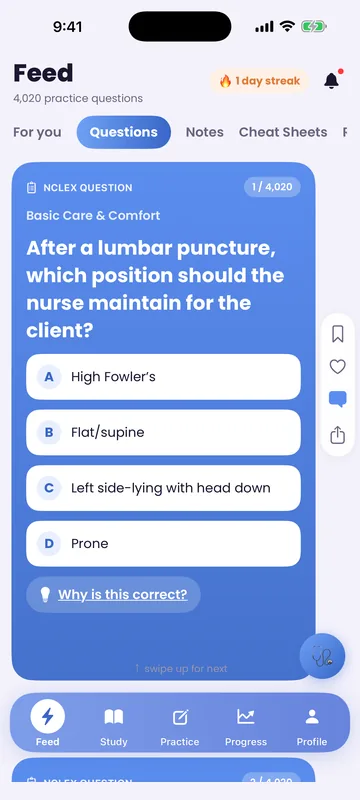
Keep the streak going with more questions like these, each with a full rationale.
The lab values worth memorizing anyway
Reference ranges vary slightly between labs and textbooks, which is exactly why the exam shows them. Still, these commonly cited adult ranges are worth knowing cold:
What a lab question looks like (worked example)
A client with heart failure takes furosemide 40 mg daily and digoxin 0.125 mg daily. This morning's results: potassium 3.1 mEq/L (reference 3.5–5.0), sodium 138 mEq/L (135–145), creatinine 1.0 mg/dL (0.6–1.2), digoxin 1.4 ng/mL (0.5–2.0). The client reports nausea. Which finding should the nurse address first?
The ranges tell you only one value is abnormal, so 'the potassium' looks obvious. The reasoning is what earns the point. Furosemide wastes potassium, low potassium makes the heart more sensitive to digoxin, and nausea is an early sign of digoxin toxicity even when the level sits inside the range. The nurse should check the apical pulse, hold the digoxin per protocol and notify the provider about the potassium.
A matrix or drop-down version of this item might ask you to link each finding to its cause. That only works if you know why each value matters, not just whether it is flagged.

Trends beat single numbers
Case studies often show results over several days, and the direction of change can matter more than whether a value sits inside the range. Three patterns worth recognizing:
When an item gives you a table, scan each row left to right before reading the question. You're looking for direction and speed of change, not just flags.
- Platelets falling from 320,000 to 150,000/mm³ five days after starting heparin: still in range, but a drop of about half from baseline should raise concern for heparin-induced thrombocytopenia.
- Creatinine climbing from 0.9 to 1.4 to 2.1 mg/dL after contrast or a nephrotoxic drug: a pattern of acute kidney injury, even before urine output falls.
- Hemoglobin sliding from 13.2 to 10.1 g/dL after surgery while heart rate rises: think bleeding, and check the dressing and drain output.
A three-step study plan for NCLEX labs
Lab tasks sit mainly in Reduction of Risk Potential, set at 9–15% of the 2026 RN exam, and they spill into pharmacology and physiological adaptation. Of the 4,033 questions in the CinnaRN bank, 324 are tagged Reduction of Risk Potential and 932 are pharmacology, so there's plenty of material to build speed. Use this plan in your final four to six weeks, then take the quiz on this page, which starts with potassium, INR, platelet and blood gas questions.
- Learn the short list above until you can recall each range without thinking. Ten minutes of flashcards a day is enough.
- Pair every lab with its drugs and conditions: potassium with loop diuretics and digoxin, INR with warfarin, aPTT with heparin, glucose with insulin, sodium with SIADH and diabetes insipidus.
- Practice reading lab tables under time pressure. Give yourself 30 seconds to name the most dangerous value and explain why.
Frequently asked questions
Does the NCLEX give you lab values?
Yes. NCSBN says any item with a numeric lab value includes the corresponding normal reference range. You still have to interpret what the value means for that client and decide what to do.
What lab values do I need to know for NCLEX?
Know electrolytes (potassium, sodium, calcium, magnesium), BUN and creatinine, CBC values, glucose and HbA1c, INR and aPTT, arterial blood gases, and drug levels such as digoxin and lithium. The ranges help with speed; the exam tests what you do with abnormal results.
Are NCLEX lab values in SI or conventional units?
Both. NCSBN says items currently use a combination of SI and imperial measurement, in units candidates will recognize. Always check the unit and the reference range shown.
Should I still memorize normal lab ranges?
Yes, a short list. The range will be on screen, but knowing it instantly saves time across up to 150 items and helps you spot which abnormal value is truly urgent.
Keep studying
Sources
Checked against official sources