
On this page
The short answer, by the numbers
Pharmacology is one of the biggest single slices of the NCLEX. The 2026 NCLEX-RN test plan puts Pharmacological and Parenteral Therapies at 13–19% of items. Only Management of Care has a higher range, at 15–21%. NCSBN's own chart plans pharmacology at 16% of the RN exam.
On the NCLEX-PN, the category is called Pharmacological Therapies and carries 10–16%, planned at 13%. Because exam length varies, NCSBN notes that your individual exam may differ by up to 3 percentage points in any category.
What that means on your actual exam
Percentages are abstract, so here is the math on a minimum-length exam. Every NCLEX is built from the same blocks: 52 content-area questions, 18 case-study questions and 15 unscored pretest questions, for 85 total.
Apply the RN range to the 52 content questions: 52 × 13% ≈ 7 and 52 × 19% ≈ 10. So expect roughly 7 to 10 scored pharmacology questions on an 85-question RN exam. For the PN, 52 × 10–16% works out to roughly 5 to 8. Longer exams add more questions from every category to keep the percentages on target.
That count undersells how often medications appear. Case studies span any content area and are counted separately, so a sepsis or heart failure case can ask about antibiotics, diuretics or IV drips. Items in other categories also lean on drug knowledge, such as checking labs before a dose.
Check yourself
4 quick questions on this topic
Question 1 of 4
Which medication is on the 'high-alert' list requiring extra safeguards?
Answer: B. High-alert medications (heparin, insulin, opioids, concentrated electrolytes like potassium chloride, chemotherapy) carry heightened risk of harm and need independent double-checks. Acetaminophen is generally not high-alert.
Question 2 of 4
A client is prescribed warfarin. Which laboratory value should the nurse monitor to evaluate the safety and effectiveness of therapy?
Answer: B. Warfarin therapy is monitored by the prothrombin time and the international normalized ratio (PT/INR); the typical therapeutic INR for most indications is about 2.0 to 3.0. The aPTT monitors heparin, not warfarin. Potassium and amylase are unrelated to anticoagulation monitoring.
Question 3 of 4
An order reads: "Give 0.5 mg digoxin PO now." The tablets on hand are 0.25 mg each. How many tablets should the nurse administer?
Answer: C. Desired dose divided by available dose: 0.5 mg / 0.25 mg = 2 tablets. This uses the standard dosage formula (Desired / Have) and requires no body-weight calculation.
Question 4 of 4
A client with atrial fibrillation is started on warfarin to reduce stroke risk. Which laboratory value does the nurse monitor to evaluate the therapeutic effect?
Answer: A. Warfarin therapy is monitored with the international normalized ratio (INR); a therapeutic INR for atrial fibrillation is generally 2 to 3. The partial thromboplastin time (PTT/aPTT) monitors heparin, not warfarin. Serum potassium and hemoglobin A1c do not measure warfarin effect.
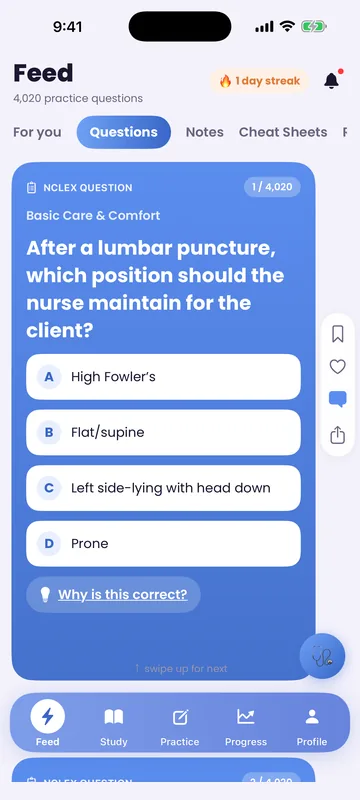
Keep the streak going with more questions like these, each with a full rationale.
What the test plan lists under pharmacology
The RN test plan describes this category as care related to giving medications and parenteral therapies. Its activity statements, drawn from NCSBN's 2024 practice analysis, read like a shift on a med-surg floor.
Notice the verbs: evaluate, review, monitor, educate. Most items test what you check before and after a drug, not just what the drug is.
- Check that a medication order is appropriate and accurate, then give it using the rights of medication administration
- Do the calculations needed for administration and titrate doses to ordered parameters
- Review pertinent data first: contraindications, lab results, allergies and interactions
- Monitor IV infusions and sites; access and maintain central venous access devices
- Give blood products and parenteral nutrition, and evaluate the client's response
- Handle controlled substances and high-risk medications safely, and dispose of medications safely
- Give pain medications, take part in medication reconciliation and teach clients about their medications
No drug list, generic names, and lab ranges on screen
NCSBN does not publish a need-to-know list of medications. On most occasions, items use generic names only, and some items refer to a drug class instead of a single drug. If you study with brand names, learn the generic name too.
You do not have to memorize every reference range. NCSBN states that items containing a numeric lab value include the normal reference range. Units are a mix of SI and imperial measures familiar to nurses. Calculation items tell you whether to answer as a whole number or with decimals, and NCSBN advises rounding only at the end.
What you do need is judgment about the number. A potassium of 3.1 mEq/L means little until you connect it to the furosemide or digoxin that is due.

A worked example: math plus judgment
Here is the kind of two-step thinking pharmacology items reward. A client has a heparin infusion of 25,000 units in 250 mL. The order is 1,000 units per hour. What rate do you set?
Step 1, concentration: 25,000 units ÷ 250 mL = 100 units/mL. Step 2, rate: 1,000 units/hour ÷ 100 units/mL = 10 mL/hour. Enter 10 as a whole number unless the item asks for decimals.
Then the judgment layer. Heparin is a high-alert medication. Before any rate change per protocol, you look at the aPTT, check for bleeding such as blood in the urine, stool or gums, and know that protamine sulfate is the antidote. The calculation earns you one item; the safety checks are what the case study asks next.
How to study pharmacology for the NCLEX
Study by class and by safety risk, not by memorizing hundreds of single drugs. A focused routine covers far more items.
The practice quiz on this page draws on the CinnaRN bank, where 932 of the 4,033 questions are pharmacology. That is about 23% of the bank, a bit more than the exam's share, so you can get extra practice in this category.
- Learn class endings: -olol (beta blockers), -pril (ACE inhibitors), -sartan (ARBs), -statin (statins), -prazole (proton pump inhibitors).
- For each class, know the check you do first, such as an apical pulse before digoxin, or heart rate and blood pressure before a beta blocker.
- Drill high-alert drugs: insulin, anticoagulants, opioids and IV potassium.
- Pair drugs with labs: potassium with diuretics and digoxin, INR with warfarin, aPTT with heparin, glucose with insulin.
- Practice dosage calculations every week; they are listed right in the test plan.
- Be able to explain each drug to a client in one plain sentence.
Frequently asked questions
Does the NCLEX give you lab values?
Yes. NCSBN states that items containing a numeric lab value include the normal reference range. You still have to interpret the value and decide what to do.
Is there a list of drugs I need to know for the NCLEX?
No. NCSBN does not publish one. Study drug classes, high-alert medications and the nursing checks for each class.
Does the NCLEX use brand names or generic names?
On most occasions, generic names only. Some items refer to a drug class rather than a specific drug.
How many pharmacology questions are on the NCLEX-PN?
Pharmacological Therapies is 10–16% of the PN test plan. On an 85-question exam, that is roughly 5 to 8 of the 52 content-area questions, with more on longer exams.
Is dosage calculation on the NCLEX?
Yes. 'Perform calculations needed for medication administration' is listed in the test plan. Items tell you whether to answer with a whole number or decimals, and you should round only at the end.
Keep studying
Sources
Checked against official sources