Never rely on alcohol-based rub alone for C. difficile or norovirus; spores require soap and water.
Before you read
Test yourself first: 5 questions
Question 1 of 5
The nurse observes a colleague who removed gloves but is about to leave an isolation room without performing hand hygiene. What is the nurse's best action?
Answer: B. Hand hygiene must be performed immediately after glove removal because hands can become contaminated during glove removal. The nurse should remind the colleague to perform hand hygiene before leaving.
Question 2 of 5
Which hand hygiene practice should the nurse follow when hands are visibly soiled?
Answer: B. When hands are visibly soiled or contaminated with blood or body fluids, the nurse must wash with soap and water; alcohol-based rub is not effective on visible soil. Alcohol rub is appropriate only when hands are not visibly dirty. Wiping on a towel or wearing gloves does not replace proper hand washing.
Question 3 of 5
Which is the correct order to DOFF (remove) PPE to avoid self-contamination?
Answer: B. Doff most-contaminated first: gloves, then goggles/face shield, gown, and finally mask/respirator (removed outside the room), with hand hygiene between/after.
Question 4 of 5
Which task related to a client's nasogastric tube is appropriate for the nurse to delegate to UAP?
Answer: A. Providing routine oral and nasal hygiene for a client with a nasogastric tube is within UAP scope. Verifying tube placement, administering tube feedings or medications, and irrigating the tube require a licensed nurse.
Question 5 of 5
Which nursing action is outside the scope of UAP and must be performed by a licensed nurse?
Answer: A. Administering medications, including insulin, requires a licensed nurse. Feeding a client who can swallow safely, ambulating a stable client, and performing routine oral hygiene are within UAP scope.
Keep the streak going with more questions like these, each with a full rationale.
What is hand hygiene?
It includes alcohol-based hand rub for routine decontamination and soap-and-water handwashing when hands are visibly soiled or after spore-forming organisms. The CDC five moments frame when to clean hands around patient care.
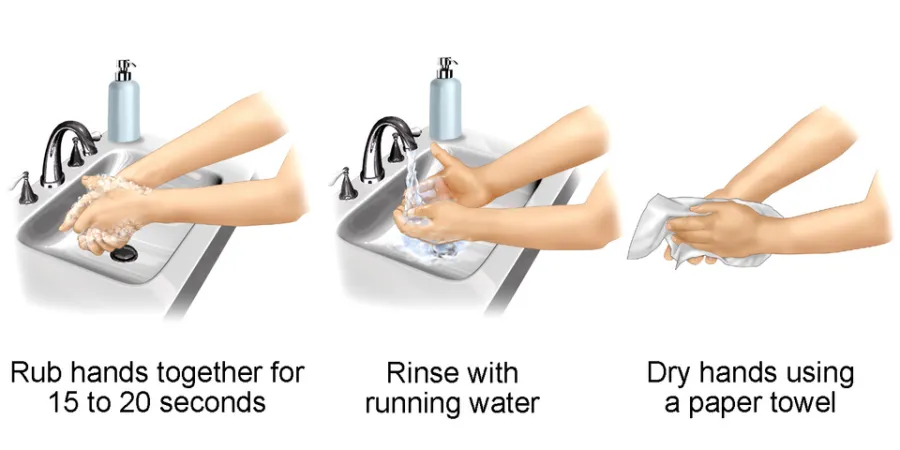
Hand Hygiene illustrated
Key points to remember
- Hand hygiene is the most important single measure to reduce healthcare-associated infections.
- Wash with soap and water when hands are visibly soiled, after using the restroom, and for C. difficile or norovirus.
- Alcohol-based rub is acceptable and often preferred for routine hand decontamination when hands are not visibly dirty.
- Soap-and-water handwashing requires at least 15 to 20 seconds of friction.
- Clean hands before and after patient contact, before aseptic tasks, after body-fluid exposure, and after touching surroundings.
- Hand hygiene is performed before donning and after removing gloves.
Nursing priorities
- Use soap and water when hands are visibly soiled or after caring for C. difficile or norovirus patients.
- Apply alcohol-based rub until hands are dry for routine decontamination.
- Scrub for at least 15 to 20 seconds covering all surfaces, including between fingers and under nails.
- Perform hand hygiene immediately after glove removal.
Patient teaching
- Teach families to wash hands before and after visiting and before eating.
- Keep fingernails short and avoid artificial nails, which harbor organisms.
- Rub alcohol gel over all surfaces until completely dry; do not wipe it off.
Red flags: report now
- Never rely on alcohol-based rub alone for C. difficile or norovirus; spores require soap and water.
- Do not treat gloves as a replacement for hand hygiene.
- Report inability to perform hand hygiene (e.g., no supplies) so it can be corrected.
References
Clinical references for this topic