Neuroleptic malignant syndrome (high fever, muscle rigidity, altered mental status, autonomic instability) is a medical emergency - stop the drug.
Before you read
Test yourself first: 5 questions
Question 1 of 5
A client newly diagnosed with schizophrenia asks the nurse, "Will I ever get better?" Which response by the nurse is most appropriate?
Answer: B. An honest, hopeful, reality-based response acknowledges that schizophrenia is a chronic, manageable illness and that many people lead meaningful lives with treatment, including medication and support. False reassurance of a cure and a hopeless prediction are both inappropriate, and deflecting the question avoids the client's concern. Offering realistic hope while emphasizing the importance of ongoing treatment supports coping.
Question 2 of 5
A client with schizophrenia repeats whatever the nurse says, word for word. The nurse documents this finding as which alteration in speech?
Answer: C. Echolalia is the pathological, parrot-like repetition of another person's words. Echopraxia is the imitation of another person's movements. Word salad is a jumble of words and phrases with no logical connection, and clang association is the linking of words by sound rather than meaning. Repeating the examiner's words exactly is the classic definition of echolalia.
Question 3 of 5
A client with schizophrenia is prescribed a long-acting injectable (depot) antipsychotic primarily to:
Answer: B. Depot injections improve adherence (given every 2–4 weeks), which reduces relapse in clients who struggle with daily oral dosing.
Question 4 of 5
A client with schizophrenia has been nonadherent with oral antipsychotics. Which is the most common reason for medication nonadherence the nurse should explore?
Answer: A. Distressing side effects, such as weight gain, sedation, sexual dysfunction, and extrapyramidal symptoms, are among the most common reasons clients stop taking antipsychotics, along with lack of insight into the illness. Identifying and managing side effects improves adherence. Cost and complex regimens can contribute, but unpleasant side effects and poor insight are the leading drivers the nurse should assess first.
Question 5 of 5
A client with paranoid schizophrenia refuses to eat, fearing the food is poisoned. The nurse should:
Answer: B. Offer foods in sealed/intact packaging the client can open themselves, allow choice, and build trust without arguing about the delusion. Forcing food or arguing increases mistrust.
Keep the streak going with more questions like these, each with a full rationale.
What is schizophrenia?
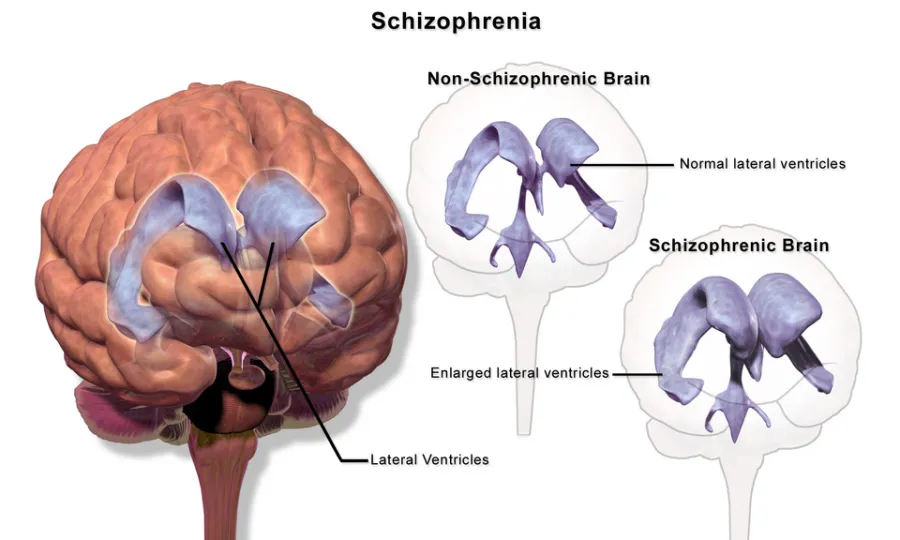
Symptoms are grouped as positive (added experiences like hallucinations and delusions) and negative (lost functions like flat affect and avolition). Onset is typically late teens to early adulthood and treatment centers on antipsychotic medication and supportive care.
Schizophrenia illustrated
Key points to remember
- Positive symptoms include hallucinations (often auditory), delusions, disorganized speech, and disorganized behavior.
- Negative symptoms include flat affect, alogia, avolition, anhedonia, and social withdrawal and are harder to treat.
- Command hallucinations may direct the client to harm self or others and must be assessed.
- First-generation antipsychotics cause extrapyramidal symptoms; second-generation cause metabolic syndrome.
- Clozapine requires routine WBC monitoring due to risk of agranulocytosis.
- Nonadherence to antipsychotics is the leading cause of relapse.
Signs & symptoms
- Positive: hallucinations, delusions
- Negative: flat affect, avolition
- Disorganized speech, paranoia
Nursing priorities
- Assess for content of hallucinations and delusions, especially command hallucinations to harm.
- Use clear, concrete, consistent communication and do not argue with or reinforce delusions.
- Present reality calmly while acknowledging the client's feelings are real to them.
- Monitor for and report extrapyramidal symptoms and signs of neuroleptic malignant syndrome.
- Promote medication adherence and establish trust over time.
Labs & values
Patient teaching
- Continue antipsychotic medication even when symptoms improve to prevent relapse.
- Report fever, sore throat, muscle stiffness, or uncontrolled movements right away.
- Rise slowly to avoid dizziness from orthostatic hypotension and avoid alcohol.
Red flags: report now
- Neuroleptic malignant syndrome (high fever, muscle rigidity, altered mental status, autonomic instability) is a medical emergency - stop the drug.
- Command hallucinations to harm self or others require immediate safety precautions.
- Agranulocytosis from clozapine (fever, sore throat, infection) requires immediate WBC check and drug hold.
- Acute dystonia or laryngospasm needs emergency anticholinergic treatment.
References
Clinical references for this topic