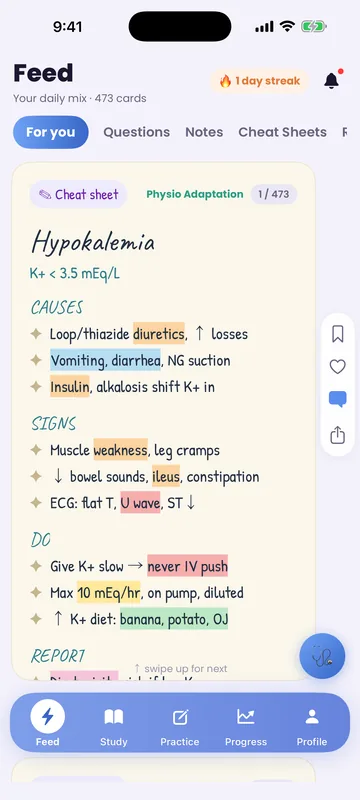
Report potassium below 3.5 mEq/L, muscle cramps, or irregular pulse (hypokalemia risk).
Before you read
Test yourself first: 5 questions
Question 1 of 5
The nurse is teaching a client about furosemide. Which statement by the client indicates a need for further teaching?
Answer: A. Furosemide is best taken in the morning to avoid nocturia and sleep disruption from diuresis; taking it at bedtime would cause the client to wake repeatedly to urinate. Rising slowly to prevent orthostatic hypotension, reporting muscle weakness, and weighing daily are all correct understandings.
Question 2 of 5
An order reads furosemide 1 mg/kg IV now for a child weighing 14 kg. The vial contains 10 mg/mL. How many milliliters should the nurse administer?
Answer: B. Dose is 14 kg times 1 mg/kg equals 14 mg. With 10 mg/mL, 14 mg divided by 10 mg/mL equals 1.4 mL.
Question 3 of 5
A client with heart failure is prescribed furosemide. Which assessment finding indicates the medication is having the desired therapeutic effect?
Answer: B. Furosemide is a loop diuretic; the desired effect in heart failure is reduced fluid volume, shown by decreased peripheral edema, clearing of lung crackles, increased urine output, and weight loss. A rising weight, increased crackles, or worsening edema would indicate the medication is not working.
Question 4 of 5
A client receiving furosemide reports ringing in the ears and decreased hearing. What does the nurse recognize about this finding?
Answer: A. Loop diuretics like furosemide can cause ototoxicity, especially with high doses or rapid IV administration, manifesting as tinnitus and hearing loss. The nurse should report this and anticipate slowing the infusion rate. It is not an expected harmless effect, a sign of low potassium, or evidence the drug is ineffective.
Question 5 of 5
A client is receiving a continuous furosemide infusion. Which daily assessment best evaluates the drug's effectiveness in a client with heart failure?
Answer: A. Daily weight is the most reliable indicator of fluid status and diuretic effectiveness because rapid weight changes reflect fluid gain or loss; a loss of 1 kg roughly equals 1 liter of fluid. Skin turgor, oral intake alone, and capillary refill are less precise measures of overall fluid balance.
Keep the streak going with more questions like these, each with a full rationale.
What is furosemide?
It is used for edema in heart failure, pulmonary edema, renal disease, and hypertension. Memory aid: 'Lasix LASTS 6 hours and makes you LOSe fluid and K+.' Key principle: it wastes potassium, so monitor for hypokalemia.
Key points to remember
- Loop diuretics are the most potent diuretics and work even in renal impairment.
- Causes loss of potassium, magnesium, calcium, and sodium, leading to hypokalemia and hypomagnesemia.
- IV furosemide must be pushed slowly (no faster than 20 mg/min) to prevent ototoxicity and hearing loss.
- It is a sulfa-based drug, so cross-sensitivity can occur in sulfa-allergic patients.
- Loop diuretics potentiate digoxin toxicity because hypokalemia increases digoxin binding.
Nursing priorities
- Monitor potassium and replace as ordered; report levels below 3.5 mEq/L before giving more.
- Weigh the patient daily at the same time and track strict intake and output.
- Monitor blood pressure and assess for orthostatic hypotension before ambulation.
- Assess lung sounds and edema to evaluate therapeutic response.
- Push IV doses slowly and monitor hearing, especially with renal impairment.
Labs & values
Patient teaching
- Take in the morning to avoid nighttime urination.
- Eat potassium-rich foods such as bananas, oranges, and potatoes.
- Rise slowly to prevent dizziness and report weight gain over 2-3 lb in a day.
Red flags: report now
- Report potassium below 3.5 mEq/L, muscle cramps, or irregular pulse (hypokalemia risk).
- Report new tinnitus or hearing changes (ototoxicity).
- Hold and report systolic BP below parameters or signs of dehydration.
References
Clinical references for this topic