Earliest sign: decreasing level of consciousness / restlessness
Before you read
Test yourself first: 5 questions
Question 1 of 5
A nurse is positioning a client in the side-lying position to prevent pressure injuries. At what angle should the client be placed to avoid direct pressure on the trochanter?
Answer: B. The 30-degree lateral (side-lying) position is recommended because it avoids placing direct pressure on the greater trochanter and sacrum. Positioning at 90 degrees concentrates pressure directly over the trochanter and increases injury risk.
Question 2 of 5
A client is receiving 0.45% sodium chloride, a hypotonic solution. Which client should the nurse identify as having a CONTRAINDICATION to this fluid?
Answer: A. Hypotonic fluids shift water into cells and can worsen cerebral edema, so they are contraindicated in clients with increased intracranial pressure or head injury. They are used cautiously for cellular dehydration but are dangerous with rising ICP.
Question 3 of 5
A client's INR on warfarin is 1.4 (subtherapeutic for atrial fibrillation). The nurse recognizes the client is at increased risk for:
Answer: B. A subtherapeutic INR means inadequate anticoagulation and increased clot/stroke risk in atrial fibrillation — the dose is usually increased per protocol and rechecked.
Question 4 of 5
A nurse reviews medications for an older adult and recognizes that aging changes affect drug response. Which physiologic change most increases the risk of drug toxicity in older adults?
Answer: A. Decreased renal function (lower glomerular filtration rate) reduces drug excretion and prolongs half-life, raising toxicity risk; decreased hepatic metabolism does the same. Increased gastric acidity, increased lean mass, and increased total body water are not typical aging changes and are not the main driver here.
Question 5 of 5
A client is scheduled for a bone marrow biopsy from the posterior iliac crest. Which nursing action is appropriate immediately after the procedure?
Answer: A. After a bone marrow biopsy the nurse applies direct pressure to the site to achieve hemostasis, then a pressure dressing, and monitors for bleeding, especially if the client is thrombocytopenic. The client is usually positioned to keep pressure on the site. Vigorous activity and removing the dressing early are inappropriate.
Keep the streak going with more questions like these, each with a full rationale.
What is increased intracranial pressure?
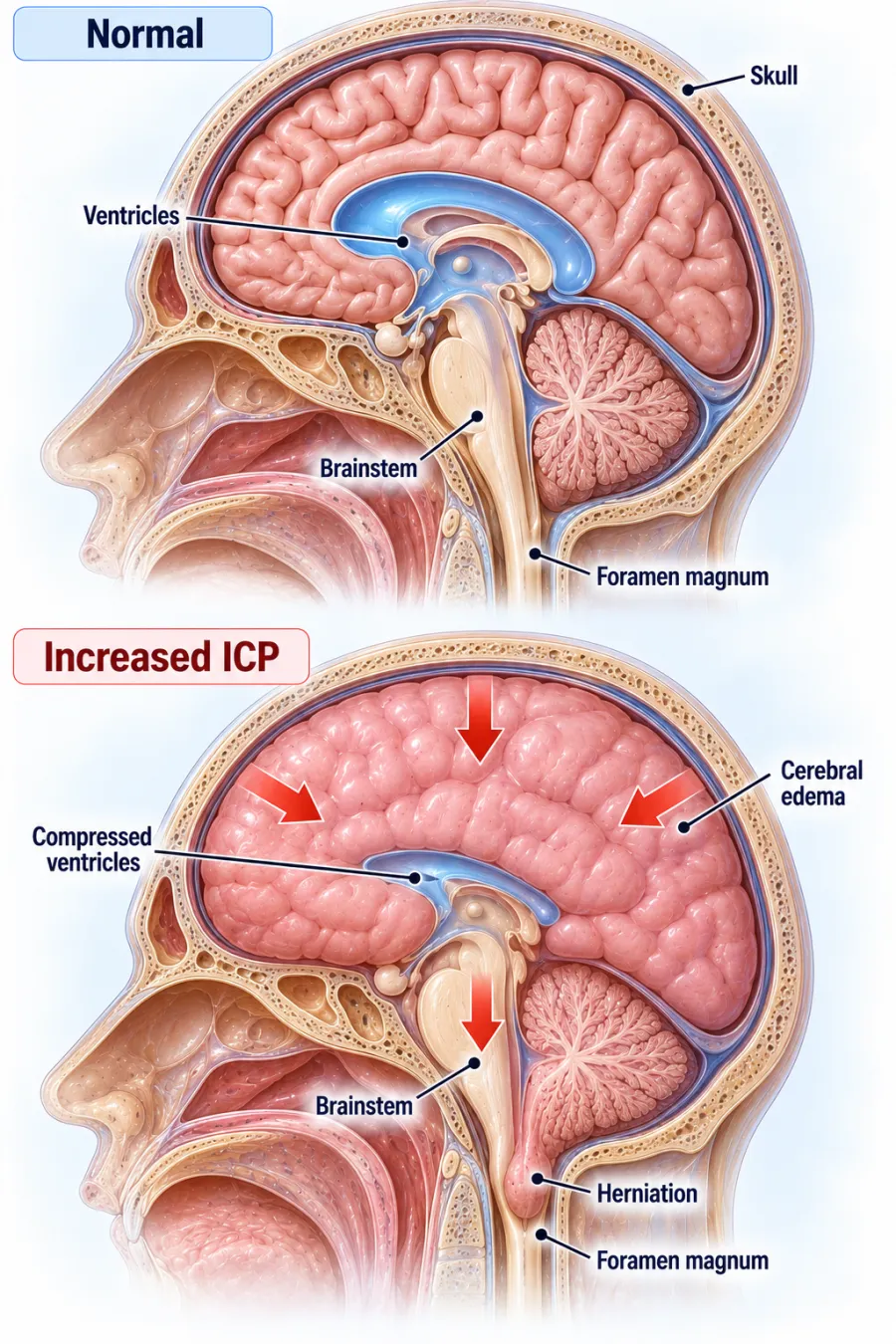
Because the skull cannot expand, rising pressure compresses brain tissue and reduces perfusion. Normal ICP is about 5–15 mmHg, and a sustained pressure above 20 mmHg needs treatment; cerebral perfusion pressure (CPP = MAP − ICP) should stay at 60 mmHg or more. A change in level of consciousness is the earliest and most sensitive sign.
Increased Intracranial Pressure illustrated
Key points to remember
- Earliest sign: decreasing level of consciousness / restlessness
- Cushing's triad (late): hypertension with widening pulse pressure, bradycardia, irregular respirations
- Headache, vomiting (often projectile), and unequal or sluggish pupils
- In infants: bulging fontanel and high-pitched cry
- Common causes: head injury, stroke, brain tumor, bleeding in the skull, meningitis and hydrocephalus.
- A dilated or sluggish pupil on the side of the lesion suggests pressure on cranial nerve III.
- Decorticate (flexion) and then decerebrate (extension) posturing signal worsening brain compression.
- A high carbon dioxide level dilates brain vessels and raises ICP, so oxygenation and ventilation are kept normal.
Signs & symptoms
- ↓ LOC = earliest sign
- Cushing's triad = late, ominous
- ↑ BP, ↓ HR, irregular RR
Nursing priorities
- Elevate head of bed 30° with the head midline to promote venous drainage
- Keep the environment calm; avoid clustering care and anything that raises ICP
- Prevent Valsalva — avoid straining, coughing, and hip flexion
- Give osmotic diuretics (mannitol) as ordered; monitor neuro status closely
- Do neuro checks — Glasgow Coma Scale, pupils and vital signs — at the ordered frequency and report any decline.
- Keep the temperature normal; fever raises the brain's oxygen demand.
- Give stool softeners and antiemetics as ordered to prevent straining and vomiting.
Labs & values
Patient teaching
- Report worsening headache, vomiting, or vision changes promptly
- Family: keep the room quiet, limit visitors and stimulation, and let the patient rest between care.
- Avoid bearing down, forceful coughing, and bending at the waist.
Red flags: report now
- Cushing's triad, fixed/dilated pupils, or sudden LOC drop — neurologic emergency
- Avoid suctioning longer than 10 seconds and avoid Trendelenburg position
- A drop in GCS of 2 or more points, a newly dilated pupil, or posturing — notify the provider immediately.
References
Clinical references for this topic