Sudden severe hip pain, leg shortening, and rotation indicate dislocation and require immediate report.
Before you read
Test yourself first: 5 questions
Question 1 of 5
A client is 1 day post total knee arthroplasty. Which intervention is MOST important for the nurse to ensure is performed as prescribed?
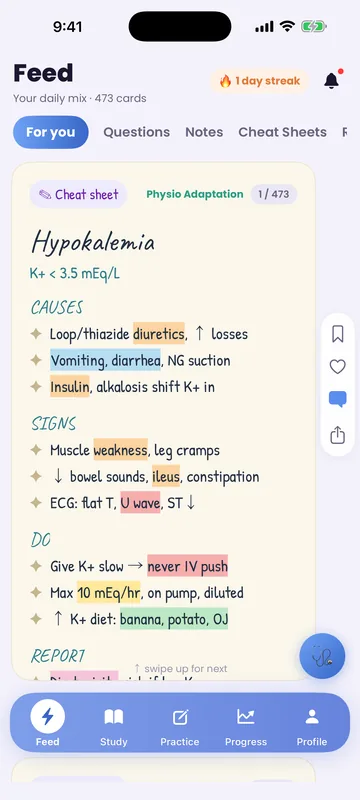
Answer: B. A continuous passive motion (CPM) device and early progressive flexion exercises maintain and improve knee range of motion and prevent stiffness and adhesions after knee replacement. Immobilizing the knee in full extension for days would lead to contractures.
Question 2 of 5
A client's potassium is reported as 2.9 mEq/L. Before the nurse acts, the priority is to:
Answer: B. A potassium of 2.9 is critically low (hypokalemia) with dysrhythmia risk — notify the provider, place on a cardiac monitor, and anticipate cautious potassium replacement (never IV push). Ignoring it is dangerous.
Question 3 of 5
A nurse is monitoring a client immediately after a large-volume paracentesis. Which finding should the nurse report to the provider as a priority?
Answer: B. Removal of a large volume of ascitic fluid can cause an intravascular fluid shift leading to hypovolemia, manifested by hypotension and tachycardia. This hemodynamic instability is the priority concern and may require albumin replacement. A small amount of serous drainage at the site, relief of dyspnea, and decreased abdominal girth are expected, favorable findings.
Question 4 of 5
A client recovering from a total thyroidectomy develops circumoral numbness and muscle twitching. What is the nurse's PRIORITY action?
Answer: A. These are signs of hypocalcemia from inadvertent parathyroid injury after thyroidectomy; tetany and laryngospasm can follow. The priority is to assess the airway and notify the provider, with IV calcium gluconate available. Encouraging fluids or repositioning does not address the developing tetany.
Question 5 of 5
A client returns to the unit after a total thyroidectomy. Which item does the nurse keep at the bedside as a priority?
Answer: A. After thyroidectomy, airway obstruction from tracheal compression (hematoma) or laryngeal edema, and tetany from accidental parathyroid injury, are the major risks. A tracheostomy tray (with suction and oxygen) is kept at the bedside so the airway can be secured emergently. This addresses the highest-priority airway threat.
Keep the streak going with more questions like these, each with a full rationale.
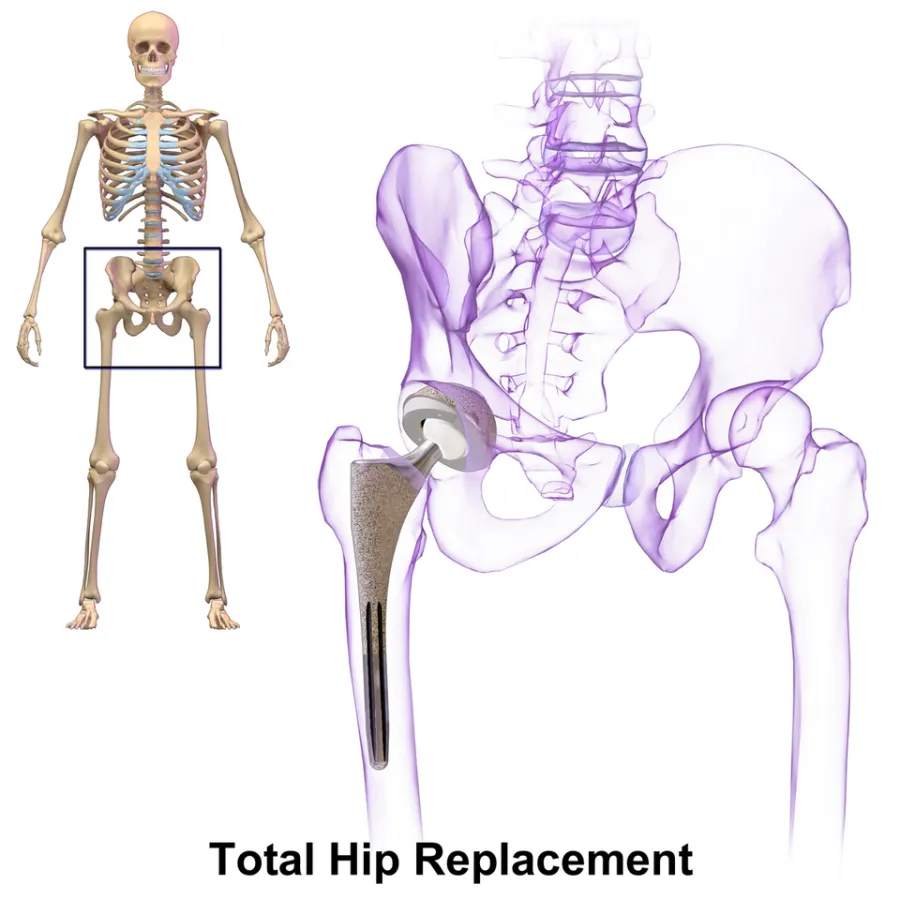
What is total hip replacement?
The major postoperative concerns are dislocation of the prosthesis, venous thromboembolism, and infection. Proper positioning and adherence to hip precautions are essential to protect the new joint.
Total Hip Replacement illustrated
Key points to remember
- With the posterior approach, key precautions are no hip flexion beyond 90 degrees, no adduction past midline, and no internal rotation.
- Signs of prosthesis dislocation include sudden severe pain, a shortened leg, and external or internal rotation of the affected leg.
- An abduction pillow keeps the legs apart and prevents the leg from crossing midline.
- VTE (DVT and pulmonary embolism) is a major risk due to immobility and surgical trauma.
- Early ambulation with physical therapy is started to prevent complications and restore function.
- Patients should avoid low chairs, toilets, and bending to put on shoes during recovery.
Nursing priorities
- Maintain hip precautions: keep the legs abducted with a pillow and avoid flexion past 90 degrees.
- Assess neurovascular status of the affected leg and monitor the surgical drain and dressing.
- Administer prescribed anticoagulants and apply sequential compression devices to prevent VTE.
- Assist with early ambulation and physical therapy using assistive devices as ordered.
- Monitor for and immediately report signs of dislocation.
Labs & values
Patient teaching
- Use a raised toilet seat, reachers, and a long-handled shoehorn; avoid bending at the hip past 90 degrees.
- Do not cross your legs, sit in low chairs, or turn the operative leg inward.
- Report increasing pain, a leg that appears shorter or rotated, or signs of infection.
Red flags: report now
- Sudden severe hip pain, leg shortening, and rotation indicate dislocation and require immediate report.
- Calf pain, swelling, warmth, or sudden dyspnea suggests DVT or PE and needs urgent action.
- Never flex the operative hip beyond 90 degrees, cross the legs, or turn the leg inward.
References
Clinical references for this topic