Sudden weight gain > 2–3 lb in a day or 5 lb in a week — report it
Before you read
Test yourself first: 5 questions
Question 1 of 5
A nurse is assessing a client with right-sided heart failure. Which finding does the nurse EXPECT?
Answer: B. Right-sided heart failure causes systemic venous congestion, producing dependent peripheral edema, jugular venous distention, hepatomegaly, and weight gain. Crackles, frothy sputum, and orthopnea are hallmark signs of left-sided failure with pulmonary congestion.
Question 2 of 5
A home care nurse is monitoring a client with heart failure. Which finding should the nurse report to the provider as a sign of worsening fluid overload?
Answer: A. A weight gain of 3 pounds or more in 24 hours, or 5 pounds in a week, signals fluid retention and worsening heart failure that requires provider notification. A stable weight, clear lungs, and adequate urine output are reassuring findings.
Question 3 of 5
A client receiving doxorubicin (an anthracycline) must be monitored for which serious long-term toxicity?
Answer: B. Anthracyclines such as doxorubicin are cardiotoxic and can cause a dose-dependent, potentially irreversible cardiomyopathy and heart failure. Cumulative lifetime dose is limited, and cardiac function (ejection fraction) is monitored. Doxorubicin is also a vesicant and turns the urine red, but cardiotoxicity is the major long-term concern.
Question 4 of 5
Which type of shock is characterized by the heart's failure to pump effectively (e.g., after a large MI)?
Answer: B. Cardiogenic shock results from pump failure — the heart can't maintain output. Hypovolemic = fluid loss; distributive (septic/anaphylactic/neurogenic) = vasodilation.
Question 5 of 5
A client with heart failure has worsening dyspnea, crackles, and pink frothy sputum. The nurse recognizes:
Answer: B. These signs indicate acute pulmonary edema (left-sided failure). Sit the client upright, give oxygen, and anticipate diuretics; notify the provider/rapid response.
Keep the streak going with more questions like these, each with a full rationale.
What is heart failure?
Left-sided failure backs blood up into the lungs (pulmonary congestion); right-sided failure backs blood up into the body (systemic/peripheral congestion). Memory aid: Left = Lungs, Right = Rest of body.
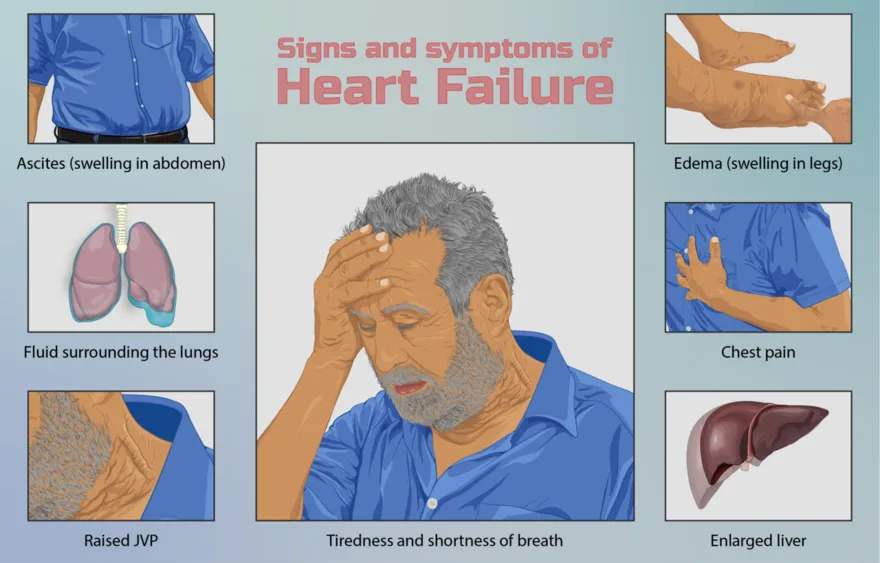
Heart Failure illustrated
Key points to remember
- Left-sided: dyspnea, orthopnea, crackles, pink frothy sputum, fatigue
- Right-sided: peripheral edema, jugular vein distention, weight gain, ascites, hepatomegaly
- Daily weight is the most reliable indicator of fluid status (1 kg ≈ 1 L fluid)
- Elevated BNP supports the diagnosis
Signs & symptoms
- Dyspnea, crackles, orthopnea
- Pink frothy sputum = pulm edema
- Weight gain, JVD, ↑ BNP
Nursing priorities
- Place in high-Fowler's position and give oxygen to ease dyspnea
- Daily weights, strict I&O, low-sodium diet, fluid restriction as ordered
- Give diuretics, ACE inhibitors/ARBs, and beta blockers as prescribed
- Monitor potassium with loop diuretics; watch for digoxin response
Labs & values
Patient teaching
- Weigh yourself daily at the same time and report rapid gains
- Limit sodium; take medications even when feeling well
Red flags: report now
- Sudden weight gain > 2–3 lb in a day or 5 lb in a week — report it
- Pink frothy sputum and severe dyspnea signal pulmonary edema — emergency
References
Clinical references for this topic