Dyspnea, chronic productive cough, prolonged expiration, wheezing
Before you read
Test yourself first: 3 questions
Question 1 of 3
A client with COPD requires oxygen. The nurse administers it at:
Answer: B. For chronic CO₂ retainers (COPD), give controlled LOW-flow oxygen (e.g., 1–2 L/min via nasal cannula) titrated to target saturation; very high flow can blunt the hypoxic drive. Always treat true hypoxia, but cautiously.
Question 2 of 3
A client with chronic obstructive pulmonary disease (COPD) has a barrel chest and prolonged expiration. The nurse understands these result from:
Answer: B. COPD (especially emphysema) causes air trapping and hyperinflation, producing a barrel chest and prolonged expiration. Teach pursed-lip breathing and energy conservation.
Question 3 of 3
A client with chronic obstructive pulmonary disease (COPD) is taught pursed-lip breathing to:
Answer: B. Pursed-lip breathing prolongs exhalation, keeps airways open longer, and helps expel trapped air/CO₂, reducing dyspnea and air trapping.
Keep the streak going with more questions like these, each with a full rationale.
What is copd?
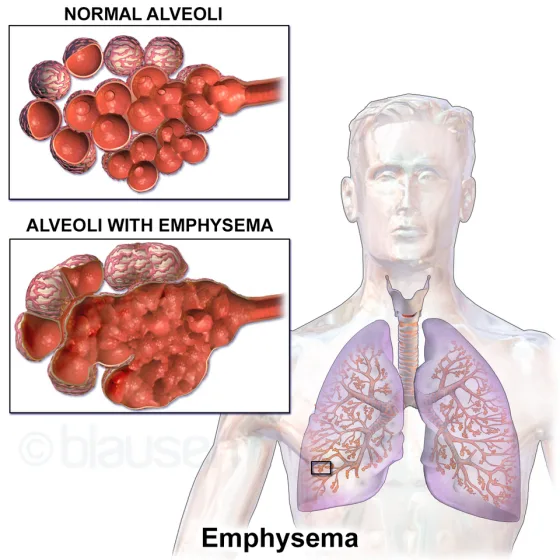
Air becomes trapped, the chest hyperinflates ('barrel chest'), and gas exchange is impaired, leading to chronically high CO₂. Many clients rely on a hypoxic drive.
COPD illustrated
Key points to remember
- Dyspnea, chronic productive cough, prolonged expiration, wheezing
- Barrel chest, use of accessory muscles, pursed-lip breathing
- Chronic CO₂ retention; baseline SpO₂ may sit around 88–92%
- Polycythemia (high RBCs) can develop from chronic hypoxia
Signs & symptoms
- Barrel chest, pursed-lip breath
- ↑ CO2 retention, chronic cough
- Clubbing, prolonged expiration
Nursing priorities
- Give low-flow oxygen (1–2 L/min) — high O₂ can suppress the hypoxic drive
- Position in high-Fowler's or tripod; teach pursed-lip breathing
- Encourage fluids to thin secretions; pace activities to conserve energy
- Bronchodilators then inhaled steroids; ensure pneumonia/flu vaccines
Labs & values
Patient teaching
- Stop smoking; use pursed-lip breathing; get vaccinated against flu and pneumonia
Red flags: report now
- Rising confusion/somnolence may signal CO₂ narcosis — do not over-oxygenate
- Avoid high-flow O₂ unless the client is in acute, monitored distress
References
Clinical references for this topic