K⁺ < 2.5 mEq/L or any dysrhythmia — notify provider immediately
Before you read
Test yourself first: 3 questions
Question 1 of 3
A client's potassium level is 2.7 mEq/L. Which EKG change is most characteristic of hypokalemia?
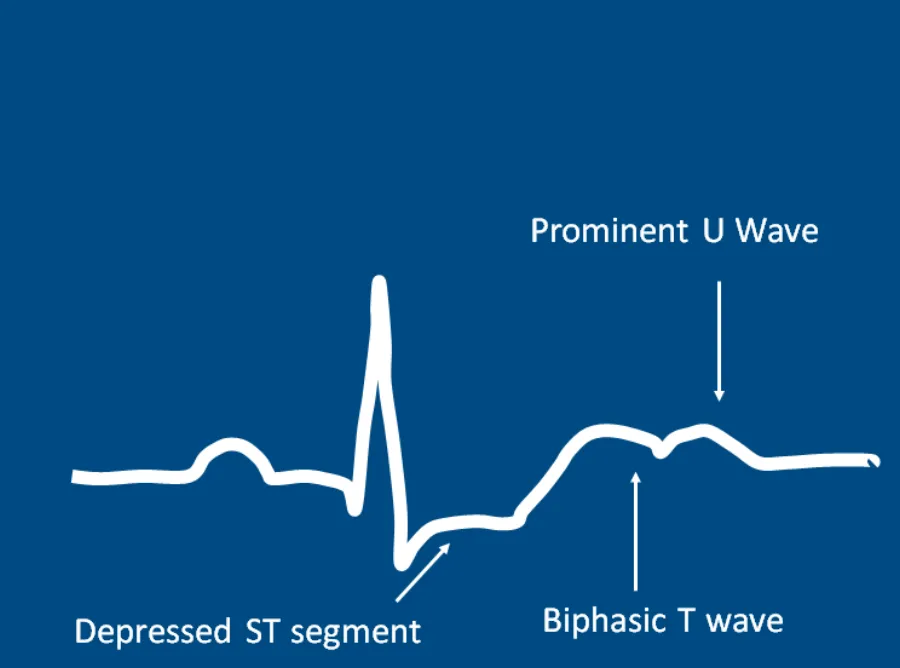
Answer: B. Hypokalemia (potassium below 3.5 mEq/L) characteristically produces prominent U waves, along with flattened T waves and ST depression. Tall peaked T waves are seen in hyperkalemia. A shortened QT interval is associated with hypercalcemia. Hypokalemia also increases the risk of ventricular ectopy.
Question 2 of 3
A client with hypokalemia (K⁺ 2.8 mEq/L) is at risk for which complication?
Answer: B. Hypokalemia causes cardiac dysrhythmias, muscle weakness, and flattened T waves with U waves. Replace potassium cautiously and monitor the ECG; it also potentiates digoxin toxicity.
Question 3 of 3
A nurse reviews ECG findings for a client with hypokalemia. Which change is most characteristic?
Answer: B. Hypokalemia classically produces a flattened T wave and the appearance of a U wave, along with ST depression. Tall peaked T waves are the hallmark of HYPERkalemia. Recognizing these changes guides cardiac monitoring and potassium replacement.
Keep the streak going with more questions like these, each with a full rationale.
What is hypokalemia?
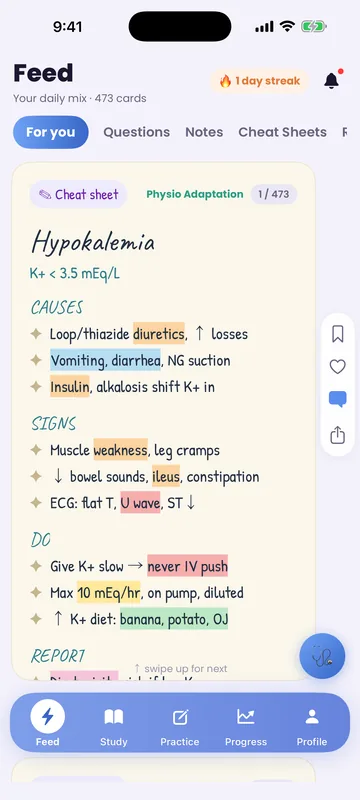
Potassium is the major intracellular cation and is essential for normal cardiac, neuromuscular, and smooth-muscle function, so a deficit shows up first as muscle weakness and cardiac irritability. Common causes are diuretics (loop/thiazide), vomiting, diarrhea, NG suction, and insulin or alkalosis shifting K⁺ into cells.
Hypokalemia illustrated
Key points to remember
- Muscle weakness, leg cramps, and fatigue — severe loss causes flaccid paralysis
- Decreased GI motility → hypoactive bowel sounds, constipation, paralytic ileus
- ECG changes: flattened T waves, ST depression, and prominent U waves
- Increases the risk of digoxin toxicity — low K⁺ potentiates digoxin
- Often paired with metabolic alkalosis (vomiting, diuretics)
Common causes
- Loop/thiazide diuretics, ↑ losses
- Vomiting, diarrhea, NG suction
- Insulin, alkalosis shift K+ in
Signs & symptoms
- Muscle weakness, leg cramps
- ↓ bowel sounds, ileus, constipation
- ECG: flat T, U wave, ST↓
Nursing priorities
- Replace potassium — oral if mild; IV for severe (NEVER IV push) at no more than 10 mEq/hr
- Always dilute IV potassium and use a pump; check that urine output is adequate first
- Put the client on a cardiac monitor and watch for dysrhythmias
- Hold further potassium-wasting diuretics and notify the provider
Labs & values
Patient teaching
- Eat potassium-rich foods: bananas, oranges, potatoes, avocado, spinach
- If on a loop/thiazide diuretic, report muscle weakness or palpitations
Red flags: report now
- K⁺ < 2.5 mEq/L or any dysrhythmia — notify provider immediately
- Never give potassium IV push or as a bolus — it can cause fatal cardiac arrest
References
Clinical references for this topic