New seizures, worsening confusion, or Na⁺ < 120 mEq/L — notify provider now
Before you read
Test yourself first: 5 questions
Question 1 of 5
A client with severe hyponatremia (serum sodium 116 mEq/L) is receiving 3% hypertonic saline. Which assessment finding requires the nurse to STOP the infusion and notify the provider immediately?
Answer: B. Correcting hyponatremia too rapidly with hypertonic saline risks osmotic demyelination syndrome (central pontine myelinolysis). New neurologic changes such as dysarthria, dysphagia, and altered level of consciousness signal overly rapid correction and require stopping the infusion. Sodium should rise no faster than about 8-10 mEq/L in 24 hours.
Question 2 of 5
A client receiving IV fluids develops a serum sodium of 119 mEq/L with confusion and a seizure. Which IV order does the nurse anticipate?
Answer: B. Severe symptomatic hyponatremia with seizures is treated with small, controlled boluses of 3% hypertonic saline to raise serum sodium enough to reduce cerebral edema, while carefully limiting the rate of correction. Hypotonic fluids or free water would worsen the hyponatremia.
Question 3 of 5
A nurse is caring for a client with DKA who has frequent vomiting and a serum sodium that appears low. The nurse understands that the measured sodium may be artificially low because of which factor?
Answer: A. Severe hyperglycemia draws water out of cells into the vascular space, diluting the serum sodium and producing a pseudohyponatremia (dilutional, falsely low sodium). As glucose is corrected, the measured sodium typically rises toward normal. This dilutional effect is a recognized feature of marked hyperglycemia, not a true total-body sodium deficit alone.
Question 4 of 5
A client with a serum sodium of 118 mEq/L is admitted. Which finding is the nurse most concerned about?
Answer: B. Severe hyponatremia causes cerebral edema. New-onset seizures and altered level of consciousness reflect this neurologic emergency and require immediate intervention.
Question 5 of 5
The nurse reviews a serum sodium of 118 mEq/L. Which assessment finding is most concerning?
Answer: A. Sodium of 118 mEq/L is critically low (normal 135-145). Severe hyponatremia causes cerebral edema, so new-onset seizures or altered mental status are the most concerning neurologic findings requiring immediate intervention.
Keep the streak going with more questions like these, each with a full rationale.
What is hyponatremia?
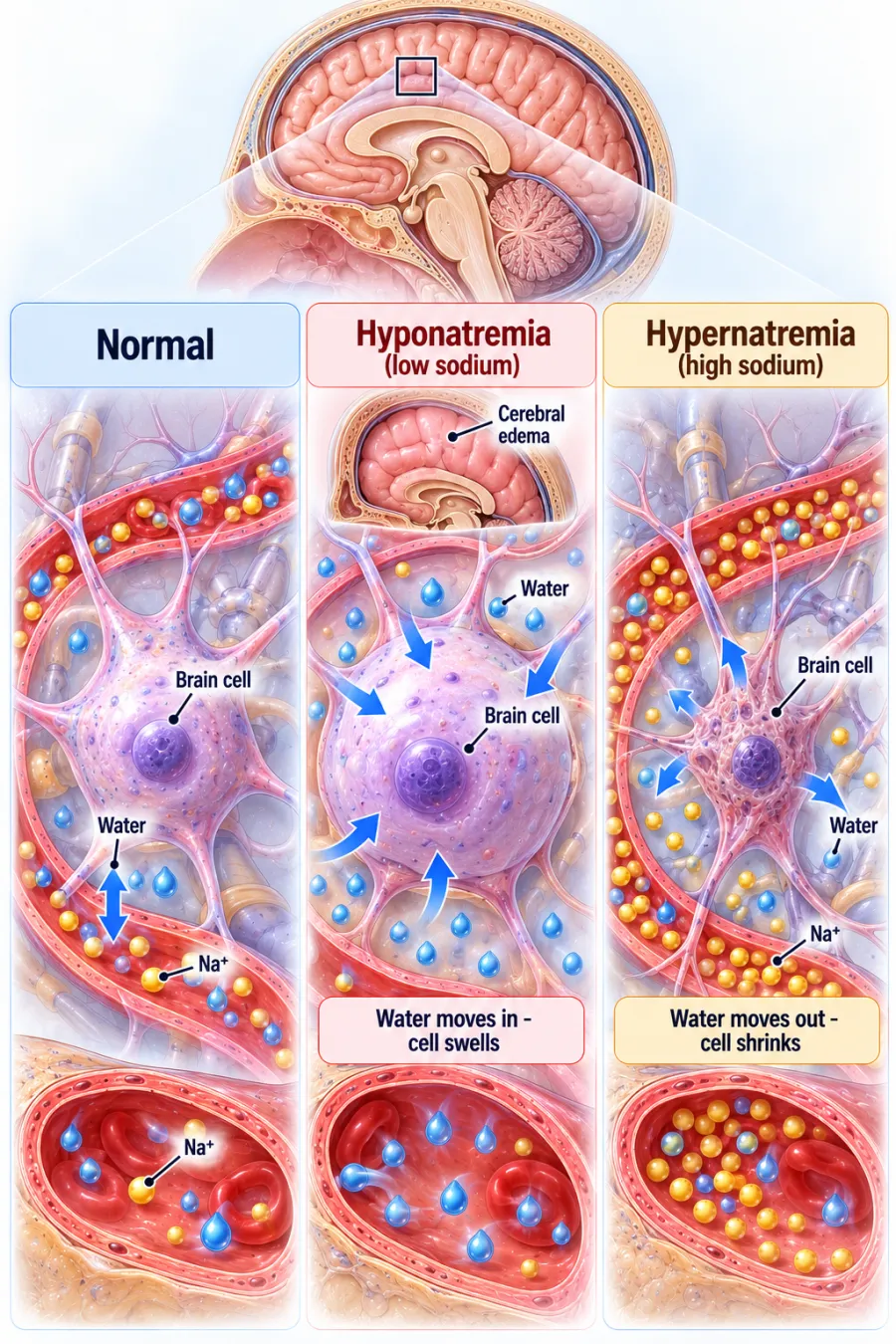
Sodium drives osmolality and water balance, so a low level pulls water into cells — the brain is most vulnerable, making neurologic changes the central concern. It is classified by fluid status: hypovolemic (vomiting, diarrhea, diuretics), euvolemic (SIADH, excess water intake) or hypervolemic (heart failure, cirrhosis, kidney failure), and the fluid status decides the treatment.
Hyponatremia illustrated
Key points to remember
- Neurologic: headache, confusion, lethargy progressing to seizures and coma
- GI: nausea, vomiting, abdominal cramping
- Muscle weakness and cramps; possible hypotension if volume-depleted
- Symptoms depend on how fast the sodium falls: a rapid drop causes brain swelling even at moderately low levels, while a slow fall may cause few symptoms.
- Fluid-loss hyponatremia is treated with isotonic saline; dilutional hyponatremia (SIADH, fluid overload) is treated with fluid restriction.
- SIADH retains water, producing concentrated urine and a low serum sodium and osmolality.
- Higher risk: older adults, patients on thiazide diuretics or SSRIs, and endurance athletes who drink large amounts of plain water.
Common causes
- SIADH, water excess, CHF
- Diuretics, vomiting, diarrhea
- Excess hypotonic IV / D5W
Signs & symptoms
- Confusion, HA, lethargy
- Seizures, coma if severe
- N/V, muscle cramps, ↓ DTRs
Nursing priorities
- Restrict fluids when the cause is dilutional/SIADH
- Give hypertonic saline (3%) ONLY for severe, symptomatic hyponatremia, slowly
- Institute seizure precautions and monitor neuro status closely
- Correct sodium slowly — rapid correction risks osmotic demyelination
- Monitor daily weight, strict intake and output, and serum sodium as ordered (often every few hours during active correction).
Labs & values
Patient teaching
- Follow a prescribed fluid restriction exactly; spread the allowed fluid across the day and use ice chips or sugar-free gum for thirst.
- During long exercise, drink fluids that contain electrolytes rather than large amounts of plain water.
- Report headache, confusion, nausea or muscle cramps, especially when taking a diuretic.
Red flags: report now
- New seizures, worsening confusion, or Na⁺ < 120 mEq/L — notify provider now
- Do NOT correct sodium too fast (> 8–12 mEq/L in 24 h)
References
Clinical references for this topic