They cause potent diuresis and can rapidly relieve pulmonary edema and fluid overload.
Before you read
Test yourself first: 3 questions
Question 1 of 3
The nurse is teaching a client newly prescribed a thiazide diuretic about photosensitivity. Which instruction is appropriate?
Answer: A. Thiazide diuretics can cause photosensitivity, increasing the risk of severe sunburn. The nurse should instruct the client to use sunscreen and protective clothing and to limit sun exposure. Telling the client that sun exposure is unaffected, that tanning beds are safe, or to stop the drug in summer would be incorrect.
Question 2 of 3
The nurse is preparing to administer the first dose of hydrochlorothiazide. Which client history would cause the nurse to question the order?
Answer: A. Thiazide diuretics contain a sulfonamide group, so a documented sulfa allergy is a contraindication and the nurse should question the order. A history of hypertension is the indication for the drug, and mild seasonal allergies or a past appendectomy are not contraindications to thiazide therapy.
Question 3 of 3
The nurse reviews labs for a client on hydrochlorothiazide. Which electrolyte abnormality is an expected adverse effect of this drug?
Answer: B. Thiazide diuretics commonly cause hypokalemia, hyponatremia, and an increase in serum calcium and uric acid. Among the choices, hypokalemia is the classic and most clinically significant expected adverse effect requiring monitoring. Thiazides do not typically cause hyperkalemia or hypocalcemia.
Keep the streak going with more questions like these, each with a full rationale.
What is loop diuretics?
They are used for edema, heart failure, and pulmonary edema. Memory aid: Lasix 'lasts six hours' and dumps potassium, so it is a strong potassium-wasting water pill.
Key points to remember
- They cause potent diuresis and can rapidly relieve pulmonary edema and fluid overload.
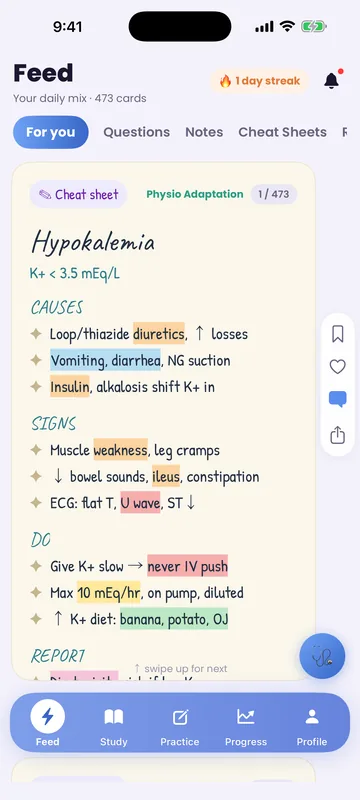
- They waste potassium, so hypokalemia is the major electrolyte risk, along with hyponatremia, hypocalcemia, and hypomagnesemia.
- Rapid IV administration of furosemide can cause ototoxicity and hearing loss.
- They can cause dehydration, orthostatic hypotension, and increased BUN/creatinine.
- Hypokalemia increases the risk of digoxin toxicity in patients also taking digoxin.
- They raise blood glucose and uric acid levels.
Nursing priorities
- Monitor daily weight, intake and output, and fluid status as the key indicators of effectiveness.
- Monitor serum potassium and other electrolytes and replace potassium as ordered.
- Administer IV furosemide slowly (no faster than 20 mg/min) to prevent ototoxicity.
- Monitor blood pressure for hypotension and implement fall precautions.
- Give morning doses to avoid nighttime urination and assess for digoxin toxicity if applicable.
Labs & values
Patient teaching
- Weigh yourself daily and report a gain of 2-3 pounds in a day or 5 pounds in a week.
- Eat potassium-rich foods such as bananas, oranges, and potatoes unless told otherwise.
- Change positions slowly and take the dose in the morning to avoid nighttime urination.
Red flags: report now
- Serum potassium below 3.5 mEq/L, especially with muscle weakness or cardiac dysrhythmias.
- Signs of severe dehydration or hypotension such as dizziness, weak pulse, and decreased urine output.
- New hearing loss or tinnitus suggesting ototoxicity.
- Signs of digoxin toxicity when given concurrently with digoxin.
References
Clinical references for this topic