It is often asymptomatic until a fragility fracture occurs from minimal trauma.
Before you read
Test yourself first: 5 questions
Question 1 of 5
A 58-year-old postmenopausal woman asks how to reduce her risk of osteoporosis. Which lifestyle recommendation should the nurse include?
Answer: B. Weight-bearing exercise (such as walking) plus adequate calcium and vitamin D intake helps maintain bone density. Smoking and excessive alcohol accelerate bone loss, and a sedentary lifestyle increases osteoporosis risk.
Question 2 of 5
A nurse teaches an older adult about preventing osteoporosis-related fractures. Which instruction is appropriate?
Answer: B. Weight-bearing exercise such as walking, along with adequate calcium and vitamin D intake, helps maintain bone density and reduce fracture risk. Bed rest accelerates bone loss, smoking worsens osteoporosis, and eliminating all dairy reduces calcium intake.
Question 3 of 5
A nurse teaches a client with osteoporosis to prevent fractures by:
Answer: B. Encourage weight-bearing exercise, adequate calcium and vitamin D, fall-prevention at home, and prescribed medications (e.g., bisphosphonates). Sedentary behavior and low calcium worsen bone loss.
Question 4 of 5
A 68-year-old client with osteoporosis is being taught measures to prevent fractures. Which client statement indicates a need for FURTHER teaching?
Answer: B. Weight-bearing exercise, adequate calcium and vitamin D, and home fall-proofing all help prevent osteoporotic fractures. Avoiding all physical activity is incorrect because inactivity accelerates bone loss; weight-bearing activity should be encouraged, so this statement requires further teaching.
Question 5 of 5
Teaching about menopause, the nurse explains that the client is at increased risk for:
Answer: B. Declining estrogen after menopause increases the risk of osteoporosis and cardiovascular disease; teach weight-bearing exercise, calcium/vitamin D, and screening.
Keep the streak going with more questions like these, each with a full rationale.
What is osteoporosis?
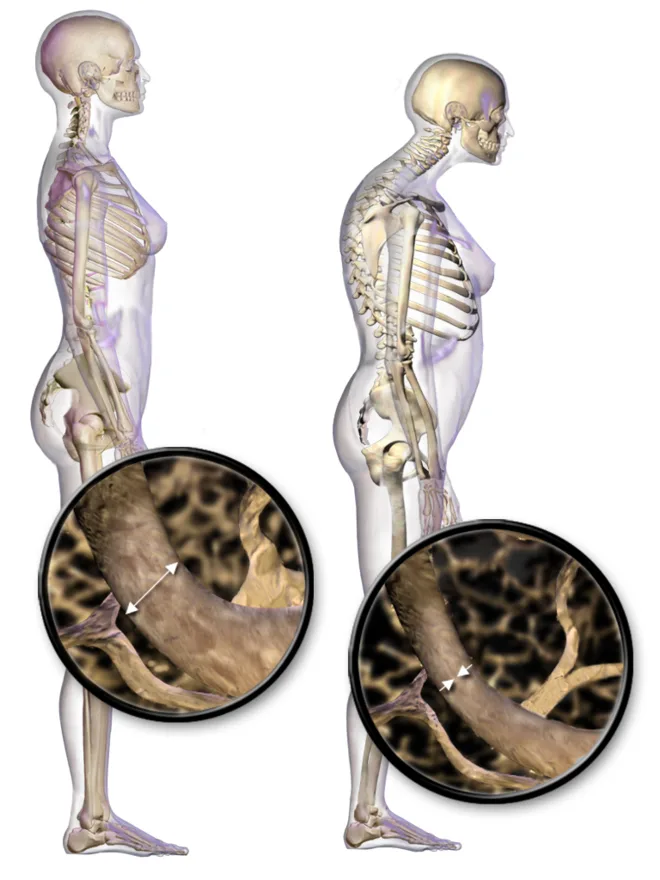
It is called the silent disease because bone loss occurs without symptoms until a fracture happens. Risk is highest in postmenopausal women due to estrogen loss, and common fracture sites are the hip, wrist, and vertebrae.
Osteoporosis illustrated
Key points to remember
- It is often asymptomatic until a fragility fracture occurs from minimal trauma.
- Loss of height and a stooped posture (kyphosis or dowager's hump) result from vertebral compression fractures.
- Major risk factors include postmenopausal estrogen loss, age, low calcium and vitamin D, smoking, alcohol, and steroid use.
- A DEXA scan T-score of -2.5 or lower confirms osteoporosis; -1.0 to -2.5 is osteopenia.
- Weight-bearing exercise stimulates bone formation, while immobility accelerates bone loss.
- Long-term corticosteroid therapy is a leading secondary cause of bone loss.
Common causes
- Postmenopausal ↓ estrogen
- Steroids, smoking, ETOH, immobility
- Thin, white/Asian, low Ca diet
Nursing priorities
- Implement fall precautions: clear clutter, ensure good lighting, use non-skid footwear, and provide assistive devices.
- Encourage adequate dietary calcium and vitamin D and administer supplements as ordered.
- Promote weight-bearing and resistance exercise such as walking.
- Administer bisphosphonates correctly and teach proper administration.
- Use safe handling and transfer techniques to prevent fractures.
Labs & values
Patient teaching
- Take bisphosphonates (alendronate) on an empty stomach with a full glass of water and remain upright for 30 to 60 minutes to prevent esophageal irritation.
- Increase intake of calcium-rich foods (dairy, leafy greens) and vitamin D, and stop smoking and limit alcohol.
- Perform regular weight-bearing exercise and remove home hazards to prevent falls.
Red flags: report now
- Sudden onset of severe back pain may indicate a vertebral compression fracture and needs evaluation.
- A fall in an osteoporotic patient should always be assessed for fracture even without obvious deformity.
References
Clinical references for this topic