A dusky, blue, purple, or black stoma indicates ischemia/necrosis; report immediately.
Before you read
Test yourself first: 5 questions
Question 1 of 5
A client's ileostomy output suddenly becomes very high and watery with signs of dehydration. The nurse should:
Answer: B. High ileostomy output risks fluid/electrolyte loss and dehydration — monitor I&O and electrolytes, encourage oral rehydration/notify the provider, and assess for blockage or infection. Ignoring it risks hypovolemia.
Question 2 of 5
A client with a new ileostomy should be taught to:
Answer: B. Ileostomy output is liquid and enzyme-rich; emphasize skin protection, adequate fluid and electrolyte intake (risk of dehydration), and chewing food well. Output is not normally formed stool.
Question 3 of 5
The nurse is providing care for a client with a new colostomy. Which finding should be reported to the provider?
Answer: B. A healthy stoma is pink/red and moist. A dusky, purple, or black stoma signals ischemia/necrosis and must be reported immediately. Mild swelling and red color early on are normal.
Question 4 of 5
A client with a new colostomy is being taught stoma care. Which finding should the nurse teach the client to report to the provider?
Answer: B. A healthy stoma is pink to red, moist, and protrudes slightly; the client should report a stoma that becomes dusky, purple, or black, which indicates impaired blood supply and possible ischemia or necrosis. Slight bleeding when cleaning, a small amount of mucus, and a moist red appearance are normal. Recognizing color change to dark or purple as ischemia prompts urgent evaluation.
Question 5 of 5
A client with a new colostomy is being taught about stoma care. Which observation indicates a healthy stoma?
Answer: A. A healthy stoma is pink to red and moist, similar to the inside of the mouth. A pale, dusky, or black stoma indicates impaired circulation and must be reported immediately.
Keep the streak going with more questions like these, each with a full rationale.
What is ostomy care?
Nursing care protects peristomal skin, ensures a proper pouch fit, and supports the client psychosocially with a major body-image change. Key principle: a healthy stoma is pink to red and moist; report dusky, blue, or black.
Ostomy Care illustrated
Key points to remember
- A normal stoma is pink/red, moist, and slightly raised; it has no sensation but bleeds slightly when cleaned.
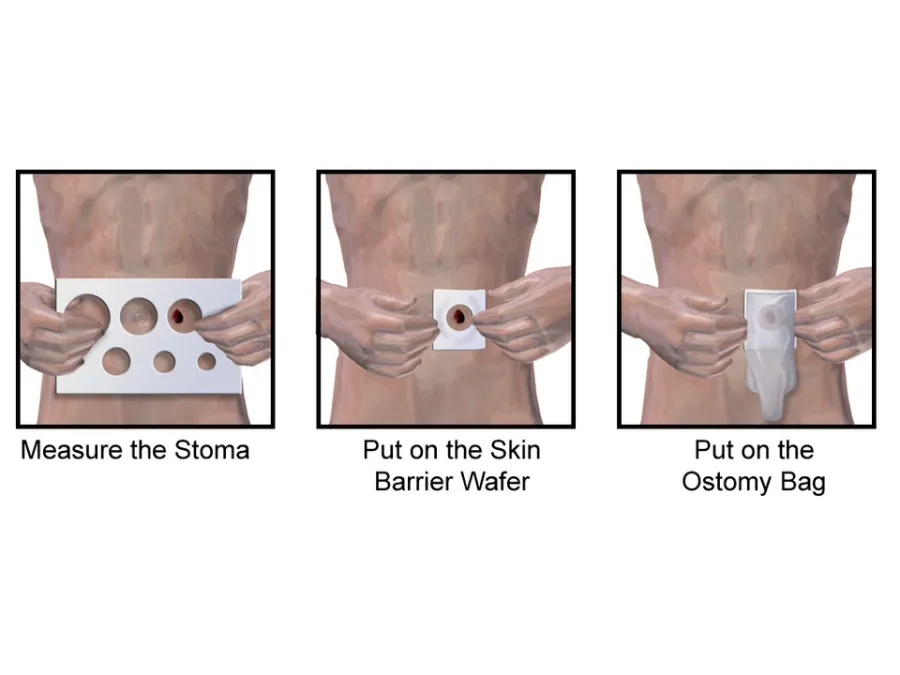
- Cut the pouch barrier to about 1/8 inch larger than the stoma to protect peristomal skin.
- Ileostomy output is liquid to pasty and high-volume (high dehydration/electrolyte risk); colostomy output thickens as it moves distally.
- Empty the pouch when one-third to one-half full to prevent leakage and weight pulling it off.
- Sigmoid colostomies may be regulated by irrigation; ileostomies are never irrigated to regulate output.
- Avoid gas-forming and odor-producing foods as needed, and chew thoroughly to prevent ileostomy blockage.
Nursing priorities
- Assess stoma color and peristomal skin at each pouch change.
- Clean the stoma and skin with water, dry well, and apply a properly sized barrier and pouch.
- Empty the pouch when one-third to one-half full and monitor output amount and consistency.
- Monitor fluid and electrolyte status, especially with an ileostomy.
- Provide emotional support and encourage the client to look at and participate in care.
Labs & values
Patient teaching
- Empty the pouch when one-third to one-half full and change the appliance per schedule.
- Inspect the stoma and skin regularly; report color changes, persistent leakage, or skin breakdown.
- Drink plenty of fluids (especially with an ileostomy) and reintroduce foods gradually to identify gas/odor triggers.
Red flags: report now
- A dusky, blue, purple, or black stoma indicates ischemia/necrosis; report immediately.
- No stool/output and abdominal cramping or distension may signal obstruction (ileostomy blockage); report.
- Signs of dehydration with high ileostomy output (dark urine, dizziness, decreased output) must be reported.
References
Clinical references for this topic