
Red flag to remember
Report excessive bright red rectal bleeding, increasing rectal pain, fever, or purulent drainage after a procedure.
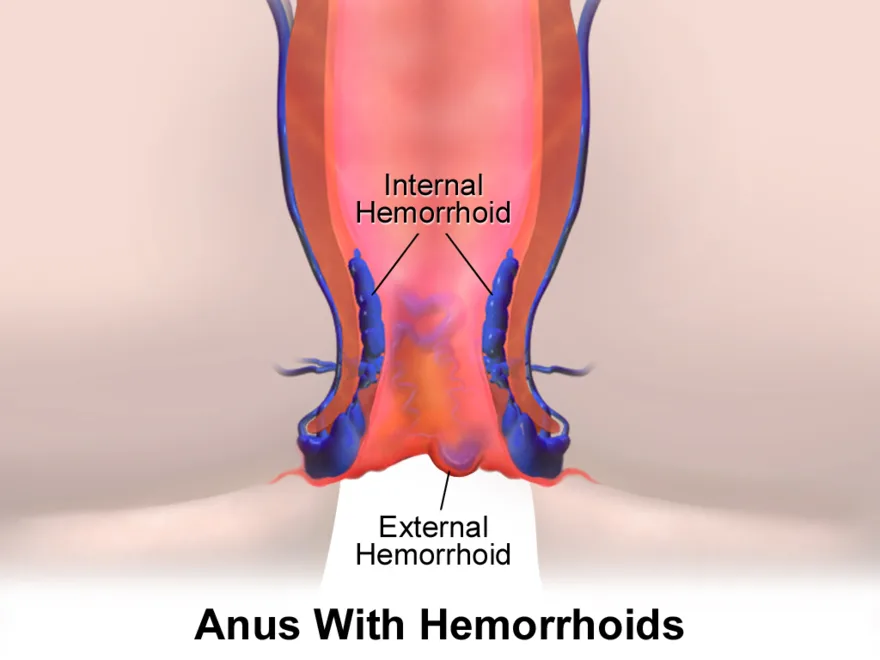
What is hemorrhoids?
They result from increased pressure (straining, constipation, pregnancy, prolonged sitting, portal hypertension). Bright red rectal bleeding on the stool or toilet paper and anal itching/pain are typical.
Hemorrhoids illustrated
Key points to remember
- Bright red painless bleeding that coats the stool surface suggests internal hemorrhoids; external hemorrhoids cause pain, especially when thrombosed.
- Conservative care emphasizes high-fiber diet, increased fluids, stool softeners, and sitz baths to reduce straining and discomfort.
- Warm sitz baths several times daily relieve pain and promote healing and hygiene.
- Procedures include rubber band ligation, sclerotherapy, infrared coagulation, and hemorrhoidectomy for severe or refractory cases.
- A thrombosed external hemorrhoid produces sudden severe anal pain and a tense bluish lump.
- After hemorrhoidectomy, the first bowel movement is painful and patients may fear or delay it, risking constipation and impaction.
Common causes
- Straining, constipation, pregnancy
- Prolonged sitting, ↑abd pressure
Signs & symptoms
- Bright red blood on stool
- Anal itching, pain, prolapse
Nursing priorities
- Promote high-fiber intake, adequate fluids, and stool softeners to keep stools soft and prevent straining.
- Provide warm sitz baths and topical agents for comfort and to reduce edema.
- Encourage the patient not to delay defecation and to avoid prolonged sitting on the toilet.
- After hemorrhoidectomy, give analgesia before the first stool, monitor for bleeding, and assess for urinary retention.
- Inspect the perianal area and assess pain, bleeding, and skin integrity.
Labs & values
Hgb may decrease with chronic bleeding (male13.5-17.5 g/dL, female 12-16 g/dL)
Patient teaching
- Eat fiber-rich foods and drink plenty of water to keep stools soft and avoid straining.
- Use sitz baths and avoid prolonged sitting or standing.
- Avoid heavy lifting and prolonged Valsalva straining.
- After surgery, take prescribed pain medicine and stool softeners, and report heavy bleeding or inability to urinate.
Red flags: report now
- Report excessive bright red rectal bleeding, increasing rectal pain, fever, or purulent drainage after a procedure.
- Report inability to void after hemorrhoidectomy (urinary retention).
- Do not assume all rectal bleeding is hemorrhoidal; new or changed bleeding warrants evaluation to rule out colorectal cancer.
References
Clinical references for this topic

Study Hemorrhoids in the app4,000+ NCLEX questions with a rationale on every answer, NGN case studies and timed mock exams.See how CinnaRN works
Start free Want more Basic Care & Comfort questions?We'll email you a free set on Hemorrhoids. No account needed.
Was this helpful?