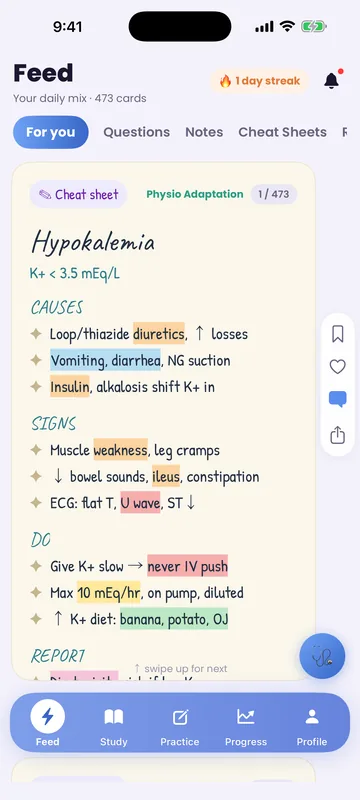
Normal serum potassium is 3.5–5.0 mEq/L; KCl treats levels below this range.
Before you read
Test yourself first: 5 questions
Question 1 of 5
A client with chronic kidney disease is prescribed a potassium-sparing diuretic. Which instruction is most important for the nurse to provide?
Answer: B. Potassium-sparing diuretics such as spironolactone, triamterene, and amiloride retain potassium, and clients with kidney disease already excrete potassium poorly, so salt substitutes (which are high in potassium) must be avoided to prevent hyperkalemia. Encouraging potassium-rich foods or salt substitutes would be unsafe here.
Question 2 of 5
A client taking an ACE inhibitor has a serum potassium of 5.9 mEq/L. What is the nurse's priority action?
Answer: C. ACE inhibitors reduce aldosterone, causing potassium retention; a level of 5.9 mEq/L is hyperkalemia, which can cause life-threatening dysrhythmias. The nurse should hold the dose and notify the provider. Encouraging potassium-rich foods or salt substitutes (which contain potassium chloride) would worsen the problem.
Question 3 of 5
A client is receiving intravenous potassium chloride. Which nursing action is essential when administering this medication?
Answer: B. IV potassium chloride must always be diluted and given on an infusion pump at a controlled rate; it is never given by IV push because rapid administration can cause fatal cardiac arrest. Confirming patency and monitoring the site for infiltration are also important, but never administering potassium as an undiluted bolus is the essential safety rule.
Question 4 of 5
A client on a potassium-sparing diuretic such as spironolactone and an ACE inhibitor should be monitored most closely for which electrolyte imbalance?
Answer: B. Both potassium-sparing diuretics and ACE inhibitors raise serum potassium. Used together they significantly increase the risk of hyperkalemia, which can cause dangerous cardiac dysrhythmias. The nurse monitors potassium and teaches the client to avoid salt substitutes containing potassium.
Question 5 of 5
A nurse reviews the medication list of a client taking an ACE inhibitor and a potassium-sparing diuretic. Which laboratory value is the nurse most concerned about?
Answer: B. Both ACE inhibitors and potassium-sparing diuretics such as spironolactone raise serum potassium, so the combination significantly increases the risk of hyperkalemia, which can cause dangerous dysrhythmias. The nurse should closely monitor the serum potassium. While sodium, hemoglobin, and white blood cell count may be checked, potassium is the priority concern with this drug combination.
Keep the streak going with more questions like these, each with a full rationale.
What is potassium chloride?
Potassium is essential for heart and muscle function, so both low and high levels can cause life-threatening arrhythmias. IV potassium is a high-alert medication. It is never given by IV push or bolus; it is always diluted and infused slowly on a pump, usually no faster than 10 mEq/hour through a peripheral line. Because the kidneys excrete potassium, the nurse confirms adequate urine output before giving it.
Key points to remember
- Normal serum potassium is 3.5–5.0 mEq/L; KCl treats levels below this range.
- NEVER give IV potassium by push or bolus; it can cause fatal arrhythmia and cardiac arrest.
- Always dilute IV KCl and infuse it on a pump; the usual maximum peripheral rate is 10 mEq/hour.
- Confirm urine output of at least 30 mL/hour first, because the kidneys excrete potassium.
- IV potassium irritates veins: burning or pain at the site needs prompt assessment for infiltration.
- Oral KCl irritates the GI tract: give it with food and a full glass of water, and do not crush extended-release forms.
- During replacement, report peaked T waves, muscle weakness, or dysrhythmias.
Nursing priorities
- Verify urine output of at least 30 mL/hour before giving potassium, because poor output lets potassium accumulate.
- Confirm IV potassium is diluted and on an infusion pump at an ordered rate within the peripheral limit, because a fast infusion can cause fatal arrhythmias.
- Monitor cardiac rhythm and serum potassium during replacement, because both low and high levels cause arrhythmias.
- Check the IV site often for pain, burning, or infiltration, because potassium irritates veins.
- Give oral doses with food and a full glass of water, with extended-release forms swallowed whole, because KCl irritates the GI tract.
Labs & values
Worked example
- Cue: A client on a diuretic has a potassium level below 3.5 mEq/L, and IV KCl is ordered. Urine output has stayed below 30 mL/hour for several hours.
- Meaning: The client needs replacement, but low urine output means potassium may not be cleared.
- Priority action: Hold the infusion and notify the provider about the urine output before giving any potassium.
- Evaluation: Potassium is given only after output is adequate, diluted on a pump, with cardiac monitoring and a follow-up level.
Patient teaching
- Take potassium pills with food and a full glass of water. Swallow extended-release tablets whole; do not crush them.
- Call your provider if you have muscle weakness, cramps, or an irregular heartbeat.
- Eat potassium-rich foods as advised and keep your lab appointments so your level can be checked.
Memory tricks
- Pump, never push; check pee before potassium.
Common mistakes
- Giving IV potassium by push or bolus. It is never pushed.
- Hanging potassium before checking urine output.
- Speeding up a peripheral infusion past the usual 10 mEq/hour limit to correct a low level faster.
- Crushing extended-release tablets to make them easier to swallow.
Red flags: report now
- An order or plan to give KCl by IV push or bolus — do not give it; clarify with the prescriber.
- Urine output below 30 mL/hour — hold potassium and notify the provider.
- Potassium below 3.5 or above 5.0 mEq/L with ECG changes such as peaked T waves or a new dysrhythmia — notify the provider now.
- Burning or pain at the IV site — stop the infusion and assess for infiltration before continuing.
References
Clinical references for this topic