Report abdominal pain, distension, or absent bowel sounds (intestinal necrosis).
Before you read
Test yourself first: 5 questions
Question 1 of 5
A client with hyperkalemia is prescribed sodium polystyrene sulfonate. The nurse explains that this medication works by which mechanism?
Answer: B. Sodium polystyrene sulfonate is a cation-exchange resin that binds potassium in the GI tract and removes it through the stool, lowering serum potassium.
Question 2 of 5
A client with hyperkalemia is prescribed sodium polystyrene sulfonate (Kayexalate). The nurse evaluates the medication as effective when which finding is noted?
Answer: A. Sodium polystyrene sulfonate exchanges sodium for potassium in the bowel and removes potassium through the stool, so a decreasing serum potassium indicates effectiveness. It commonly causes a bowel movement; an increasing potassium or no stooling would suggest it is not working.
Question 3 of 5
A client with hyperkalemia is prescribed sodium polystyrene sulfonate. The nurse understands this medication works by which mechanism?
Answer: A. Sodium polystyrene sulfonate is a cation-exchange resin that binds potassium in the gastrointestinal tract and exchanges it for sodium, removing excess potassium through the stool. It does not increase renal potassium excretion directly, shift potassium into cells, or neutralize cardiac effects like calcium does.
Question 4 of 5
A client with severe symptomatic hyperkalemia and ECG changes is being treated emergently. Which medication does the nurse anticipate administering first to protect the heart?
Answer: A. IV calcium gluconate is given first in life-threatening hyperkalemia to stabilize the cardiac membrane and protect against dysrhythmias; it does not lower potassium but buys time. Insulin with dextrose and beta agonists then shift potassium into cells, and sodium polystyrene sulfonate removes it more slowly.
Question 5 of 5
A client with hyponatremia is receiving a 3% sodium chloride (hypertonic saline) infusion. Which nursing action is most important?
Answer: A. Hypertonic saline must be infused slowly with frequent neurologic and sodium monitoring because correcting sodium too rapidly can cause osmotic demyelination and serious neurologic injury. Using a controlled pump and monitoring closely is essential. Rapid bolus administration or infrequent monitoring would be dangerous.
Keep the streak going with more questions like these, each with a full rationale.
What is sodium polystyrene sulfonate?
It is given orally or by retention enema. Key principle: it works slowly, so it is not for emergency hyperkalemia, and the nurse must monitor for resulting hypokalemia and bowel necrosis.
Key points to remember
- It lowers serum potassium by exchanging sodium for potassium in the bowel, excreting potassium in stool.
- Onset is slow (hours), so it is not used alone for life-threatening hyperkalemia.
- It can cause hypokalemia, sodium retention, and fluid overload.
- It can cause intestinal necrosis, especially when combined with sorbitol or in postoperative patients.
- A bowel movement is needed for the drug to work, so it is held if the patient is constipated or has ileus.
Nursing priorities
- Monitor serum potassium before, during, and after therapy to avoid overcorrection.
- Assess bowel sounds and bowel movements; the drug requires evacuation to be effective.
- Monitor for sodium and fluid overload, especially in heart failure patients.
- Assess for signs of bowel necrosis: abdominal pain, distension, and decreased bowel sounds.
- For enema administration, ensure the resin is retained and then thoroughly removed.
Labs & values
Patient teaching
- A bowel movement is needed for the medicine to remove potassium.
- Report constipation, severe abdominal pain, or swelling.
- Follow up on potassium levels and dietary potassium restrictions.
Red flags: report now
- Report abdominal pain, distension, or absent bowel sounds (intestinal necrosis).
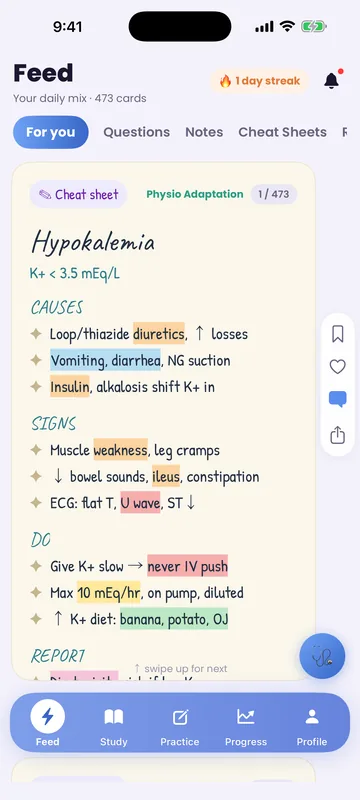
- Report potassium dropping below 3.5 mEq/L (overcorrection to hypokalemia).
- Do not rely on it for emergency hyperkalemia; it acts slowly.
References
Clinical references for this topic