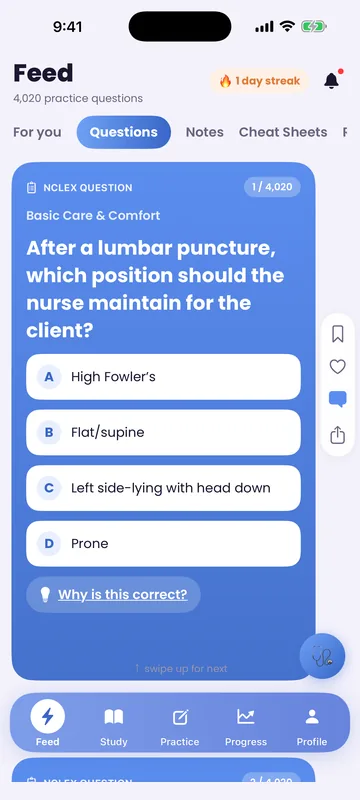
15 free questions from the CinnaRN basic care and comfort bank (282 in the app). Tap an answer to check it. The rationale opens right away.
An older adult reports difficulty sleeping at night. Which recommendation best supports healthy sleep in the elderly?
Answer: B. Keep a consistent sleep schedule and limit daytime naps
Maintaining a regular sleep-wake schedule and limiting daytime napping supports better nighttime sleep. Long late-day naps, evening caffeine, and routine hypnotics (which raise fall and confusion risk) are discouraged.
A client with right-sided hemiplegia after a stroke is learning to dress. Which instruction reflects correct technique to promote independence?
Answer: A. Put clothing on the affected (weak) side first
When a client has one-sided weakness, dressing is easier and safer if the client puts clothing on the weak (affected) side first and removes it from the strong side first. This avoids forcing the weak limb through a sleeve last. Dressing the strong side first, dressing only with full assistance, and avoiding adaptive equipment do not promote safe independence.
A nurse is caring for a laboring client lying flat in the supine position who becomes pale, dizzy, and hypotensive. What is the nurse's first action?
Answer: A. Place the client in a left lateral position
Supine positioning lets the gravid uterus compress the inferior vena cava, reducing venous return and causing supine hypotensive syndrome. Turning the client to a left lateral position relieves the compression and restores circulation. Oxygen and fluids may follow, but repositioning is the immediate, simple corrective action.
A nurse is teaching a postoperative client how to reduce pain when coughing and deep breathing after abdominal surgery. Which instruction is correct?
Answer: A. Hold a pillow firmly against the incision while coughing
Splinting the incision with a pillow or folded blanket supports the wound and reduces pain and tension during coughing and deep breathing, which encourages the client to perform these important pulmonary exercises and lowers the risk of atelectasis.
A child with chickenpox is itching intensely. Which nursing intervention best promotes comfort and prevents complications?
Answer: B. Keep fingernails short and trimmed
Keeping the child's fingernails short and trimmed helps prevent scratching, which reduces secondary bacterial infection and scarring. Oatmeal baths and cool compresses also relieve itching. Aspirin is avoided due to the risk of Reye syndrome.

A nurse is caring for a client with severe anemia and fatigue. Which intervention best supports the client's activity tolerance?
Answer: A. Schedule rest periods between activities
With low oxygen-carrying capacity, the client tires easily. Balancing activity with frequent rest periods and clustering care to allow uninterrupted rest conserves oxygen and energy while gradually rebuilding tolerance. Forcing continuous activity, enforcing strict bed rest indefinitely, or withholding all assistance does not appropriately support a fatigued anemic client.
A nurse is suctioning a client through an endotracheal tube. How far should the catheter be inserted before suction is applied?
Answer: A. Until resistance is met, then withdraw slightly before suctioning
During endotracheal suctioning, the catheter is inserted until resistance is met or about 1 cm past the end of the tube, then withdrawn slightly before suction is applied. Suctioning too deep traumatizes the mucosa and stimulates the cough and vagal responses unnecessarily.
An alert client with type 1 diabetes reports feeling shaky and sweaty. A fingerstick glucose is 54 mg/dL. Which action does the nurse take first?
Answer: A. Give 4 ounces of orange juice
For a conscious client with hypoglycemia, the first step is to give 15 grams of fast-acting carbohydrate (for example, 4 ounces of fruit juice or glucose tablets), then recheck glucose in 15 minutes (the 15-15 rule). IM glucagon is reserved for unconscious clients or those who cannot swallow. A complex meal or insulin would not correct hypoglycemia quickly.
A client on hemodialysis should be taught to limit foods high in potassium. Which food should the nurse teach the client to avoid?
Answer: A. Bananas
Bananas are high in potassium and should be limited in clients with kidney failure, who cannot excrete potassium and are at risk for hyperkalemia. Other high-potassium foods include oranges, potatoes, tomatoes, and salt substitutes containing potassium.
A nurse plans dietary teaching for a client with type 2 diabetes. Which principle should guide carbohydrate intake?
Answer: A. Eat consistent, measured amounts of carbohydrate at each meal
Carbohydrate counting and consistent, portion-controlled carbohydrate intake spread across meals help maintain stable glucose levels. Emphasis is on whole grains, vegetables, and fiber rather than eliminating all carbohydrates, which are the body's primary energy source.
A home care nurse is teaching a client with COPD on home oxygen about safety. Which statement by the client indicates correct understanding?
Answer: A. I should keep my oxygen at least several feet from the gas stove and open flames
Oxygen supports combustion, so the client must keep the oxygen away from open flames, including gas stoves, candles, and cigarettes, and avoid smoking. Increasing the flow rate without an order is unsafe, petroleum jelly near oxygen is a fire hazard, and storing tanks near a heater is dangerous.
A nurse is sizing the opening of a colostomy pouch skin barrier for a client. How should the opening be cut relative to the stoma?
Answer: B. About 1/8 inch larger than the stoma
The barrier opening should be cut approximately 1/8 inch (about 1 to 3 mm) larger than the stoma. This protects the peristomal skin from effluent while avoiding constriction of the stoma. An opening that is too large exposes skin to irritating output; one cut too small can cut into and injure the stoma.
A client with acute viral hepatitis is fatigued and anorexic. Which nutritional approach should the nurse recommend?
Answer: A. Eat the largest meal of the day in the morning
During acute hepatitis, clients tolerate food poorly, especially later in the day. Eating small, frequent meals with the largest meal in the morning, when nausea is usually least, supports adequate intake. A high-carbohydrate, moderate-protein diet is generally recommended, and adequate calories aid liver recovery. Forcing large high-fat meals worsens nausea, and prolonged fasting is harmful.
A client is on a 1500 mL fluid restriction for hyponatremia. Which nursing action best supports adherence while maintaining comfort?
Answer: B. Distribute fluids across the day and offer frequent mouth care
Spreading the allotted fluid throughout the day, offering frequent oral care, and using ice chips (counting them as half their volume) help control thirst within the restriction. Providing all fluid at once or ignoring the limit would compromise the treatment plan or comfort.
A client in skeletal traction asks the nurse to remove the weights to make repositioning more comfortable. What is the nurse's BEST response?
Answer: B. "The weights must hang freely at all times to keep the bone aligned, so they cannot be removed."
Skeletal traction must be continuous; the weights provide the pulling force that maintains bone alignment and must never be removed or rested on the bed by the nurse. Lifting the weights eliminates the therapeutic force. The other statements either undermine the prescription or imply the weights may be removed.
Answer all 15 questions to see how you did.
Free to start
Timed mock exams, a rationale on every answer and progress that follows you from web to phone.
