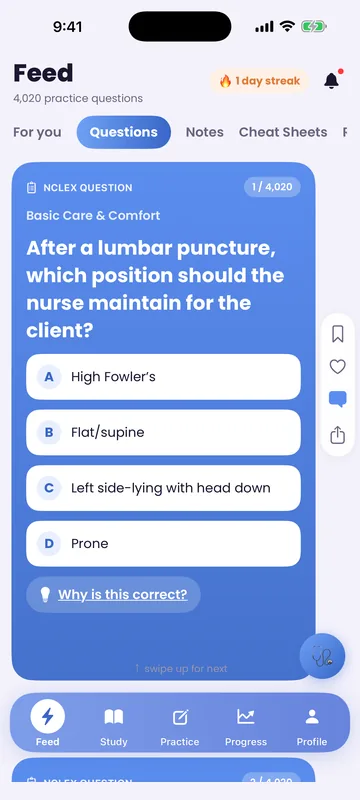
15 free questions from the CinnaRN safety and infection control bank (391 in the app). Tap an answer to check it. The rationale opens right away.
Immediately after a below-the-knee amputation, the nurse notes a small amount of serosanguineous drainage on the residual limb dressing. What is the nurse's priority action?
Answer: B. Mark the drainage and time on the dressing and monitor for bleeding
Because hemorrhage is a serious early postoperative risk, the nurse should outline (mark) the drainage and time on the dressing to monitor for active or increasing bleeding and keep a tourniquet available at the bedside. A small amount of serosanguineous drainage initially is expected, but it must be monitored for progression.
A postpartum client on day 4 has a temperature of 101.8 F, uterine tenderness, and malodorous lochia. Which condition is most consistent with these findings?
Answer: A. Endometritis
Fever of 100.4 F (38 C) or higher after the first 24 hours, uterine tenderness, and foul-smelling lochia are classic signs of endometritis, an infection of the uterine lining. It commonly appears on postpartum days 2 to 5 and requires antibiotic therapy.
The nurse is caring for a client with a methicillin-resistant Staphylococcus aureus (MRSA) wound infection. Which precautions are required?
Answer: B. Contact precautions
MRSA is spread by direct and indirect contact, so contact precautions (gown and gloves, dedicated equipment, private room or cohorting) are required. Airborne or droplet precautions address respiratory spread and are not indicated. Standard precautions alone are insufficient for a multidrug-resistant organism.
A client on contact precautions for Clostridioides difficile needs a stool sample collected. Which staff member is appropriate to perform this task, and why?
Answer: A. A UAP trained in contact precautions and proper hand hygiene
Collecting a stool specimen from a client on contact precautions is within UAP scope as long as the UAP is trained in the proper precautions, including hand hygiene with soap and water. The task does not require nursing judgment.
A client with suspected meningococcal meningitis is admitted. Which precaution is most appropriate until the causative organism is identified?
Answer: B. Droplet precautions
Neisseria meningitidis is spread by respiratory droplets, so droplet precautions (private room, surgical mask within 3 feet) are indicated. This is maintained until 24 hours of effective antibiotic therapy have been completed.

A client is placed on protective (neutropenic) precautions due to severe neutropenia following chemotherapy. Which action by the nursing assistant requires intervention?
Answer: B. Bringing fresh flowers and a vase of water into the room
Protective precautions aim to keep pathogens away from the immunocompromised client. Bringing fresh flowers and standing water into the room is contraindicated because they can harbor Pseudomonas and fungal organisms.
A nurse is teaching a pregnant client about preventing listeriosis, which can cause miscarriage and stillbirth. Which food should the nurse advise the client to avoid?
Answer: A. Unpasteurized soft cheese
Listeria is associated with unpasteurized (soft) cheeses, unpasteurized milk, deli meats, and refrigerated smoked seafood. Soft cheeses such as queso fresco made from unpasteurized milk should be avoided. Thoroughly cooked foods, pasteurized milk, and washed produce are safe.
A client with a suspected cervical spinal cord injury is found at the scene of a fall. Which action by the nurse takes priority during the initial assessment?
Answer: A. Maintain manual in-line stabilization of the head and neck
Until a cervical injury is ruled out, the spine must be immobilized; the nurse maintains in-line stabilization of the head and neck and keeps the body aligned to prevent extension of the cord injury. Logrolling with the spine kept straight is used for any necessary movement. Flexing the neck or sitting the client up could worsen the injury.
The nurse is reviewing a medication order and reads it as the abbreviation U for units. According to error-prevention guidelines, what should the nurse do?
Answer: B. Clarify the order and have units written out in full
The abbreviation U is on the ISMP/Joint Commission do-not-use list because it can be misread as a zero, the number 4, or cc, leading to dosing errors. The nurse should clarify and have units written out in full. Assuming it means units or proceeding without clarification risks a tenfold or larger overdose.
When two strengths of the same liquid medication exist (infant drops and children's suspension), what is the safest nursing practice?
Answer: B. Verify the concentration on the label and calculate for that strength
Different concentrations are a known source of fatal pediatric errors. The nurse must verify the exact concentration on the label, calculate the volume for that specific strength, and never assume the strengths are interchangeable.
During a transfusion, a client suddenly develops dyspnea, crackles, distended neck veins, and a rapid rise in blood pressure. The nurse recognizes which transfusion complication?
Answer: A. Transfusion-associated circulatory overload
These findings indicate transfusion-associated circulatory overload (TACO), in which the rapid volume infusion overloads the circulation, causing pulmonary congestion and hypertension. The transfusion is slowed or stopped, the head of bed is raised, and a diuretic is often given.
A public health nurse is performing contact tracing for a client newly diagnosed with a sexually transmitted infection. Which principle guides this process?
Answer: B. Contacts are notified without revealing the index client's identity
Confidentiality is essential; the index client's identity is not revealed to contacts. The purpose is to notify exposed partners so they can be tested and treated, interrupting transmission. Contacts are notified discreetly without disclosing who named them.
A nurse notes that a client on airborne precautions for tuberculosis needs to be transported to radiology. Which action should the nurse take?
Answer: A. Place a surgical mask on the client during transport
When a client on airborne precautions must leave the room, the client should wear a surgical mask during transport. Health care personnel do not need a respirator if the client is masked and not coughing into the open air.
A nurse is preparing to administer routine immunizations to a healthy 2-month-old infant. Which vaccine is contraindicated at this age because the child is too young to receive it?
Answer: B. MMR
MMR is a live vaccine first given at 12 to 15 months and is not given at 2 months. At 2 months an infant routinely receives DTaP, Hib, IPV, PCV, rotavirus, and hepatitis B, so those are appropriate.
A nursing student calculates a pediatric dose that is much higher than the typical amount the unit usually gives. What is the safest next step?
Answer: B. Recheck the calculation and have a second nurse verify
When a calculated dose seems unusually high, the safety practice is to stop and recheck the calculation and have a second nurse independently verify before administering. Trusting an outlier result without rechecking risks a serious error.
Answer all 15 questions to see how you did.
Free to start
Timed mock exams, a rationale on every answer and progress that follows you from web to phone.
