15 free questions from the CinnaRN management of care bank (472 in the app). Tap an answer to check it. The rationale opens right away.
A nurse on a medical unit is planning care for several clients with diabetes. Which client should the nurse assess first?
Answer: A. A client who is difficult to arouse with a blood glucose of 42 mg/dL
A client who is difficult to arouse with a fingerstick glucose of 42 mg/dL has acute, life-threatening hypoglycemia affecting the brain and must be assessed and treated first. The other clients are stable or have less urgent, expected findings that can be addressed after the emergency.
A client with early-stage dementia who has decision-making capacity wishes to complete advance directives. What is the nurse's best action?
Answer: A. Support the client in completing advance directives now
While the client retains capacity, the nurse should support and facilitate completion of advance directives and a durable power of attorney, ensuring the client's wishes are documented. Waiting until capacity is lost or having the family decide ignores the client's right to self-determination.
A client is being discharged after a new diagnosis of a seizure disorder. Which statement by the client indicates a NEED FOR FURTHER teaching?
Answer: A. I can stop my medication once I have gone a while without a seizure
Stopping antiseizure medication when feeling well is incorrect and dangerous because abrupt discontinuation can precipitate status epilepticus; this statement indicates a need for more teaching. Wearing medical identification, taking medication consistently at the same time, and avoiding alcohol and triggers such as sleep deprivation reflect correct understanding.
A nurse is prioritizing care for four clients. Using the ABC and Maslow frameworks, which client has the HIGHEST priority?
Answer: C. A client with a decreased level of consciousness and gurgling respirations
Airway is always first. A client with a decreased level of consciousness and gurgling respirations has a compromised airway requiring immediate intervention. The clients with anxiety, a 0900 medication due, and a low-grade fever are lower priority than the airway threat.
During a code, the team leader notes the rescuer doing compressions is fatiguing. What should occur to maintain compression quality?
Answer: B. Switch compressors about every 2 minutes
Compressors should switch about every 2 minutes (or sooner if fatigued) to prevent a decline in compression depth and rate. The switch should take less than 5 seconds, ideally during a rhythm check.

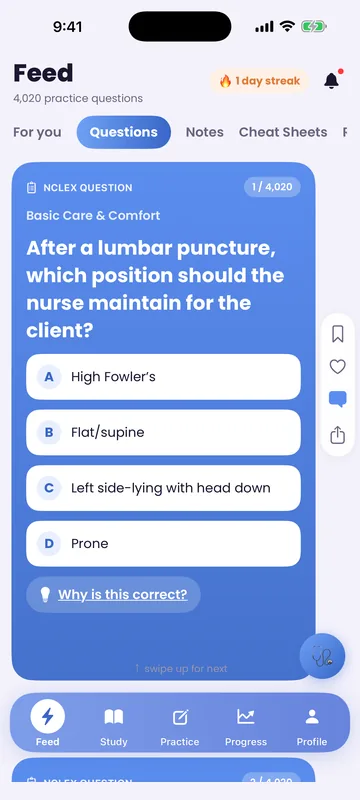
A client in skin traction for a femur fracture asks why the weights are hanging freely off the end of the bed. What is the nurse's BEST response?
Answer: A. The weights keep a constant pull that holds the bone in alignment
Traction weights must hang freely and not rest on the floor or bed to maintain a continuous, constant pull that keeps the bone aligned. Lifting or removing the weights interrupts the therapeutic pull and is not done without an order.
A client with painless third-trimester bleeding is admitted to rule out placenta previa. Which nursing action should the nurse perform first?
Answer: A. Apply continuous fetal monitoring and assess maternal vital signs and bleeding
When placenta previa is suspected, the priority is to assess maternal and fetal status and prevent further bleeding, so the nurse first applies continuous external fetal and maternal monitoring and assesses blood loss while keeping the client on bed rest. Digital and speculum examinations are avoided until previa is excluded by ultrasound.
A 4-year-old presents with a high fever, drooling, muffled voice, and is sitting upright leaning forward. The nurse suspects epiglottitis. Which action should the nurse take first?
Answer: C. Keep the child calm and avoid inspecting the throat
With suspected epiglottitis, the priority is to avoid agitating the child and to NOT inspect the throat or place anything in the mouth, because this can trigger laryngospasm and complete airway obstruction. Keep the child calm and prepare for emergency airway management.
A nurse is delegating tasks for a stable postpartum client to unlicensed assistive personnel (UAP). Which task is appropriate to delegate to the UAP?
Answer: A. Measuring and recording the stable client's vital signs
UAP may perform tasks that are routine, standardized, and do not require nursing assessment or judgment, such as measuring and recording vital signs on a stable client and assisting with hygiene and ambulation. Assessing the fundus and lochia, teaching about danger signs, and evaluating the perineum require nursing assessment, judgment, and education and cannot be delegated to UAP.
A conscious adult suddenly clutches the throat during a meal, cannot speak, and is making no sound. The nurse determines the client has a complete airway obstruction. What is the priority intervention?
Answer: B. Perform abdominal thrusts (the Heimlich maneuver)
A conscious adult with a complete foreign-body airway obstruction who cannot speak, cough, or breathe requires immediate abdominal thrusts (the Heimlich maneuver) to expel the object. Back blows alone are used in infants; in a choking conscious adult, abdominal thrusts are the standard intervention.
A nurse on a medical-surgical unit notes a client with a rising heart rate, falling blood pressure, increased confusion, and a respiratory rate of 28. What is the most appropriate action?
Answer: B. Activate the rapid response team
These are early warning signs of clinical deterioration. The appropriate action is to activate the rapid response team, which brings critical-care expertise to the bedside before the client progresses to full arrest. Waiting for the next scheduled assessment or simply documenting delays needed intervention.
A client develops new-onset third-degree heart block with a ventricular rate of 32 and worsening hypotension. Which intervention does the nurse anticipate as definitive treatment?
Answer: B. Prepare for cardiac pacing
Complete heart block with symptomatic bradycardia is best treated with cardiac pacing; transcutaneous pacing is initiated emergently and a transvenous or permanent pacemaker provides definitive management. Atropine is often ineffective in high-grade or infranodal block. Adenosine and beta-blockers would further slow conduction and are contraindicated.
A client with multiple injuries including a closed femur fracture, a wrist fracture, and new shortness of breath with restlessness arrives in the emergency department. Using priority setting, which problem should the nurse address FIRST?
Answer: A. The shortness of breath and restlessness
Applying the ABCs, the new shortness of breath and restlessness suggest a breathing/oxygenation problem (possible fat or pulmonary embolism) and take priority over the orthopedic injuries. The femur and wrist fractures, while important, are not immediately life-threatening compared with a compromised airway and breathing.
The nurse plans care for clients with the following needs. Which need should be addressed first based on the ABC priority framework?
Answer: A. A client with copious secretions and an ineffective cough
Airway always comes first. A client with copious secretions and an ineffective cough has a threatened airway and must be addressed before circulation, mobility, or comfort needs.
The nurse is assigning rooms and care for four clients. Which client requires placement in a room nearest the nurses' station for closest monitoring?
Answer: B. A client with frequent dysrhythmias and a borderline low blood pressure
The least stable client requiring the closest observation is one with frequent dysrhythmias and a borderline blood pressure, who may deteriorate rapidly. The clients awaiting discharge, with controlled pain, and with a healing wound are more stable and do not require the closest monitoring.
Answer all 15 questions to see how you did.
Free to start
Timed mock exams, a rationale on every answer and progress that follows you from web to phone.
