
Most common in men over 65 with a history of smoking, hypertension, and atherosclerosis.
Before you read
Test yourself first: 5 questions
Question 1 of 5
A client is diagnosed with a stable abdominal aortic aneurysm (AAA). Which finding may the nurse detect on physical assessment?
Answer: A. An AAA may present as a pulsatile abdominal mass, sometimes with a bruit on auscultation. Aggressive palpation is avoided due to rupture risk, but a pulsatile mass is the classic finding. Absent femoral pulses, a rigid board-like abdomen, and visible peristalsis are not characteristic of a stable AAA.
Question 2 of 5
A client is 1 day postoperative from abdominal surgery. The nurse notes absent bowel sounds, abdominal distention, and no passage of flatus. The nurse recognizes this as which expected or complicating condition?
Answer: A. A temporary slowing of peristalsis (paralytic ileus) is common after abdominal surgery and anesthesia, producing absent bowel sounds, distention, and no flatus. Management includes NPO, NG decompression, and early ambulation. This is not an early sign of wound dehiscence, dumping syndrome, or a normal return of full bowel function.
Question 3 of 5
A nurse palpates the fundus of a client who gave birth vaginally 24 hours ago. Where does the nurse expect the fundus to be located?
Answer: B. The fundus is normally at or near the level of the umbilicus immediately after birth and involutes about one fingerbreadth (1 cm) per day thereafter. At 24 hours it is expected to be approximately at the umbilicus or 1 cm below it. By about 10 days it descends below the symphysis and is no longer palpable abdominally.
Question 4 of 5
A client with major burns develops a sudden drop in urine output, abdominal distention, and absent bowel sounds on day two. Which complication should the nurse suspect?
Answer: A. Paralytic ileus is a common complication after major burns because of the stress response and decreased gastrointestinal perfusion. Signs include abdominal distention, absent bowel sounds, and nausea. The nurse anticipates withholding oral intake and inserting a nasogastric tube for decompression. Curling ulcer is a separate gastric stress ulcer complication.
Question 5 of 5
Four hours after abdominal surgery, a client has not voided and reports lower abdominal discomfort with a palpable, distended bladder. What is the nurse's first action?
Answer: A. Bladder distention with inability to void is common after surgery and anesthesia. The nurse first uses noninvasive measures such as assisting to a normal voiding position, providing privacy, and running water to promote voiding before resorting to catheterization, which carries infection risk. A diuretic and simply increasing fluids do not relieve acute retention.
Keep the streak going with more questions like these, each with a full rationale.
Abdominal Aortic Aneurysm (AAA) illustrated
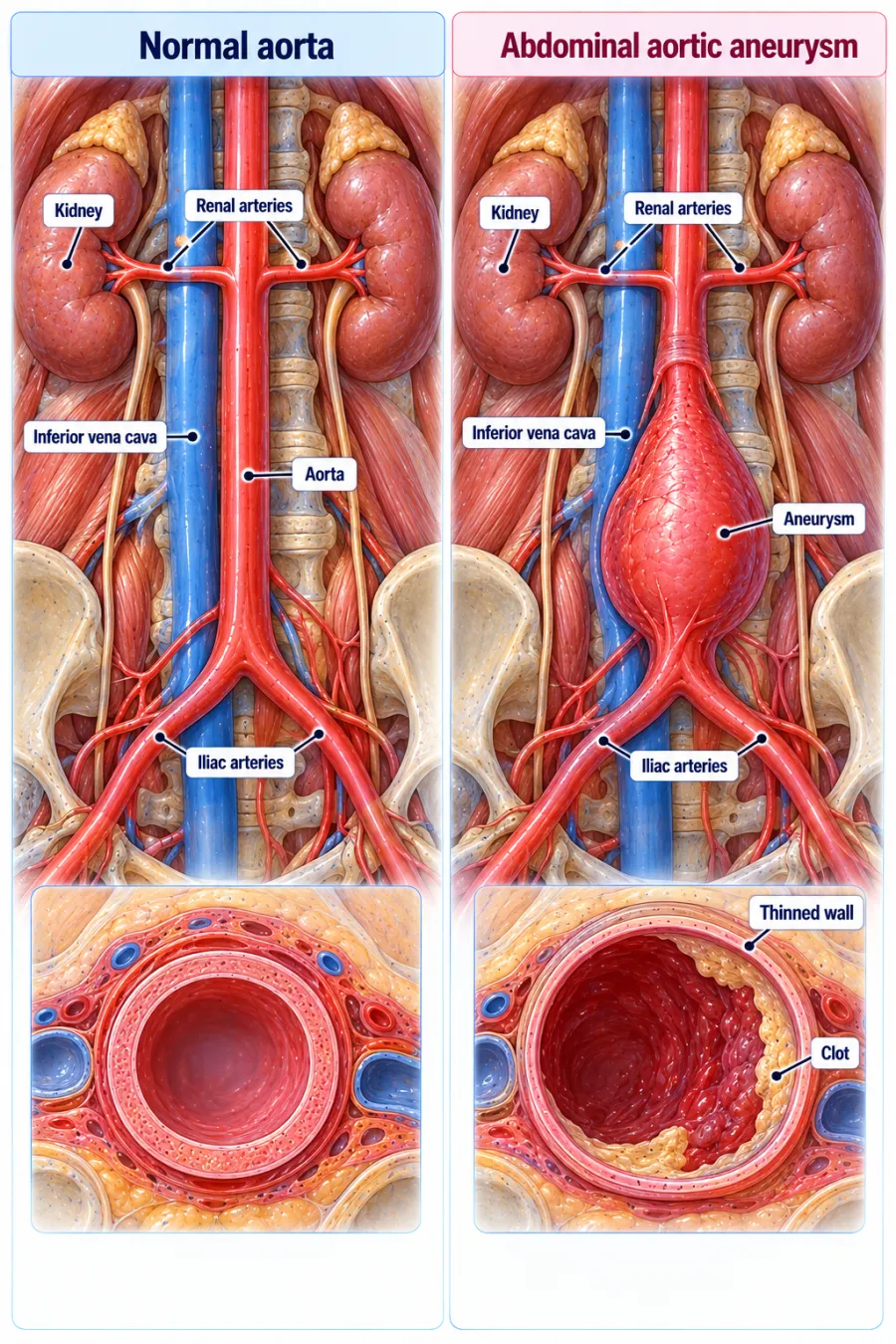
Key points to remember
- Most common in men over 65 with a history of smoking, hypertension, and atherosclerosis.
- A pulsating abdominal mass and a bruit on auscultation are classic signs.
- NEVER deeply palpate a known or suspected AAA — pressure can trigger rupture.
- Risk of rupture rises sharply once the aneurysm exceeds 5.5 cm; surgical repair is typically considered at this size.
- Sudden severe tearing abdominal or back/flank pain signals expansion or rupture.
- Repair options are open surgical grafting or endovascular aneurysm repair (EVAR).
Signs & symptoms
- Pulsatile abdominal mass
- Bruit on auscultation
- Often asymptomatic
Nursing priorities
- Monitor and tightly control blood pressure to reduce wall stress (antihypertensives, beta-blockers).
- Assess for a pulsating mass and bruit, but do not palpate deeply or repeatedly.
- Monitor for signs of rupture: hypotension, tachycardia, decreasing hematocrit, flank/back pain.
- Postoperatively assess peripheral pulses, urine output, and bowel sounds; report changes in lower-extremity perfusion.
- Keep blood typed and crossmatched and large-bore IV access ready for high-risk or symptomatic patients.
Labs & values
Patient teaching
- Avoid heavy lifting, straining, and activities that raise abdominal pressure.
- Take antihypertensive medications consistently and stop smoking.
- Report new or worsening back, flank, or abdominal pain immediately.
- Keep all surveillance ultrasound/CT appointments to monitor aneurysm size.
Red flags: report now
- Sudden severe tearing back, flank, or abdominal pain with hypotension and tachycardia indicates rupture — a surgical emergency.
- Grey Turner sign (flank bruising) or a rigid, distended abdomen suggests retroperitoneal bleed.
- Never palpate deeply over a known abdominal aortic aneurysm.
- New cool, mottled, pulseless lower extremity post-repair signals graft occlusion or embolism.
References
Clinical references for this topic

