Severe hypertension, headache, or visual changes - risk of hypertensive encephalopathy; report immediately.
Before you read
Test yourself first: 3 questions
Question 1 of 3
A client having an acute asthma attack has wheezing and uses accessory muscles. The priority intervention is to:
Answer: B. Give a short-acting bronchodilator (e.g., albuterol), high-Fowler's position, and oxygen; assess response. A SILENT chest (no wheezing) with worsening distress is ominous (severe airflow limitation).
Question 2 of 3
A nurse assesses an older adult for normal age-related vision changes. Which finding is an expected change of aging?
Answer: B. Presbyopia, the decreased ability to focus on near objects, is a normal age-related vision change. Sudden painless vision loss, halos with eye pain, and a curtain over the visual field are signs of pathology (such as retinal detachment or acute glaucoma), not normal aging.
Question 3 of 3
A client reports substernal chest pain that began 30 minutes ago and radiates to the left arm and jaw. Which action should the nurse take FIRST?
Answer: B. When acute chest pain suggests myocardial ischemia, obtaining a 12-lead ECG is the priority diagnostic action so ST-segment changes can be identified quickly and reperfusion therapy is not delayed. Oxygen, aspirin, and nitroglycerin follow, but the ECG must not be delayed because time-to-diagnosis drives treatment.
Keep the streak going with more questions like these, each with a full rationale.
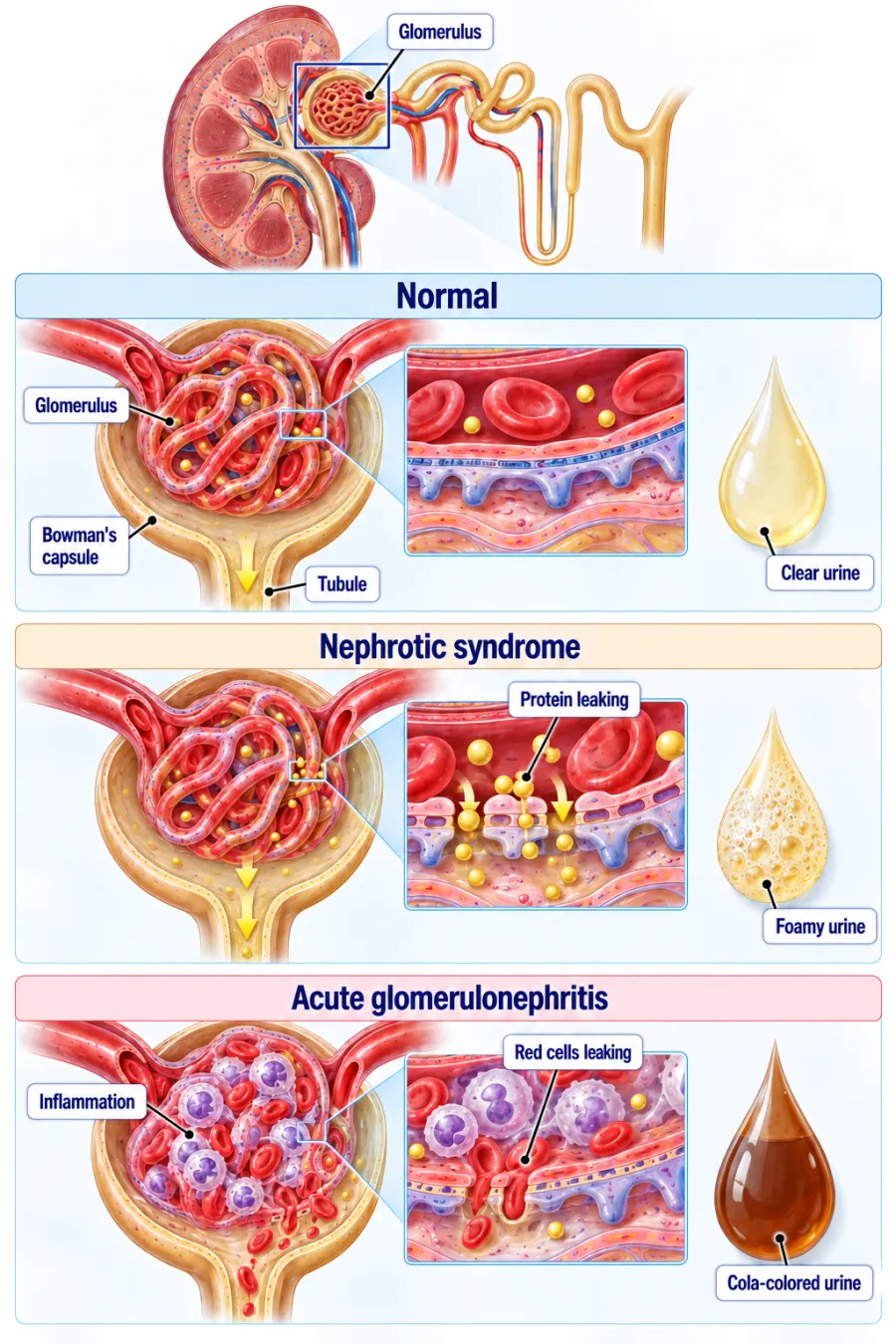
What is acute glomerulonephritis?
Antigen-antibody complexes deposit in the glomeruli, impairing filtration. It is most common in children and usually self-limiting, but matters because it causes fluid retention and hypertension.
Acute Glomerulonephritis illustrated
Key points to remember
- Classic signs are hematuria producing tea-colored or cola-colored urine, proteinuria, and oliguria.
- Periorbital and facial edema with hypertension occur from fluid retention.
- A recent strep throat or skin infection precedes symptoms by about 1-3 weeks.
- Antistreptolysin O (ASO) titer is elevated, confirming a recent streptococcal infection.
- BUN and creatinine may rise temporarily as filtration is impaired.
- Unlike nephrotic syndrome, protein loss is mild-to-moderate and hematuria is the dominant feature.
Signs & symptoms
- tea/cola-colored urine (hematuria)
- HTN, periorbital/facial edema
- proteinuria (mild), oliguria
Nursing priorities
- Monitor blood pressure, daily weights, intake/output, and urine color.
- Restrict sodium and fluids; restrict protein and potassium if azotemia is present.
- Administer antibiotics to eradicate residual streptococcal infection and antihypertensives/diuretics as ordered.
- Promote rest during the acute phase to reduce metabolic demand.
- Monitor for signs of fluid overload and worsening renal function.
Labs & values
Patient teaching
- Complete the full antibiotic course and treat strep infections promptly to prevent recurrence.
- Follow sodium and fluid restrictions and rest during recovery.
- Report decreased urine output, swelling, headache, or dark urine.
Red flags: report now
- Severe hypertension, headache, or visual changes - risk of hypertensive encephalopathy; report immediately.
- Signs of fluid overload/pulmonary edema (dyspnea, crackles) - escalate.
- Worsening oliguria or rising creatinine signaling progression to renal failure - report.
- Seizures or decreased level of consciousness - emergency.
References
Clinical references for this topic