Hallmark findings are fatigue, muscle weakness, weight loss, anorexia, nausea, and hypotension.
Before you read
Test yourself first: 5 questions
Question 1 of 5
A client with Addison disease (adrenal insufficiency) is admitted. Which set of findings does the nurse expect?
Answer: B. In Addison disease, deficient cortisol and aldosterone produce hyponatremia, hyperkalemia, hypoglycemia, hypotension, weight loss, fatigue, and hyperpigmentation of the skin. The combination of low sodium and high potassium is the classic electrolyte pattern.
Question 2 of 5
A client with Addison's disease (adrenal insufficiency) is most likely to have:
Answer: B. Addison's (low cortisol/aldosterone): fatigue, weight loss, hypotension, hyponatremia, hyperkalemia, hypoglycemia, and bronze hyperpigmentation. Hypertension and weight gain occur in Cushing's.
Question 3 of 5
A client with Addison's disease is under physical stress (e.g., infection). The nurse anticipates the need to:
Answer: B. Clients with adrenal insufficiency cannot mount a cortisol response to stress — anticipate INCREASED (stress-dose) corticosteroids to prevent adrenal crisis. Withholding steroids during stress is dangerous.
Question 4 of 5
A client with Addison's disease is admitted in adrenal (Addisonian) crisis. Which combination of laboratory findings does the nurse expect?
Answer: A. Adrenal crisis results from cortisol and aldosterone deficiency. Aldosterone loss causes sodium and water loss with potassium retention, producing hyponatremia and hyperkalemia. Cortisol deficiency contributes to hypoglycemia. The classic triad is hyponatremia, hyperkalemia, and hypoglycemia.
Question 5 of 5
The nurse is assessing a newborn for Hirschsprung disease. Which finding in the first 48 hours of life is most suggestive of this disorder?
Answer: A. Failure to pass meconium within 24 to 48 hours of birth is a hallmark of Hirschsprung disease, caused by absence of ganglion cells in a segment of the distal colon. Frequent loose stools, projectile vomiting, and excessive meconium passage are not characteristic.
Keep the streak going with more questions like these, each with a full rationale.
What is addison disease (adrenal insufficiency)?
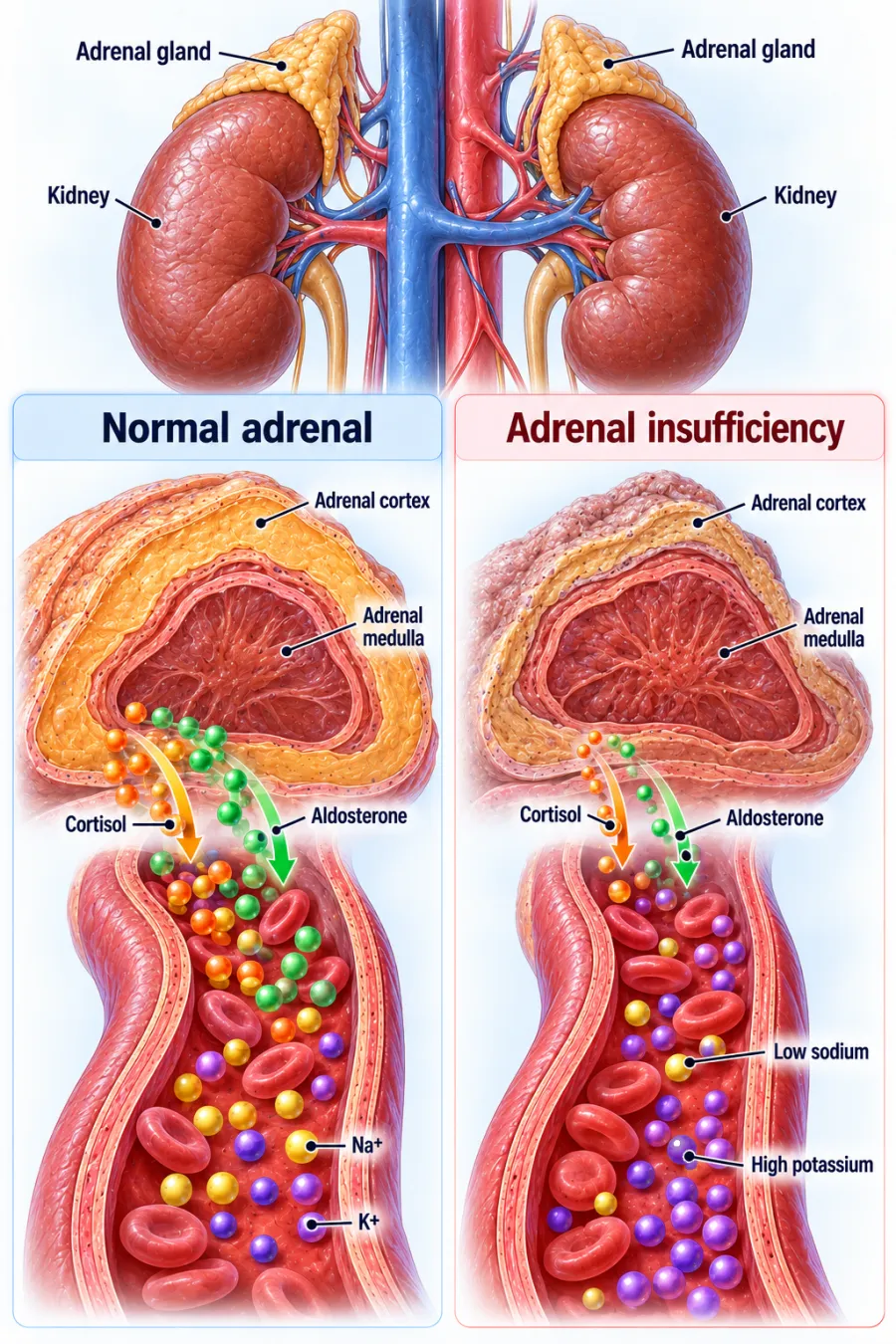
Cortisol deficiency impairs stress response and glucose regulation, while aldosterone deficiency causes sodium loss and potassium retention. Memory aid: it is essentially the opposite of Cushing syndrome, with hyperpigmentation ('bronzing') as a classic primary sign. Abrupt steroid withdrawal or stress can trigger life-threatening Addisonian crisis.
Addison Disease (Adrenal Insufficiency) illustrated
Key points to remember
- Hallmark findings are fatigue, muscle weakness, weight loss, anorexia, nausea, and hypotension.
- Hyponatremia, hyperkalemia, and hypoglycemia result from aldosterone and cortisol deficiency.
- Bronze hyperpigmentation of the skin and mucous membranes is classic in primary disease.
- Salt craving, orthostatic hypotension, and dehydration are common.
- Stress, infection, surgery, or stopping steroids abruptly can precipitate Addisonian crisis with profound hypotension and shock.
Signs & symptoms
- Bronze skin hyperpigmentation
- Hypotension, wt loss, fatigue
- Salt craving, N/V, weakness
Nursing priorities
- Administer lifelong glucocorticoid and mineralocorticoid replacement as ordered, increasing the dose during physiologic stress.
- Monitor blood pressure (orthostatics), fluid status, electrolytes, and blood glucose closely.
- Provide a high-sodium diet as appropriate, and ensure adequate hydration.
- Reduce stressors and protect from infection; cluster care to conserve energy.
- Keep IV access, fluids, and IV hydrocortisone available for rapid treatment of crisis.
Labs & values
Patient teaching
- Take replacement hormones for life and never skip or stop doses; double or increase the dose during illness or stress as directed.
- Wear medical alert identification and carry an emergency injectable hydrocortisone kit.
- Report illness, vomiting, dizziness, or inability to keep medication down immediately.
Red flags: report now
- Severe hypotension, profound weakness, confusion, and shock signal Addisonian crisis, a life-threatening emergency.
- Never abruptly stop corticosteroid therapy, which can precipitate adrenal crisis.
- Report fever, vomiting, or any illness, as stress doses of steroids are needed immediately.
References
Clinical references for this topic