Onset is sudden, usually within minutes of exposure, and rapidly worsening.
Before you read
Test yourself first: 3 questions
Question 1 of 3
A nurse is reviewing care for a client recovering from anaphylaxis. Which finding indicates the client may be entering the biphasic (recurrent) phase and needs continued monitoring?
Answer: A. Anaphylaxis can have a biphasic reaction, with symptoms recurring hours after the initial event even without re-exposure. Returning respiratory difficulty such as wheezing, throat tightness, or hypotension signals recurrence and the need for continued observation and possible re-treatment with epinephrine.
Question 2 of 3
A client arrives in the emergency department with anaphylaxis after a bee sting. The nurse anticipates which medication as the priority treatment?
Answer: B. Epinephrine is the first-line treatment for anaphylaxis. It reverses bronchospasm, vasodilation, and angioedema through alpha and beta adrenergic effects. Antihistamines and corticosteroids are adjuncts that act more slowly and do not replace epinephrine for the acute airway and circulatory threat.
Question 3 of 3
A client receiving a new IV antibiotic suddenly develops wheezing, hypotension, and swelling. The nurse anticipates administering:
Answer: B. Anaphylaxis is treated with epinephrine first (IM), plus stopping the drug, maintaining the airway, oxygen, IV fluids, and antihistamines/corticosteroids as adjuncts. Epinephrine is the priority drug.
Keep the streak going with more questions like these, each with a full rationale.
What is anaphylaxis?
It can progress to airway obstruction and distributive (anaphylactic) shock within minutes and is a true emergency. Common triggers include foods (peanuts, shellfish), insect stings, latex, contrast dye, and medications (especially penicillins). Epinephrine is the first-line, life-saving treatment, addressing both airway and circulation.
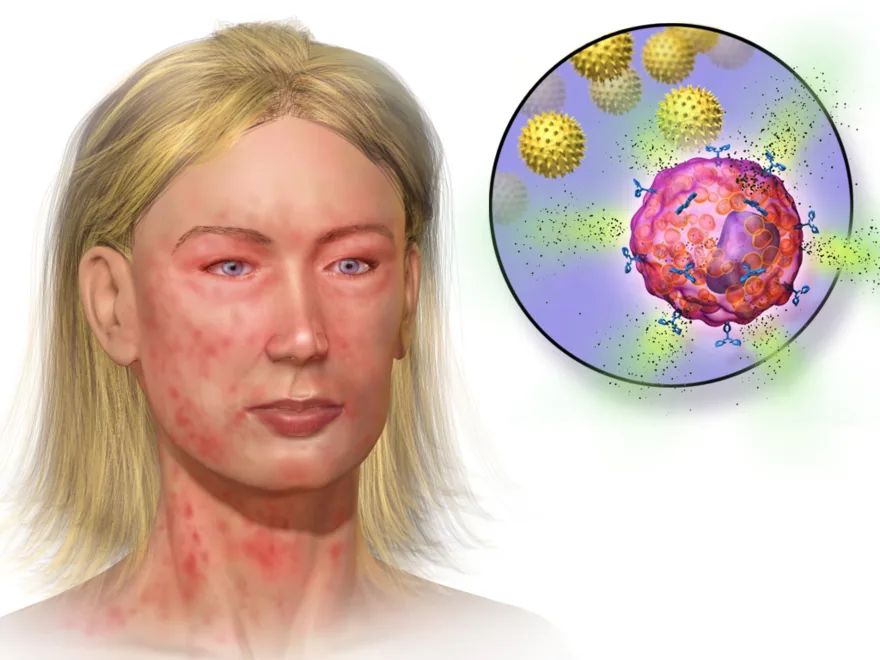
Anaphylaxis illustrated
Key points to remember
- Onset is sudden, usually within minutes of exposure, and rapidly worsening.
- Airway and breathing signs include throat tightness, stridor, hoarseness, wheezing, and dyspnea.
- Circulatory signs include hypotension, tachycardia, dizziness, and impending sense of doom from vasodilation.
- Skin signs include urticaria (hives), flushing, pruritus, and angioedema of the lips, tongue, and face.
- GI symptoms such as cramping, nausea, vomiting, and diarrhea may accompany the reaction.
- A biphasic reaction can recur hours later, so observation after stabilization is required.
- The faster the reaction starts after exposure, the more severe it tends to be.
Signs & symptoms
- Stridor, wheeze, throat swelling
- Hypotension, tachycardia, shock
- Hives, angioedema, anxiety
Nursing priorities
- Stop the offending allergen or infusion immediately and call for help.
- Administer intramuscular epinephrine into the lateral thigh without delay; this is the priority drug.
- Maintain a patent airway, give high-flow oxygen, and prepare for possible intubation.
- Establish IV access and give rapid isotonic fluids for hypotension; lay the patient flat with legs elevated unless dyspneic.
- Give adjuncts as ordered (antihistamines, corticosteroids, bronchodilators) and monitor continuously.
Labs & values
Patient teaching
- Carry two epinephrine auto-injectors at all times and use one into the outer thigh at the first sign of a severe reaction, then call emergency services.
- Always seek emergency care after using epinephrine because a second-phase reaction can occur.
- Strictly avoid the known trigger, read food and product labels, and wear a medical-alert bracelet.
- Inject the auto-injector into the outer thigh (through clothing if needed), hold it as the device instructs, then call 911 even if you feel better.
Red flags: report now
- Stridor, hoarseness, or tongue/lip swelling signals impending airway loss; act and escalate now.
- Hypotension with weak pulse indicates anaphylactic shock requiring immediate epinephrine and fluids.
- Never delay epinephrine to give antihistamines or steroids first; epinephrine is always first.
- Watch for a biphasic recurrence and keep the patient under observation even after improvement.
References
Clinical references for this topic