Syncope or near-fainting on exertion signals critical obstruction — report immediately.
Before you read
Test yourself first: 3 questions
Question 1 of 3
A nurse is caring for a client with aortic stenosis. Which classic triad of symptoms should the nurse monitor for?
Answer: B. The classic triad of symptomatic aortic stenosis is angina, syncope (especially exertional), and exertional dyspnea from heart failure. The narrowed valve obstructs left ventricular outflow, limiting cardiac output. Fever, productive cough, and peripheral cyanosis at rest are not the defining triad.
Question 2 of 3
A nurse auscultates a high-pitched, blowing systolic murmur heard best at the apex and radiating to the axilla in a client. This finding is MOST consistent with which valvular disorder?
Answer: B. Mitral regurgitation produces a holosystolic, blowing murmur heard best at the apex (fifth intercostal space, midclavicular line) that radiates to the left axilla. Aortic stenosis is a systolic murmur at the right second intercostal space radiating to the carotids; mitral stenosis and aortic regurgitation are diastolic murmurs.
Question 3 of 3
A nurse suspects coarctation of the aorta in an infant. Which classic assessment finding supports this diagnosis?
Answer: B. Coarctation of the aorta produces higher blood pressure and bounding pulses in the upper extremities with lower blood pressure and weak or absent femoral (lower extremity) pulses due to the narrowing distal to the aortic arch.
Keep the streak going with more questions like these, each with a full rationale.
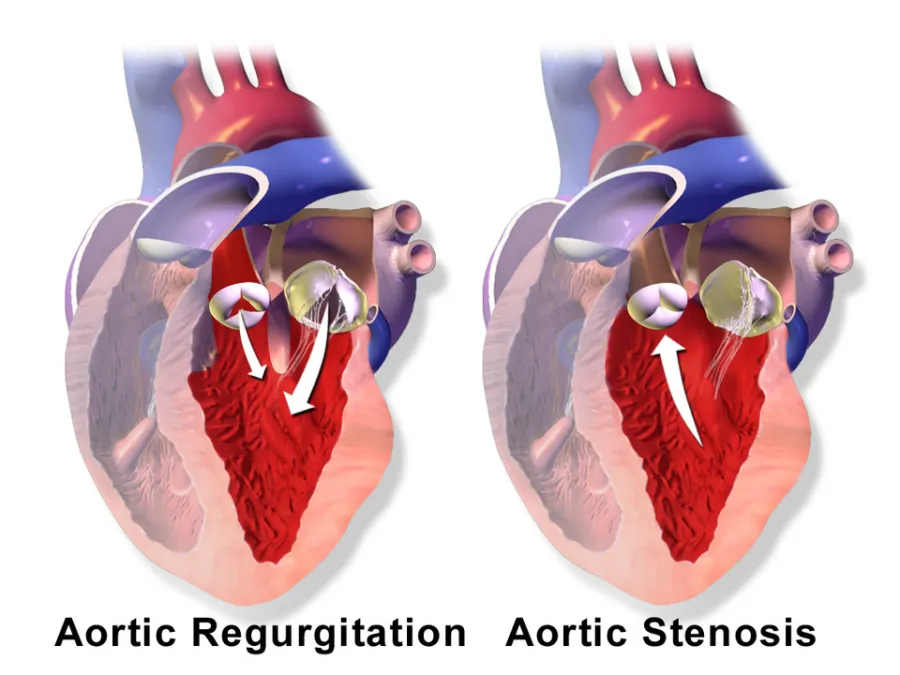
What is aortic stenosis?
Causes include age-related calcification, congenital bicuspid valve, and rheumatic disease. The classic symptom triad is angina, syncope, and exertional dyspnea (heart failure).
Aortic Stenosis illustrated
Key points to remember
- Classic triad: angina, syncope (especially on exertion), and dyspnea/heart failure.
- Produces a harsh systolic crescendo-decrescendo murmur radiating to the carotids.
- Left ventricular hypertrophy develops as the heart pumps against the obstruction.
- Symptomatic aortic stenosis carries a poor prognosis without valve replacement.
- Treatment is surgical valve replacement or transcatheter aortic valve replacement (TAVR).
- Avoid drugs that drop preload/afterload (nitrates, diuretics, vasodilators) as they can cause dangerous hypotension and syncope.
Signs & symptoms
- Angina, syncope, exertional dyspnea
- Systolic crescendo murmur
- Narrow pulse pressure
Nursing priorities
- Monitor for syncope, exertional chest pain, and signs of heart failure.
- Use caution with vasodilators, nitrates, and diuretics that can precipitate severe hypotension.
- Assess for the characteristic systolic murmur and monitor blood pressure closely.
- Pace activity to avoid exertion-triggered syncope or angina.
- Provide pre/postoperative care for valve replacement or TAVR and monitor for arrhythmias.
Patient teaching
- Avoid strenuous exertion and report fainting, chest pain, or worsening shortness of breath.
- Do not take nitroglycerin or other vasodilators unless specifically prescribed for this condition.
- Inform providers of valve disease before dental or invasive procedures.
- Change positions slowly to prevent fainting and avoid dehydration.
Red flags: report now
- Syncope or near-fainting on exertion signals critical obstruction — report immediately.
- Sudden severe hypotension after nitrates or vasodilators is dangerous in aortic stenosis.
- New chest pain or signs of acute heart failure (severe dyspnea, crackles) require urgent evaluation.
References
Clinical references for this topic