Refractory hypoxemia that does not respond to increasing oxygen is the defining feature.
Before you read
Test yourself first: 3 questions
Question 1 of 3
A client with a stroke has expressive (Broca's) aphasia. Which communication approach is most appropriate?
Answer: B. In expressive aphasia, comprehension is largely intact but the client struggles to produce speech. Allowing extra time, using yes/no questions, and offering communication boards supports the client without frustration.
Question 2 of 3
A chest x-ray of a client with suspected ARDS is reviewed. Which finding is most consistent with this diagnosis?
Answer: B. ARDS produces diffuse bilateral infiltrates often described as a white-out or ground-glass appearance, reflecting widespread alveolar flooding. A unilateral lobar consolidation suggests pneumonia, and a deviated trachea suggests tension pneumothorax.
Question 3 of 3
A client with ARDS on positive end-expiratory pressure (PEEP) suddenly develops a drop in blood pressure and decreased breath sounds on one side. Which complication should the nurse suspect?
Answer: A. High levels of PEEP can cause barotrauma leading to a tension pneumothorax, which presents with sudden hypotension, unilateral absent breath sounds, and decreased venous return. This is an emergency requiring immediate intervention.
Keep the streak going with more questions like these, each with a full rationale.
What is ards?
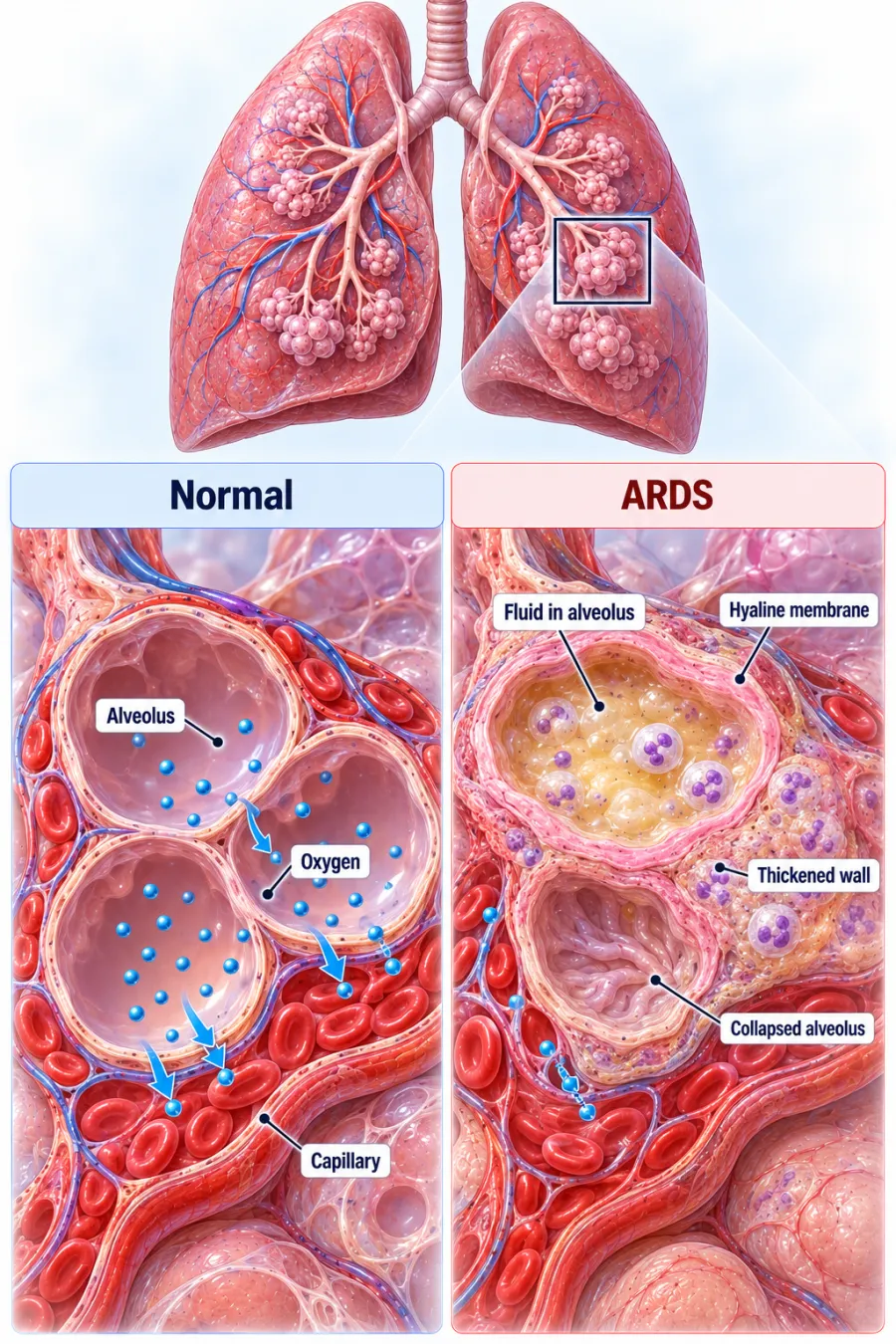
It develops 12 to 48 hours after an insult such as sepsis, aspiration, trauma, or pancreatitis. The hallmark is hypoxemia that does not improve with supplemental oxygen.
ARDS illustrated
Key points to remember
- Refractory hypoxemia that does not respond to increasing oxygen is the defining feature.
- Severe dyspnea, tachypnea, and use of accessory muscles develop rapidly.
- Chest x-ray shows bilateral diffuse white-out infiltrates with no cardiac cause.
- Decreased lung compliance makes the lungs stiff and hard to ventilate.
- Pulmonary capillary wedge pressure is normal or low, distinguishing it from cardiogenic pulmonary edema.
- ARDS commonly progresses to multi-organ dysfunction and carries high mortality.
Common causes
- Sepsis, aspiration, trauma
Signs & symptoms
- Severe dyspnea, ↓ O₂ despite O₂
- Tachypnea, retractions, anxiety
- Bilateral infiltrates (white-out)
Nursing priorities
- Support oxygenation and prepare for intubation and mechanical ventilation with PEEP.
- Use low tidal volume lung-protective ventilation to prevent further barotrauma.
- Consider prone positioning to improve oxygenation and ventilation-perfusion matching.
- Treat the underlying cause, such as sepsis or aspiration, aggressively.
- Monitor ABGs, hemodynamics, and oxygenation continuously, and provide sedation as needed.
Labs & values
Red flags: report now
- Worsening hypoxemia despite high FiO2 and PEEP indicates deterioration toward failure.
- Sudden drop in oxygen saturation or chest asymmetry on a ventilator may signal pneumothorax from barotrauma.
- Signs of multi-organ failure (oliguria, hypotension, altered mentation) require immediate escalation.
References
Clinical references for this topic