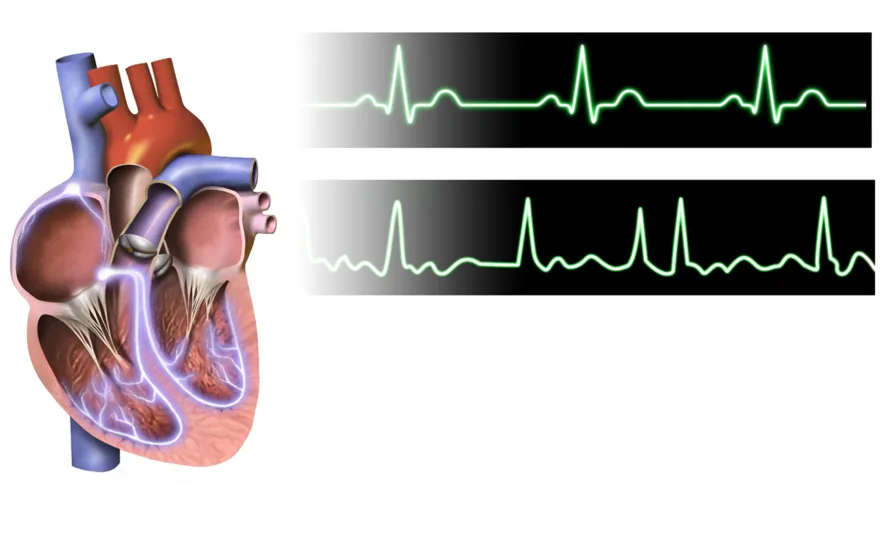
The hallmark is an irregularly irregular pulse with no identifiable P waves on the ECG.
Before you read
Test yourself first: 5 questions
Question 1 of 5
A nurse is preparing to assist with synchronized cardioversion. Which statement correctly distinguishes synchronized cardioversion from defibrillation?
Answer: B. Synchronized cardioversion delivers the shock in time with the R wave of the QRS to avoid the vulnerable T-wave (relative refractory) period, which could trigger ventricular fibrillation; it is used for unstable rhythms that have a pulse, such as unstable SVT or atrial fibrillation. Defibrillation delivers an unsynchronized shock and is used for pulseless rhythms like ventricular fibrillation and pulseless ventricular tachycardia.
Question 2 of 5
A client in stable atrial fibrillation with a rapid ventricular response is scheduled for synchronized cardioversion. Which nursing action is essential before the procedure when the rhythm has been present more than 48 hours?
Answer: B. When atrial fibrillation has persisted longer than 48 hours, atrial clots may form. Cardioverting can dislodge a clot and cause an embolic stroke, so the client should be anticoagulated, commonly for several weeks, or have a transesophageal echocardiogram to rule out clot before elective cardioversion. Stopping all anticoagulants, keeping NPO for a week, or omitting sedation are incorrect or unsafe.
Question 3 of 5
A client with atrial fibrillation is started on warfarin. Which laboratory test does the nurse use to monitor the therapeutic effect of this medication?
Answer: B. Warfarin works by inhibiting vitamin K-dependent clotting factors, and its effect is monitored with the prothrombin time reported as the INR (international normalized ratio). For atrial fibrillation the target INR is generally 2 to 3. The aPTT monitors heparin, while platelet count and hemoglobin do not gauge warfarin's anticoagulant effect.
Question 4 of 5
A client is in pulseless ventricular tachycardia. According to advanced cardiac life support principles, which intervention is the immediate priority?
Answer: B. Pulseless ventricular tachycardia, like ventricular fibrillation, is a shockable rhythm. The immediate priority is high-quality CPR and defibrillation as soon as a defibrillator is available; antidysrhythmics such as amiodarone and vasopressors such as epinephrine are given during resuscitation but follow the start of CPR and defibrillation. Synchronized cardioversion is not used for a pulseless rhythm.
Question 5 of 5
During an adult cardiac arrest, the rhythm shows ventricular fibrillation. What is the most appropriate immediate intervention?
Answer: B. Ventricular fibrillation is a shockable rhythm. Defibrillation is the definitive treatment and should be delivered as soon as the defibrillator is available, with CPR resumed immediately afterward. Antiarrhythmics and epinephrine are adjuncts given during ongoing resuscitation, not the first action for VF.
Keep the streak going with more questions like these, each with a full rationale.
What is atrial fibrillation?
Because blood pools and stagnates in the fibrillating atria, clots form and can travel to the brain, making stroke the major danger. The loss of the atrial kick reduces cardiac output and may cause fatigue, palpitations, and heart failure.
Atrial Fibrillation illustrated
Key points to remember
- The hallmark is an irregularly irregular pulse with no identifiable P waves on the ECG.
- Blood stasis in the left atrium promotes thrombus formation, greatly increasing the risk of embolic stroke.
- A rapid ventricular response can decrease cardiac output, causing hypotension, dizziness, and dyspnea.
- Common causes include hypertension, heart failure, valvular disease, hyperthyroidism, and ischemic heart disease.
- Management focuses on rate control, rhythm control, and anticoagulation to prevent stroke.
Signs & symptoms
- Irregularly irregular pulse
- Palpitations, fatigue, SOB
- Apical-radial pulse deficit
Nursing priorities
- Assess apical heart rate, blood pressure, and signs of decreased perfusion, and place on continuous cardiac monitoring.
- Administer rate-control agents such as beta-blockers, calcium channel blockers, or digoxin as ordered.
- Administer anticoagulation as prescribed to prevent thromboembolic stroke.
- Prepare the patient for cardioversion if hemodynamically unstable, ensuring anticoagulation status is verified first.
- Monitor for signs of stroke and bleeding throughout treatment.
Labs & values
Patient teaching
- Take anticoagulants exactly as prescribed and never skip doses, as they prevent life-threatening strokes.
- Check the pulse daily and report a rate that is very fast, very slow, or newly irregular.
- Avoid excess caffeine and alcohol, watch for bleeding signs, and keep all follow-up and lab appointments.
Red flags: report now
- New onset of stroke symptoms such as facial droop, slurred speech, or one-sided weakness requires immediate action.
- Hemodynamic instability with hypotension, chest pain, or syncope demands urgent intervention or cardioversion.
- Signs of bleeding from anticoagulation such as black stools, hematuria, or severe headache must be reported immediately.
References
Clinical references for this topic