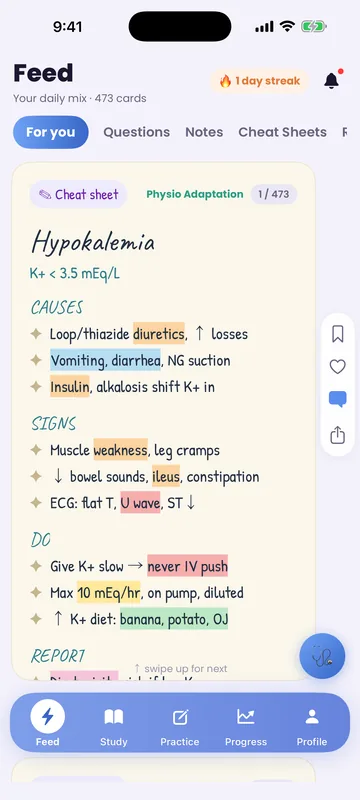
Potassium has a narrow range; both high and low levels cause dangerous cardiac dysrhythmias.
Before you read
Test yourself first: 3 questions
Question 1 of 3
The nurse is interpreting the metabolic component of an arterial blood gas. Which laboratory value reflects the metabolic, or renal, portion of acid-base balance?
Answer: A. The bicarbonate (HCO3), normally 22-26 mEq/L, reflects the metabolic and renal component of acid-base balance. The PaCO2 reflects the respiratory component, while pH is the overall balance and PaO2 reflects oxygenation rather than acid-base status.
Question 2 of 3
Thirty minutes after general anesthesia, a client suddenly develops a temperature of 104 F, muscle rigidity, tachycardia, and an elevated end-tidal carbon dioxide. The nurse recognizes these as signs of which life-threatening complication?
Answer: A. Malignant hyperthermia is a rare, life-threatening hypermetabolic reaction triggered by certain inhaled anesthetics and succinylcholine. Hallmark signs include rapidly rising end-tidal CO2, muscle rigidity (often masseter), tachycardia, and a late but dramatic rise in temperature. Dantrolene is the antidote.
Question 3 of 3
A nurse is caring for a client in the progressive stage of shock. Which finding indicates the shock is worsening?
Answer: A. In the progressive stage, compensatory mechanisms fail and organ hypoperfusion advances. A falling level of consciousness reflects cerebral hypoperfusion, and metabolic acidosis develops from anaerobic metabolism and lactate accumulation. These are hallmark signs that shock is progressing.
Keep the streak going with more questions like these, each with a full rationale.
What is basic metabolic panel?
Potassium is the most dangerous electrolyte because abnormal levels cause life-threatening cardiac arrhythmias. The panel guides hydration, medication safety, and renal monitoring.
Key points to remember
- Potassium has a narrow range; both high and low levels cause dangerous cardiac dysrhythmias.
- Sodium reflects fluid balance, and rapid correction of sodium can cause neurologic harm.
- Hyperkalemia produces peaked T waves, while hypokalemia produces flattened T waves and U waves.
- Elevated BUN and creatinine indicate impaired kidney function or dehydration.
- Calcium and magnesium, when included on the panel, also affect cardiac and neuromuscular function.
- Glucose abnormalities on the BMP can signal diabetes, stress response, or critical hypoglycemia.
Nursing priorities
- Place the patient on cardiac monitoring when potassium is critically high or low.
- Verify the prescribed potassium replacement is given correctly and never as an IV push.
- Assess hydration, intake and output, and weight when sodium or BUN is abnormal.
- Hold potassium-raising drugs and notify the provider when hyperkalemia is present.
- Recheck a suspiciously high potassium for hemolysis before acting on a non-emergent result.
Labs & values
Patient teaching
- Follow prescribed dietary sodium and potassium limits, especially with kidney or heart conditions.
- Report muscle weakness, cramping, palpitations, or confusion, which can signal electrolyte shifts.
Red flags: report now
- Potassium above 6.0 or below 2.5 mEq/L is a cardiac emergency requiring immediate action.
- Never administer IV potassium by rapid push or bolus; it can cause fatal arrhythmia.
- Sodium below 120 mEq/L raises seizure risk and demands urgent reporting.
References
Clinical references for this topic