Acute inability to void with a distended, painful bladder - urinary retention emergency; report and catheterize.
Before you read
Test yourself first: 3 questions
Question 1 of 3
A client is admitted with suspected postrenal acute kidney injury. Which condition is the most likely cause?
Answer: A. Postrenal AKI results from obstruction of urine flow distal to the kidneys, such as benign prostatic hyperplasia, ureteral or bladder stones, or tumors. Relieving the obstruction can restore renal function if treated promptly.
Question 2 of 3
A client with benign prostatic hyperplasia (BPH) reports difficulty starting urination, a weak stream, and a sensation of incomplete emptying. The nurse recognizes the client is at increased risk for which complication?
Answer: A. BPH obstructs the bladder outlet, causing urinary retention. Retained, stagnant urine promotes bacterial growth and urinary tract infection, and back-pressure can lead to hydronephrosis and renal impairment over time. The presentation does not indicate dehydration, diabetes insipidus, or hyperkalemia from the obstruction itself.
Question 3 of 3
A client with a stroke affecting the brainstem is at high risk for which life-threatening complication the nurse should monitor closely?
Answer: A. The brainstem controls vital functions including respiration, heart rate, and the gag and swallow reflexes. A brainstem stroke places the client at high risk for respiratory failure and airway compromise, so the nurse closely monitors respiratory status and protects the airway. Expressive aphasia and contralateral arm weakness relate to cerebral cortex injury, and gingival hyperplasia is a phenytoin effect.
Keep the streak going with more questions like these, each with a full rationale.
What is benign prostatic hyperplasia?
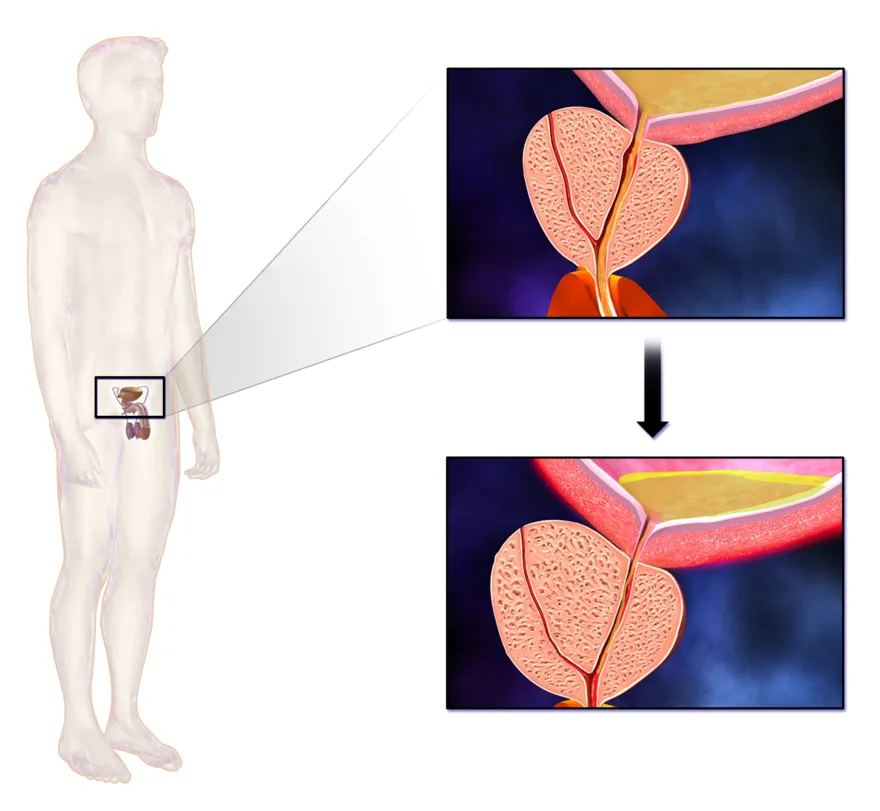
The enlarged gland compresses the urethra, obstructing urine flow from the bladder. It matters because chronic obstruction can lead to urinary retention, recurrent infections, bladder distention, and kidney damage. It is not cancer, but symptoms overlap and PSA may be checked.
Benign Prostatic Hyperplasia illustrated
Key points to remember
- Obstructive symptoms include weak/hesitant stream, dribbling, incomplete emptying, and straining to void.
- Irritative symptoms include urinary frequency, urgency, and nocturia.
- Urinary retention with bladder distention can develop, causing overflow incontinence.
- Stasis of urine increases the risk of UTIs and bladder stones.
- Chronic backup of urine can cause hydronephrosis and renal impairment.
- Digital rectal exam reveals a smooth, firm, enlarged prostate.
Signs & symptoms
- weak stream, hesitancy, dribbling
- frequency, nocturia, urgency
- retention, incomplete emptying
Nursing priorities
- Assess for urinary retention - palpate/scan for bladder distention and monitor output.
- Catheterize for acute retention as ordered, releasing urine gradually if extreme distention.
- Administer alpha-blockers (relax muscle, e.g., tamsulosin) and 5-alpha-reductase inhibitors (shrink gland, e.g., finasteride) as prescribed.
- Encourage scheduled voiding and adequate fluids; monitor post-void residuals.
- Post-prostatectomy/TURP: maintain continuous bladder irrigation and monitor output color.
Labs & values
Patient teaching
- Avoid bladder irritants (caffeine, alcohol) and decongestants/anticholinergics that worsen retention.
- Finasteride takes months to work and can lower PSA; alpha-blockers can cause dizziness, so change positions slowly.
- Void on a schedule, do not delay urinating, and report inability to urinate immediately.
Red flags: report now
- Acute inability to void with a distended, painful bladder - urinary retention emergency; report and catheterize.
- After TURP, bright red bloody outflow with clots or sudden decreased irrigation outflow - report immediately.
- Signs of obstruction causing renal impairment (decreasing output, rising creatinine) - escalate.
- Tamsulosin can cause orthostatic hypotension - take fall precautions.
References
Clinical references for this topic