Small bowel obstruction causes high-pitched hyperactive bowel sounds early, then absent sounds; large bowel obstruction causes gradual onset with marked distention.
Before you read
Test yourself first: 5 questions
Question 1 of 5
A client has a small bowel obstruction. Which set of findings does the nurse most expect?
Answer: B. A small bowel obstruction classically produces colicky abdominal pain, abdominal distention, and copious vomiting that may become bilious; high-pitched or absent bowel sounds and obstipation also occur. Bloody diarrhea suggests inflammatory bowel disease or ischemia, not mechanical obstruction. A soft, nontender abdomen and increased flatus are inconsistent with obstruction, where gas and stool cannot pass.
Question 2 of 5
A client with a bowel obstruction has a nasogastric tube to decompress the stomach. The nurse evaluates effectiveness by:
Answer: B. NG decompression should relieve distention and vomiting — assess for decreased abdominal distention, return of bowel sounds, and decreased nausea/vomiting, and ensure tube patency. Increasing distention suggests obstruction/tube problems.
Question 3 of 5
A nurse notes a newborn has not passed meconium 26 hours after birth and has a distended abdomen with bilious vomiting. What does the nurse suspect?
Answer: A. Failure to pass meconium within 24 to 48 hours, abdominal distension, and bilious vomiting suggest a bowel obstruction such as Hirschsprung disease or meconium ileus. This requires prompt evaluation. Most healthy newborns pass meconium within 24 to 48 hours.
Question 4 of 5
A nurse is teaching a client about the expected output from a newly created sigmoid (descending) colostomy. Which description of the stool is accurate for this location?
Answer: B. A sigmoid or descending colostomy is the most distal colostomy, so water has been reabsorbed and the stool is formed/solid, similar to normal bowel movements. The more proximal the ostomy, the more liquid the output: an ileostomy produces liquid-to-pasty output, and an ascending colostomy produces semiliquid output.
Question 5 of 5
A nurse observes a newborn's first stool, which is greenish-black, sticky, and tarry. How does the nurse interpret this finding?
Answer: B. Meconium, the first stool, is sticky, tarry, and greenish-black and is normally passed within 24-48 hours of birth. Failure to pass meconium within 48 hours may indicate an obstruction such as imperforate anus or Hirschsprung disease. Stools then transition to greenish (transitional) and finally to yellow milk stools.
Keep the streak going with more questions like these, each with a full rationale.
What is bowel obstruction?
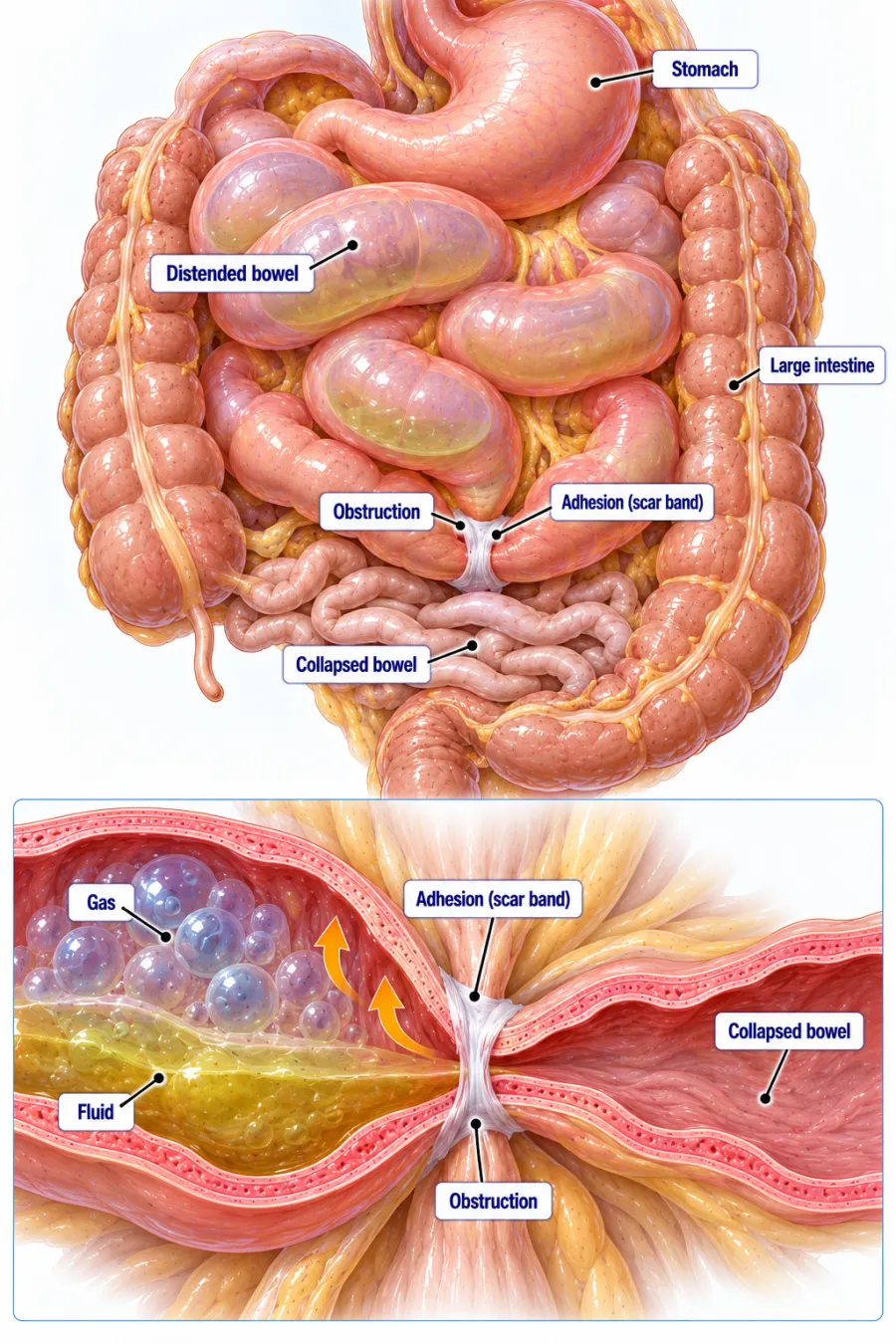
Mechanical causes include adhesions (most common in small bowel), hernias, tumors, and volvulus; functional causes (paralytic ileus) involve loss of peristalsis. Obstruction causes fluid and gas to accumulate, leading to distention, vomiting, and fluid/electrolyte loss. Untreated, it can progress to bowel ischemia and perforation.
Bowel Obstruction illustrated
Key points to remember
- Small bowel obstruction causes high-pitched hyperactive bowel sounds early, then absent sounds; large bowel obstruction causes gradual onset with marked distention.
- Vomiting is early and may be projectile in small bowel obstruction; vomiting (sometimes fecal-smelling) is late in large bowel obstruction.
- Abdominal distention, cramping pain, and failure to pass stool or flatus (obstipation) are key signs.
- Fluid and electrolyte imbalances develop from vomiting and third-spacing, risking hypovolemia and metabolic alkalosis (high) or acidosis (low).
- Adhesions from prior surgery are the most common cause of small bowel obstruction.
- Paralytic ileus produces absent bowel sounds without a mechanical block, often after surgery or with opioids.
Signs & symptoms
- NO stool/flatus, distension
- small bowel: ↑pitched then absent
- vomiting (fecal if low), cramping
Nursing priorities
- Keep the patient NPO and insert an NG tube for gastric decompression as ordered.
- Administer IV fluids and replace electrolytes to correct losses.
- Monitor bowel sounds, abdominal girth, NG output, and intake/output.
- Assess for signs of strangulation/ischemia such as fever, tachycardia, and worsening pain.
- Prepare for surgery if the obstruction is complete or strangulated.
Labs & values
Patient teaching
- Report inability to pass stool or gas, persistent vomiting, or worsening distention.
- After abdominal surgery, follow guidance to promote early ambulation and prevent ileus.
- Maintain adequate hydration and fiber to reduce recurrent obstruction risk where appropriate.
Red flags: report now
- Sudden severe constant pain, fever, and tachycardia suggest strangulation or perforation requiring emergency surgery.
- Signs of peritonitis (rigid abdomen, rebound tenderness) must be reported immediately.
- Marked hypovolemia or shock from fluid loss requires urgent fluid resuscitation.
References
Clinical references for this topic