
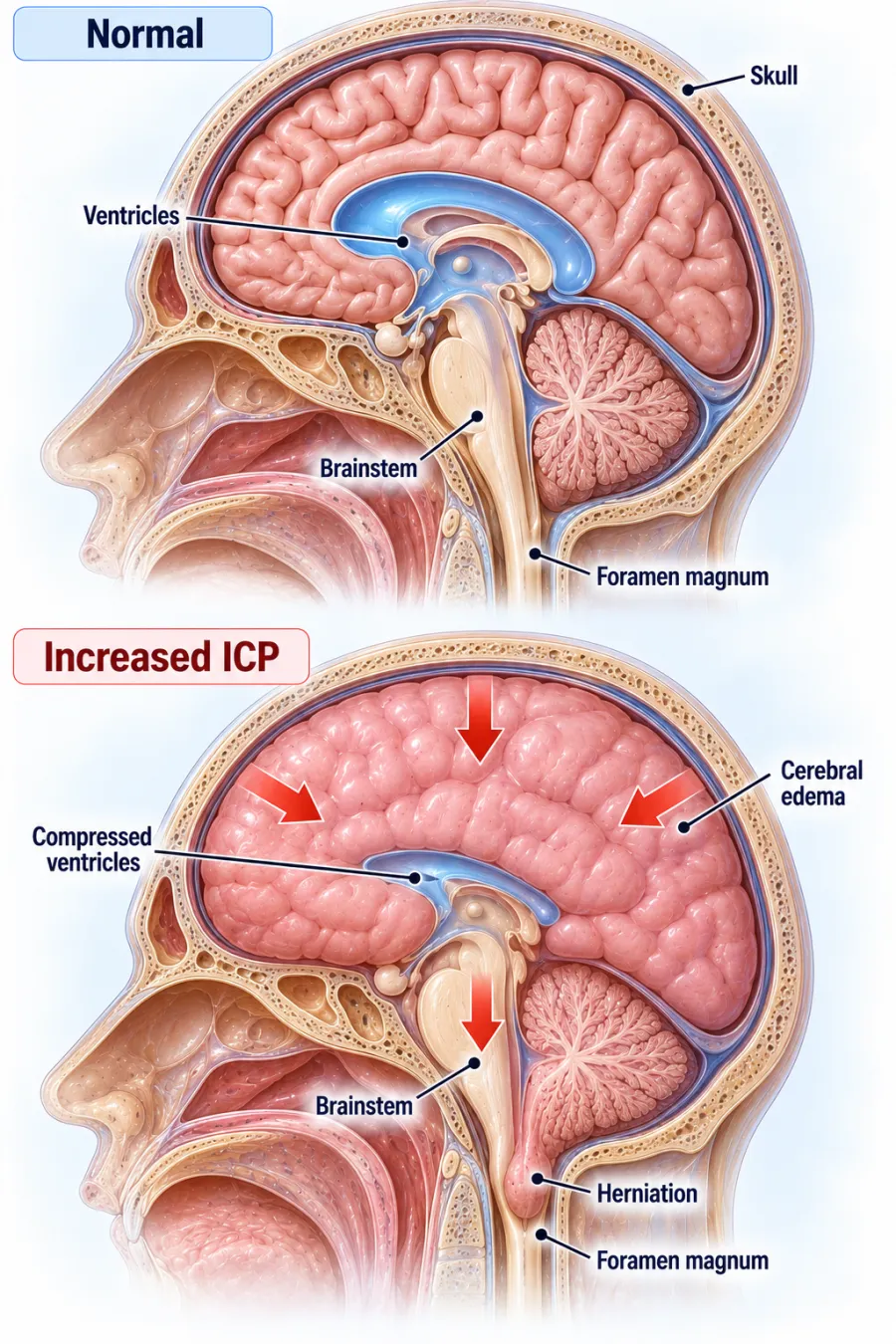
Symptoms result from increased intracranial pressure and local compression: headache classically worse in the morning or with coughing/straining, projectile vomiting, and papilledema.
Before you read
Test yourself first: 3 questions
Question 1 of 3
A client with a traumatic brain injury is being monitored for increased intracranial pressure (ICP). Which value indicates a normal adult ICP?
Answer: A. Normal adult ICP is 5 to 15 mm Hg (often cited as 5-15, with up to 20 transiently tolerated). Sustained pressures above 20 mm Hg require treatment. Values of 25 and 30 are clearly elevated; a negative value is not physiologic for a supine adult.
Question 2 of 3
A nurse documents that a client exhibits decorticate posturing. How should the nurse describe this finding?
Answer: B. Decorticate posturing is flexion of the arms toward the core (toward the cord) with extension of the legs, indicating damage to the corticospinal tracts above the brainstem.
Question 3 of 3
A nurse evaluates a client 1 hour after starting an IV insulin infusion for DKA. The blood glucose has dropped from 520 to 250 mg/dL. The nurse recognizes that lowering glucose too rapidly increases the risk of which complication?
Answer: A. Excessively rapid correction of blood glucose and serum osmolality in DKA, especially in younger clients, increases the risk of cerebral edema due to fluid shifts into the brain. Glucose is therefore lowered gradually, generally no faster than about 50 to 75 mg/dL per hour, and dextrose is added once glucose nears 200 to 250 mg/dL.
Keep the streak going with more questions like these, each with a full rationale.
What is brain tumor?
Because the skull is a fixed space, an enlarging tumor raises intracranial pressure and compresses surrounding tissue, producing symptoms based on its location. Common features include a new or worsening headache (often worse in the morning), seizures, vomiting, and progressive focal neurologic deficits. Treatment may combine surgery, radiation, and chemotherapy.
Brain Tumor illustrated
Key points to remember
- Symptoms result from increased intracranial pressure and local compression: headache classically worse in the morning or with coughing/straining, projectile vomiting, and papilledema.
- New-onset seizures, progressive focal deficits, personality or cognitive changes, and visual disturbances are common presenting signs.
- Specific deficits map to tumor location (e.g., frontal lobe — personality changes; cerebellar — balance/coordination; occipital — vision).
- Diagnosis is confirmed with MRI with contrast; corticosteroids (dexamethasone) reduce peritumoral edema and ICP.
- Management may include surgical resection, radiation, and chemotherapy, with seizure prophylaxis as indicated.
Signs & symptoms
- Morning HA, worse w/ Valsalva
- Projectile vomiting (no nausea)
- Seizures, focal deficits
- Papilledema, vision/personality change
Nursing priorities
- Monitor neurologic status frequently and assess for rising intracranial pressure.
- Position with head of bed elevated about 30 degrees, head midline, and avoid activities that increase ICP (straining, coughing).
- Maintain seizure precautions and administer anticonvulsants and corticosteroids as ordered.
- Manage pain and nausea, and monitor for and address neurologic deficits affecting safety (vision, balance, swallowing).
- Provide emotional support and education regarding diagnosis, treatment options, and prognosis.
Labs & values
Patient teaching
- Report worsening headache, new vomiting, vision changes, weakness, or seizures promptly.
- Take corticosteroids and anticonvulsants exactly as prescribed and do not stop steroids abruptly.
- Avoid activities that raise intracranial pressure such as straining and heavy lifting.
- Understand the planned treatment (surgery, radiation, chemotherapy) and expected side effects.
- Use safety measures at home for any balance, vision, or weakness deficits and arrange support as needed.
Red flags: report now
- Decreasing level of consciousness, unequal/fixed pupils, widening pulse pressure with bradycardia (Cushing triad), or projectile vomiting indicating dangerously increased ICP and possible herniation — emergency.
- New or prolonged seizure activity (status epilepticus) or sudden severe worsening of deficits.
References
Clinical references for this topic

