Hoarseness, stridor, drooling, or increasing facial edema signals impending airway obstruction; intubate immediately.
Before you read
Test yourself first: 3 questions
Question 1 of 3
An adult client has burns over the entire anterior trunk and the entire anterior surface of both legs. Using the rule of nines, what total body surface area (TBSA) does the nurse estimate is burned?
Answer: C. By the rule of nines, the anterior trunk is 18% and each entire leg is 18% (anterior surface of one leg is 9%). Anterior trunk (18%) plus the anterior surfaces of both legs (9% + 9% = 18%) equals 36%. This estimate guides fluid resuscitation needs.
Question 2 of 3
A nurse is assessing a client who sustained a burn to the forearm. The area is red, painful, blanches with pressure, and has no blisters. How does the nurse classify this burn?
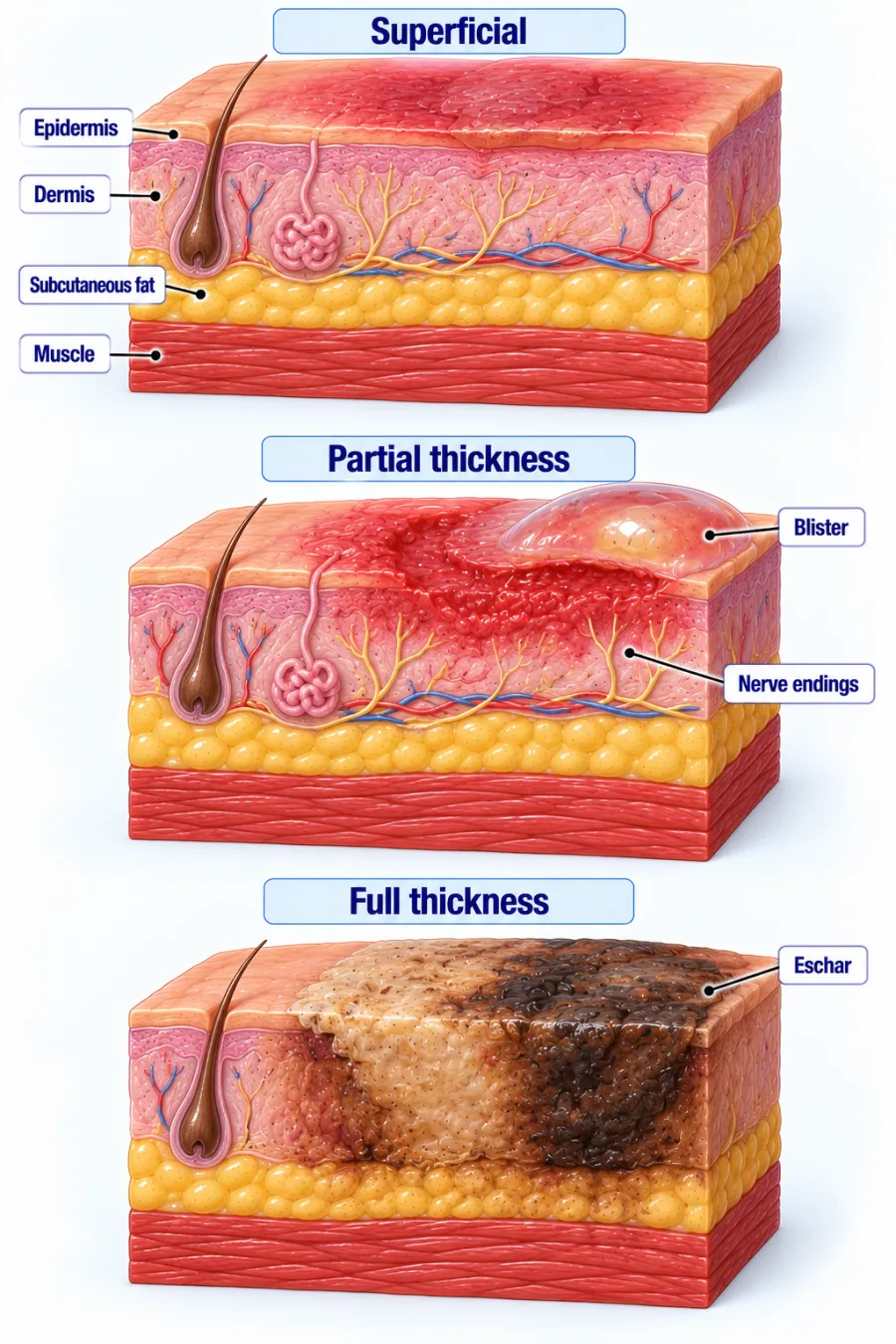
Answer: A. A superficial (first-degree) burn involves only the epidermis. It appears red and dry, blanches with pressure, is painful, and has no blisters. A superficial partial-thickness burn would have moist blisters. Deep partial-thickness and full-thickness burns extend into or through the dermis; full-thickness burns are often painless because nerve endings are destroyed.
Question 3 of 3
A nurse classifies a client's burn that is dry, white or charred, leathery, and painless. Which burn depth does this describe?
Answer: D. A full-thickness (third-degree) burn destroys the epidermis, dermis, and nerve endings, producing a dry, leathery, white, brown, or charred (eschar) surface that is PAINLESS in the center due to nerve destruction. Superficial and partial-thickness burns are painful; partial-thickness burns are moist and blistered.
Keep the streak going with more questions like these, each with a full rationale.
What is burns and rule of nines?
Severity is judged by depth (superficial, partial-thickness, full-thickness) and by the percent of total body surface area (TBSA) burned, estimated with the Rule of Nines. In adults the Rule of Nines assigns 9% to the head, 9% to each arm, 18% to each leg, 18% to the anterior trunk, 18% to the posterior trunk, and 1% to the perineum. The Parkland formula guides fluid resuscitation in the first 24 hours.
Burns and Rule of Nines illustrated
Key points to remember
- Rule of Nines (adult): head 9%, each arm 9%, each leg 18%, front trunk 18%, back trunk 18%, perineum 1%.
- The first 24 to 48 hours is the emergent (fluid shift) phase with capillary leak, third-spacing, and hypovolemic burn shock.
- Inhalation injury is suspected with facial burns, singed nasal hair, soot in mouth, hoarseness, or carbonaceous sputum.
- Full-thickness (third-degree) burns appear dry, leathery, white or charred, and are painless because nerve endings are destroyed.
- Circumferential burns to the chest or extremities can cause compartment syndrome and may require escharotomy.
- Parkland formula: 4 mL lactated Ringer's x kg x %TBSA; give half in the first 8 hours from time of injury.
Nursing priorities
- Assess and secure the airway first; anticipate early intubation if inhalation injury is present before edema closes the airway.
- Administer warmed lactated Ringer's per Parkland formula and titrate to urine output of 30 to 50 mL/hr (about 0.5 mL/kg/hr).
- Remove constricting clothing and jewelry; stop the burning process and cover wounds with clean dry dressings.
- Provide IV opioid analgesia (not IM or SubQ) because absorption is unreliable during fluid shifts.
- Maintain strict aseptic technique, protective isolation, and high-calorie high-protein nutrition to support healing.
Labs & values
Patient teaching
- Keep healed burn areas out of direct sun and use sunscreen; new skin burns easily.
- Perform range-of-motion exercises and wear pressure garments to prevent contractures and scarring.
- Report increasing redness, foul drainage, or fever as signs of wound infection.
Red flags: report now
- Hoarseness, stridor, drooling, or increasing facial edema signals impending airway obstruction; intubate immediately.
- Urine output below 30 mL/hr or rising specific gravity indicates inadequate fluid resuscitation; escalate now.
- Cherry-red skin or altered mental status suggests carbon monoxide poisoning; give 100% oxygen.
- Never apply ice to burns or give IM/SubQ medications; never break blisters at the bedside.
References
Clinical references for this topic