
Beck's triad of hypotension, muffled or distant heart sounds, and jugular venous distention is the classic sign.
Before you read
Test yourself first: 4 questions
Question 1 of 4
A client diagnosed with cardiac tamponade is being assessed by the nurse. Which classic finding (Beck triad) would the nurse expect?
Answer: B. Beck triad in cardiac tamponade is hypotension, muffled (distant) heart sounds, and jugular venous distention, caused by fluid in the pericardial sac compressing the heart and impairing filling. Hypertension, bounding pulses, and clear lung sounds with a loud S1 are not consistent with tamponade physiology.
Question 2 of 4
Cardiac tamponade is causing obstructive shock in a client. The nurse anticipates that definitive treatment will involve:
Answer: A. Cardiac tamponade compresses the heart with fluid in the pericardial sac, preventing adequate filling. Definitive treatment is pericardiocentesis to remove the fluid and relieve the obstruction. Fluids and vasopressors are temporizing; the mechanical cause must be corrected.
Question 3 of 4
A client involved in a motorcycle crash presents with hypotension, distended neck veins, muffled heart sounds, and pulsus paradoxus. The nurse recognizes these as signs of which condition?
Answer: A. Hypotension, jugular venous distention, and muffled heart sounds make up Beck triad, classic for cardiac tamponade. Pulsus paradoxus (an exaggerated drop in systolic pressure during inspiration) further supports tamponade. Pericardiocentesis is the emergency treatment.
Question 4 of 4
A client suddenly develops jugular venous distension, muffled heart sounds, and hypotension after blunt chest trauma. The nurse suspects what life-threatening condition?
Answer: A. Beck triad (jugular venous distension, muffled or distant heart sounds, and hypotension) indicates cardiac tamponade, in which fluid in the pericardial sac compresses the heart and reduces cardiac output.
Keep the streak going with more questions like these, each with a full rationale.
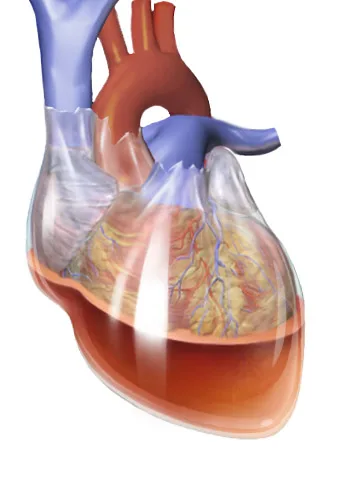
What is cardiac tamponade?
It can result from pericarditis, chest trauma, MI rupture, or cardiac procedures. The classic presentation is Beck's triad: hypotension, muffled heart sounds, and jugular venous distention.
Cardiac Tamponade illustrated
Key points to remember
- Beck's triad of hypotension, muffled or distant heart sounds, and jugular venous distention is the classic sign.
- Pulsus paradoxus, a drop in systolic blood pressure greater than 10 mmHg on inspiration, is a key finding.
- Compression prevents ventricular filling, causing a sharp fall in cardiac output and shock.
- Narrowed pulse pressure, tachycardia, and dyspnea accompany the falling cardiac output.
- Causes include pericarditis, blunt or penetrating chest trauma, MI, and cardiac surgery or catheterization.
Common causes
- Pericarditis, trauma, post-MI
- Post cardiac surgery
Signs & symptoms
- Beck's triad: ↓ BP, ↑ JVD, muffled
- Pulsus paradoxus
- Narrow pulse pressure, ↑ HR
Nursing priorities
- Recognize Beck's triad and pulsus paradoxus and notify the provider immediately as an emergency.
- Prepare the patient for emergency pericardiocentesis to remove the fluid.
- Administer IV fluids to temporarily support cardiac output while preparing for the procedure.
- Provide continuous hemodynamic and cardiac monitoring and maintain IV access.
- Have emergency and resuscitation equipment readily available.
Labs & values
Patient teaching
- After pericardiocentesis, report any return of shortness of breath, dizziness, or chest pressure immediately.
- Keep all follow-up appointments to monitor for fluid reaccumulation.
Red flags: report now
- Beck's triad with worsening hypotension is a true emergency requiring immediate pericardiocentesis.
- Rapidly falling blood pressure, narrowing pulse pressure, or loss of consciousness must be escalated immediately.
- Pulseless electrical activity can occur and requires immediate resuscitation.
References
Clinical references for this topic

