It results from pump failure, most commonly after a massive MI, but also from severe heart failure, dysrhythmias, or valve failure.
Before you read
Test yourself first: 5 questions
Question 1 of 5
A nurse is caring for a client with cardiogenic shock following a large myocardial infarction. Which assessment finding would the nurse expect?
Answer: A. Cardiogenic shock results from pump failure, so the heart cannot maintain output. Findings include hypotension, tachycardia, pulmonary congestion with crackles, jugular venous distention, and cool clammy skin. Clear lung sounds with a strong bounding pulse would not be expected when the heart is failing.
Question 2 of 5
A client is being treated for shock and the nurse notes the central venous pressure (CVP) is very low. Which type of shock is most consistent with a low CVP and the need for aggressive fluid resuscitation?
Answer: A. Hypovolemic shock is characterized by a low central venous pressure reflecting reduced circulating volume, and it responds to fluid resuscitation. Cardiogenic and obstructive shock typically present with an elevated CVP, and giving large fluid volumes in cardiogenic shock can worsen pulmonary edema.
Question 3 of 5
A client is admitted with cardiogenic shock following a large anterior myocardial infarction. Which assessment finding does the nurse expect?
Answer: A. Cardiogenic shock results from pump failure, so the heart cannot eject blood forward. Blood backs up into the pulmonary circulation, producing crackles, dyspnea, and jugular venous distention along with hypotension and a weak, thready pulse. Hypovolemic shock, by contrast, presents with flat neck veins.
Question 4 of 5
A client in cardiogenic shock has a blood pressure of 78/50 mm Hg and pulmonary congestion. Why must the nurse use caution with aggressive IV fluid boluses?
Answer: A. In cardiogenic shock the heart already cannot pump the existing volume forward, so aggressive fluids can worsen pulmonary edema. Fluids are given cautiously, if at all, while inotropes and afterload reduction address the pump problem. The risk is overloading a failing heart, not dehydration.
Question 5 of 5
A client with a suspected systemic infection has a temperature of 38.9 C (102 F), heart rate of 118 beats/min, blood pressure of 88/50 mm Hg, and warm, flushed skin. The nurse suspects which type of shock?
Answer: A. Septic shock is a distributive shock from systemic infection. In the early (warm/hyperdynamic) phase, vasodilation produces warm, flushed skin, fever, tachycardia, and hypotension. The infectious source and warm skin differentiate it from hypovolemic and cardiogenic shock.
Keep the streak going with more questions like these, each with a full rationale.
What is cardiogenic shock?
The failing pump causes a drop in cardiac output, poor tissue perfusion, and blood backing up into the lungs. It carries a high mortality, so the goal is to improve cardiac output and reduce the workload on the damaged heart.
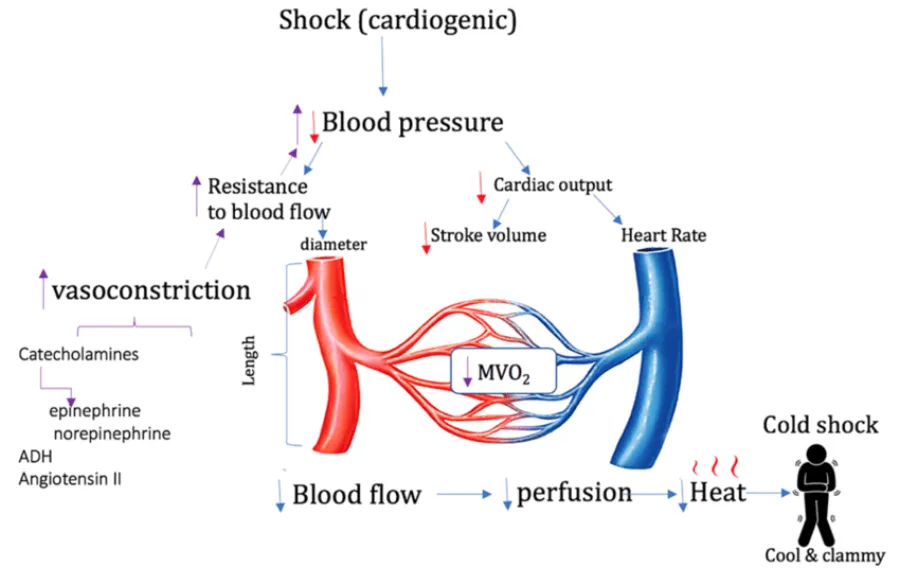
Cardiogenic Shock illustrated
Key points to remember
- It results from pump failure, most commonly after a massive MI, but also from severe heart failure, dysrhythmias, or valve failure.
- Signs include hypotension, tachycardia, cool clammy skin, weak pulses, and decreased urine output.
- Pulmonary congestion with crackles and dyspnea occurs as blood backs up into the lungs.
- Altered mental status and confusion reflect poor cerebral perfusion.
- Unlike hypovolemic shock, the problem is the pump itself, not low blood volume, so heart sounds and pressures reflect fluid overload.
Common causes
- MI #1, HF, dysrhythmias
Signs & symptoms
- ↓ BP, ↑ HR, weak pulse
- Cool clammy skin, mottled
- Crackles, ↓ urine, ↓ LOC
Nursing priorities
- Ensure airway, breathing, and oxygenation, providing supplemental oxygen and preparing for possible intubation.
- Administer inotropes such as dobutamine to improve contractility and vasopressors to support blood pressure as ordered.
- Administer diuretics and vasodilators cautiously to reduce preload and afterload as ordered.
- Provide continuous hemodynamic and cardiac monitoring and monitor urine output hourly.
- Prepare for advanced support such as intra-aortic balloon pump or revascularization.
Labs & values
Patient teaching
- Report chest pain, shortness of breath, or worsening symptoms immediately, as early treatment of MI prevents progression.
- After recovery, follow the prescribed cardiac medication, diet, and activity plan to protect heart function.
Red flags: report now
- Worsening hypotension, falling urine output, and deteriorating mental status indicate progressing shock requiring immediate action.
- New or worsening pulmonary edema with severe dyspnea and hypoxia is an emergency.
- Life-threatening dysrhythmias require immediate intervention.
References
Clinical references for this topic