Sudden severe 'worst headache of my life,' loss of consciousness, seizure, or new neuro deficit — possible rupture or rebleed; notify provider/activate emergency response immediately.
Before you read
Test yourself first: 4 questions
Question 1 of 4
A nurse is calculating cerebral perfusion pressure (CPP). The mean arterial pressure (MAP) is 90 mm Hg and the ICP is 20 mm Hg. What is the CPP, and how should the nurse interpret it?
Answer: A. CPP equals MAP minus ICP, so 90 minus 20 equals 70 mm Hg, which is within the normal target range of about 60 to 70 mm Hg or higher. A CPP below 50 to 60 risks cerebral ischemia. The other values are miscalculations.
Question 2 of 4
A nurse is monitoring a client for cerebral vasospasm, a complication that can occur several days after a subarachnoid hemorrhage. Which finding suggests vasospasm?
Answer: B. Cerebral vasospasm typically appears days after a subarachnoid hemorrhage and reduces cerebral blood flow, producing new or worsening neurologic deficits such as decreased level of consciousness or new focal weakness.
Question 3 of 4
A client is hyperventilated briefly to manage an acute rise in ICP. What is the physiologic rationale for this intervention?
Answer: A. Lowering PaCO2 through controlled hyperventilation causes cerebral vasoCONSTRICTION, which reduces cerebral blood volume and acutely lowers ICP. It is a short-term measure; excessive or prolonged hyperventilation can cause ischemia. Hyperventilation does not directly remove CSF or change sodium.
Question 4 of 4
A nurse caring for a client with increased ICP should avoid administering which type of intravenous fluid because it can worsen cerebral edema?
Answer: A. Hypotonic and dextrose-containing solutions such as D5W are avoided in increased ICP because, once the dextrose is metabolized, free water shifts into brain cells and worsens cerebral edema. Isotonic 0.9% sodium chloride is generally preferred, and hypertonic saline is used therapeutically to reduce edema.
Keep the streak going with more questions like these, each with a full rationale.
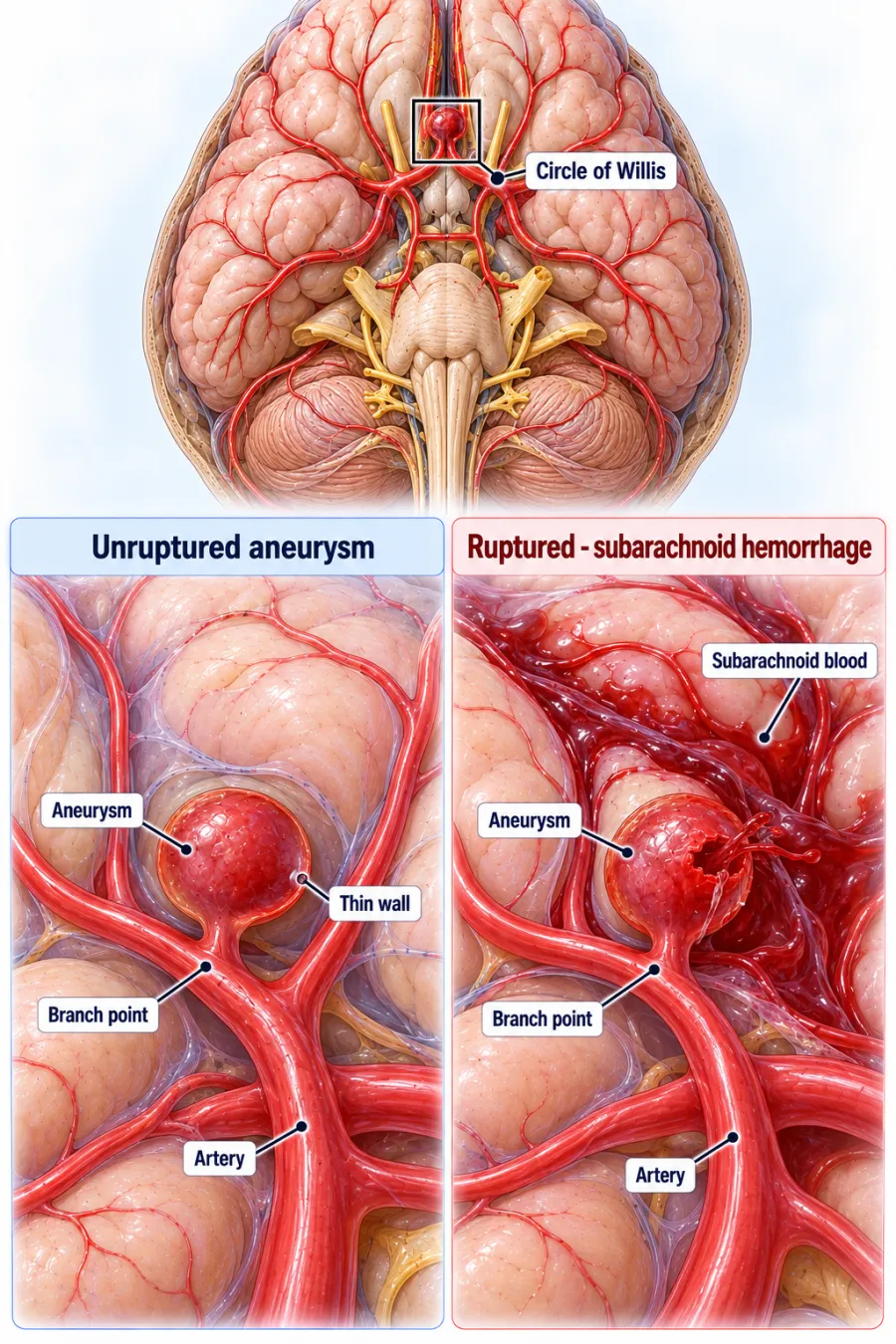
What is cerebral aneurysm?
It is frequently silent until it leaks or ruptures, causing a subarachnoid hemorrhage. The classic warning of rupture is a sudden, severe 'thunderclap' headache described as the worst headache of the patient's life. Rupture is a life-threatening emergency with high risk of rebleeding and vasospasm.
Cerebral Aneurysm illustrated
Key points to remember
- Often asymptomatic until rupture; a small warning leak may cause a sudden severe headache, and full rupture causes subarachnoid hemorrhage.
- Classic rupture sign is a sudden 'thunderclap' headache — the worst headache of the patient's life — with nuchal rigidity, photophobia, nausea/vomiting, and decreased level of consciousness.
- Major post-rupture complications are rebleeding (highest risk in the first 24 hours) and cerebral vasospasm (peaks around days 4 to 14) leading to ischemia.
- Aneurysm precautions reduce stimulation: bed rest, quiet dim room, limited visitors, no straining, and stool softeners to prevent Valsalva-driven rebleeding.
- Definitive treatment is surgical clipping or endovascular coiling; nimodipine is given to prevent vasospasm.
Signs & symptoms
- Sudden "thunderclap" headache
- Nuchal rigidity, photophobia
- ↓LOC, N/V, seizures
Nursing priorities
- Institute aneurysm (subarachnoid) precautions: bed rest with HOB elevated, dim quiet room, limited visitors, and minimal stimulation.
- Prevent increased intracranial pressure and rebleeding by avoiding straining, coughing, and Valsalva; give stool softeners and avoid the prone position.
- Perform frequent neurologic checks and monitor for vasospasm (new deficits, worsening headache, decreased LOC).
- Administer nimodipine on schedule to reduce vasospasm and maintain prescribed blood pressure parameters.
- Keep the patient calm, manage pain and anxiety, and control blood pressure to reduce rupture/rebleed risk.
Patient teaching
- Seek emergency care immediately for a sudden, severe headache unlike any before.
- Avoid activities that raise intracranial pressure such as straining, heavy lifting, and bending over; use stool softeners.
- Control modifiable risk factors: manage hypertension, stop smoking, and avoid stimulant drugs and excessive alcohol.
- Take nimodipine and antihypertensive medications exactly as prescribed.
- Attend follow-up imaging to monitor unruptured or treated aneurysms.
Red flags: report now
- Sudden severe 'worst headache of my life,' loss of consciousness, seizure, or new neuro deficit — possible rupture or rebleed; notify provider/activate emergency response immediately.
- New focal weakness, speech changes, or declining LOC several days after bleed indicating cerebral vasospasm and ischemia.
References
Clinical references for this topic