
A boggy fundus with heavy bleeding, or saturating a pad in under an hour, signals hemorrhage and must be reported.
Before you read
Test yourself first: 3 questions
Question 1 of 3
A nurse is caring for a postpartum client 6 days after a cesarean birth who reports a sudden onset of sharp chest pain, shortness of breath, and anxiety. What is the priority action?
Answer: A. Sudden dyspnea, pleuritic chest pain, and anxiety in a postpartum cesarean client suggest pulmonary embolism, a life-threatening emergency. The priority is to apply oxygen, elevate the head of the bed, and immediately notify the rapid response team or provider while staying with the client.
Question 2 of 3
A child with asthma uses a peak expiratory flow meter at home. The reading falls in the red zone (less than 50% of the personal best). Which instruction should the nurse reinforce with the family?
Answer: B. A red-zone peak flow reading signals a medical alert: the child should take the prescribed quick-relief (short-acting beta agonist) medication and seek medical care immediately. Continuing routine activity, doubling the controller, or waiting to recheck delays needed treatment.
Question 3 of 3
A nurse assesses a newborn 4 hours after a cesarean birth and notes mild tachypnea (66/min) with mild retractions but good color and oxygen saturation. Which condition does the nurse most likely suspect?
Answer: A. Transient tachypnea of the newborn (TTN) results from delayed clearance of fetal lung fluid and is more common after cesarean birth (no vaginal squeeze). It presents as tachypnea with mild distress and good oxygenation, typically resolving within 24-72 hours. It is distinguished from RDS, which is more severe and seen in preterm surfactant-deficient infants.
Keep the streak going with more questions like these, each with a full rationale.
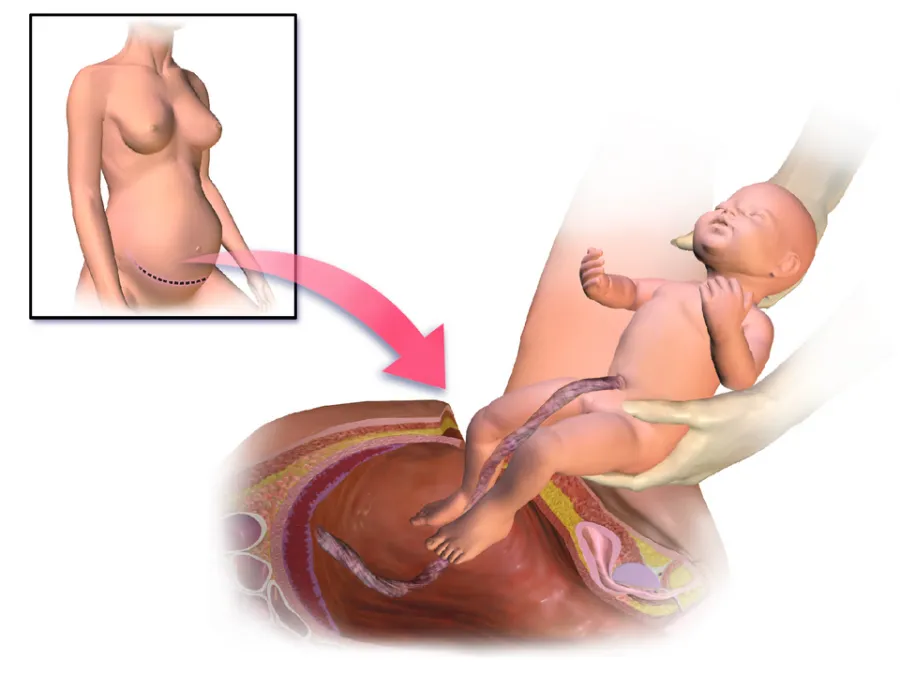
What is cesarean care?
The client is both a postoperative surgical patient and a postpartum mother, so care combines incision and pain management with fundal, lochia, and bonding assessment. Priorities include preventing hemorrhage, infection, and venous thromboembolism while supporting recovery and feeding.
Cesarean Care illustrated
Key points to remember
- The client has both an abdominal incision and a uterine incision, increasing risks of hemorrhage, infection, and slowed recovery compared with vaginal birth.
- Postoperative monitoring still includes BUBBLE-HE: fundus, lochia, and bonding are assessed alongside the surgical site.
- Immobility plus the postpartum hypercoagulable state markedly raises the risk of deep vein thrombosis.
- Spinal or epidural anesthesia can cause hypotension, and opioid use can cause respiratory depression and ileus.
- Early ambulation, incentive spirometry, and bowel return are key recovery milestones.
Nursing priorities
- Monitor vital signs, the incision for REEDA, the fundus for firmness, and lochia for excessive bleeding.
- Manage pain with scheduled analgesia and assess respiratory status if opioids are used.
- Promote early ambulation, leg exercises, sequential compression devices, and incentive spirometry to prevent VTE and atelectasis.
- Assess return of bowel sounds and passage of flatus before advancing diet; monitor urine output and the indwelling catheter.
- Support breastfeeding with positions that protect the incision, such as the football hold or side-lying.
Labs & values
Patient teaching
- Splint your incision with a pillow when coughing, laughing, or moving.
- Report increasing incision redness, drainage, fever, or worsening pain as signs of infection.
- Avoid heavy lifting beyond the baby's weight and avoid driving until cleared by your provider.
- Walk early and often to prevent blood clots, and use the football or side-lying hold to keep pressure off the incision while feeding.
Red flags: report now
- A boggy fundus with heavy bleeding, or saturating a pad in under an hour, signals hemorrhage and must be reported.
- Fever, a red, warm, or draining incision, or foul lochia indicates infection.
- Calf pain, unilateral leg swelling, or sudden chest pain and shortness of breath suggest DVT or pulmonary embolism.
- Respiratory rate under 12 after opioids requires holding the medication and notifying the provider.
References
Clinical references for this topic

