A dusky, dark, or blue/black stoma indicates ischemia and must be reported immediately.
Before you read
Test yourself first: 3 questions
Question 1 of 3
A client with a new colostomy after surgery for colorectal cancer is being taught stoma care. Which finding about the stoma should the nurse teach the client to report to the provider?
Answer: B. A healthy stoma is pink to red, moist, and slightly raised, and a small amount of bleeding when cleaning is normal. A stoma that becomes dusky, pale, or dark/black indicates impaired circulation (ischemia) and must be reported immediately. Pink color and minimal cleaning-related bleeding are normal and do not require reporting.
Question 2 of 3
A client with bladder cancer has undergone creation of an ileal conduit (urinary diversion). Which finding in the stoma should the nurse report immediately?
Answer: A. A healthy urostomy/ileal conduit stoma is pink to beefy red and moist. A dusky, dark, purple, or black stoma indicates ischemia or necrosis from compromised blood supply and must be reported immediately. Mucus in the urine is expected because the conduit is made from bowel, and a small amount of urine draining continuously is normal.
Question 3 of 3
A client receiving radiation therapy to the abdomen for cancer reports several loose stools per day. Which dietary instruction is most appropriate for the nurse to provide?
Answer: A. Radiation enteritis causes diarrhea. A low-residue, low-fiber diet reduces stool bulk and bowel irritation. High-fiber foods, raw vegetables, and whole grains increase peristalsis and worsen diarrhea, so they should be limited during treatment.
Keep the streak going with more questions like these, each with a full rationale.
What is colorectal cancer?
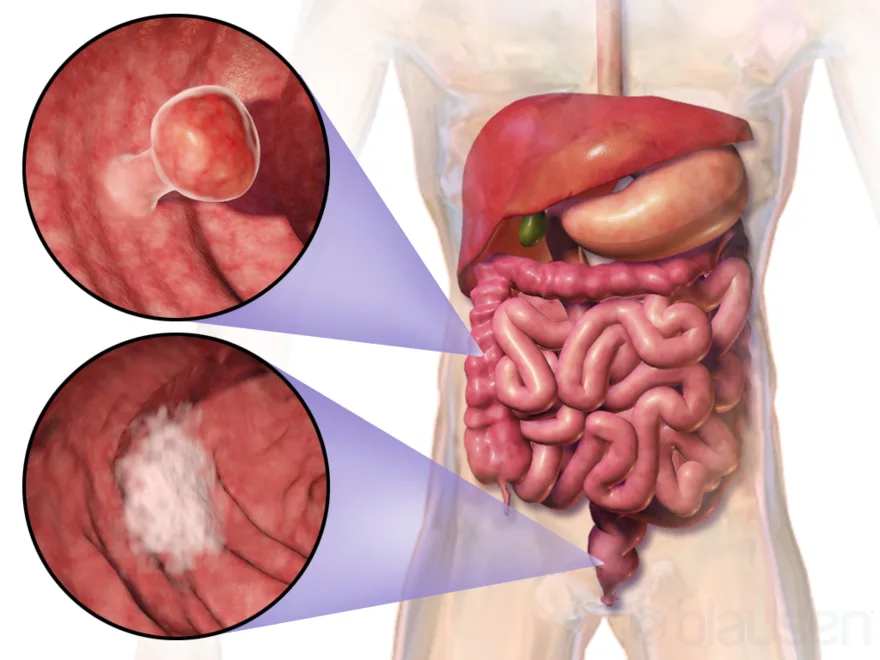
It is among the most common and most preventable cancers because screening can remove polyps before they become malignant. Hallmark warning signs include a change in bowel habits and rectal bleeding/blood in the stool. Risk increases with age, family history, inflammatory bowel disease, and a high-fat, low-fiber diet.
Colorectal Cancer illustrated
Key points to remember
- Most colorectal cancers develop from adenomatous polyps, making screening and polyp removal highly preventive.
- Classic warning signs are a change in bowel habits (caliber/frequency), rectal bleeding, blood in the stool, and unexplained anemia.
- Right-sided tumors tend to cause occult bleeding and anemia; left-sided tumors more often cause obstruction and a change in stool shape.
- Risk factors include age over 50, family history, familial polyposis, inflammatory bowel disease, and a high-fat/low-fiber diet.
- Colonoscopy is the gold-standard screening and diagnostic test; CEA is used to monitor treatment response and recurrence.
- Treatment may involve surgical resection (sometimes with colostomy), chemotherapy, and radiation.
Signs & symptoms
- Change in bowel habits, narrow stool
- Rectal bleeding, blood in stool
- Unexplained anemia, weight loss
Nursing priorities
- Assess bowel elimination patterns and monitor stools for blood; track for obstruction or perforation.
- Provide preoperative bowel preparation and postoperative monitoring for ileus and anastomotic leak.
- Provide ostomy care and stoma assessment when a colostomy is created; the stoma should be pink/red and moist.
- Support nutrition and monitor for anemia, weight loss, and dehydration.
- Offer emotional support and body image/coping help, especially for ostomy adjustment.
Labs & values
Patient teaching
- Follow recommended screening (colonoscopy starting at age 45-50 or earlier with risk factors).
- Eat a high-fiber, low-fat diet; limit red and processed meats; maintain a healthy weight and stay active.
- Report any change in bowel habits, rectal bleeding, blood in stool, or unexplained weight loss.
- For an ostomy, teach pouch care, skin protection, and to report a dusky stoma or no output.
- Limit alcohol and avoid smoking, which raise colorectal cancer risk.
Red flags: report now
- A dusky, dark, or blue/black stoma indicates ischemia and must be reported immediately.
- Signs of bowel obstruction or perforation (severe abdominal pain, distension, rigidity, no stool/flatus, fever) require urgent action.
- Significant rectal bleeding or signs of acute blood loss need prompt evaluation.
References
Clinical references for this topic