Hallmark signs are a harsh barking or seal-like cough, hoarseness, and inspiratory stridor.
Before you read
Test yourself first: 3 questions
Question 1 of 3
A nurse is caring for an unimmunized infant diagnosed with pertussis (whooping cough). Which clinical manifestation is characteristic of the paroxysmal stage?
Answer: A. During the paroxysmal stage of pertussis, the child has severe coughing fits often ending in a high-pitched inspiratory whoop, and infants may become cyanotic or apneic. A barking cough indicates croup, and the other findings are not specific to the paroxysmal stage of pertussis.
Question 2 of 3
A 2-year-old is admitted with a barking, seal-like cough, inspiratory stridor, and a hoarse voice that worsen at night. Which condition does the nurse suspect?
Answer: B. The classic barking or seal-like cough with inspiratory stridor and hoarseness is the hallmark of croup (laryngotracheobronchitis), which causes upper-airway edema below the vocal cords.
Question 3 of 3
A 2-year-old is brought to the emergency department with a barking, seal-like cough and inspiratory stridor that worsened at night. The nurse recognizes these findings as characteristic of which condition?
Answer: B. Laryngotracheobronchitis (croup) classically presents with a barking, seal-like cough and inspiratory stridor, often worse at night. Epiglottitis causes drooling and tripod posture; pertussis causes a whooping cough; asthma causes expiratory wheezing.
Keep the streak going with more questions like these, each with a full rationale.
What is croup?
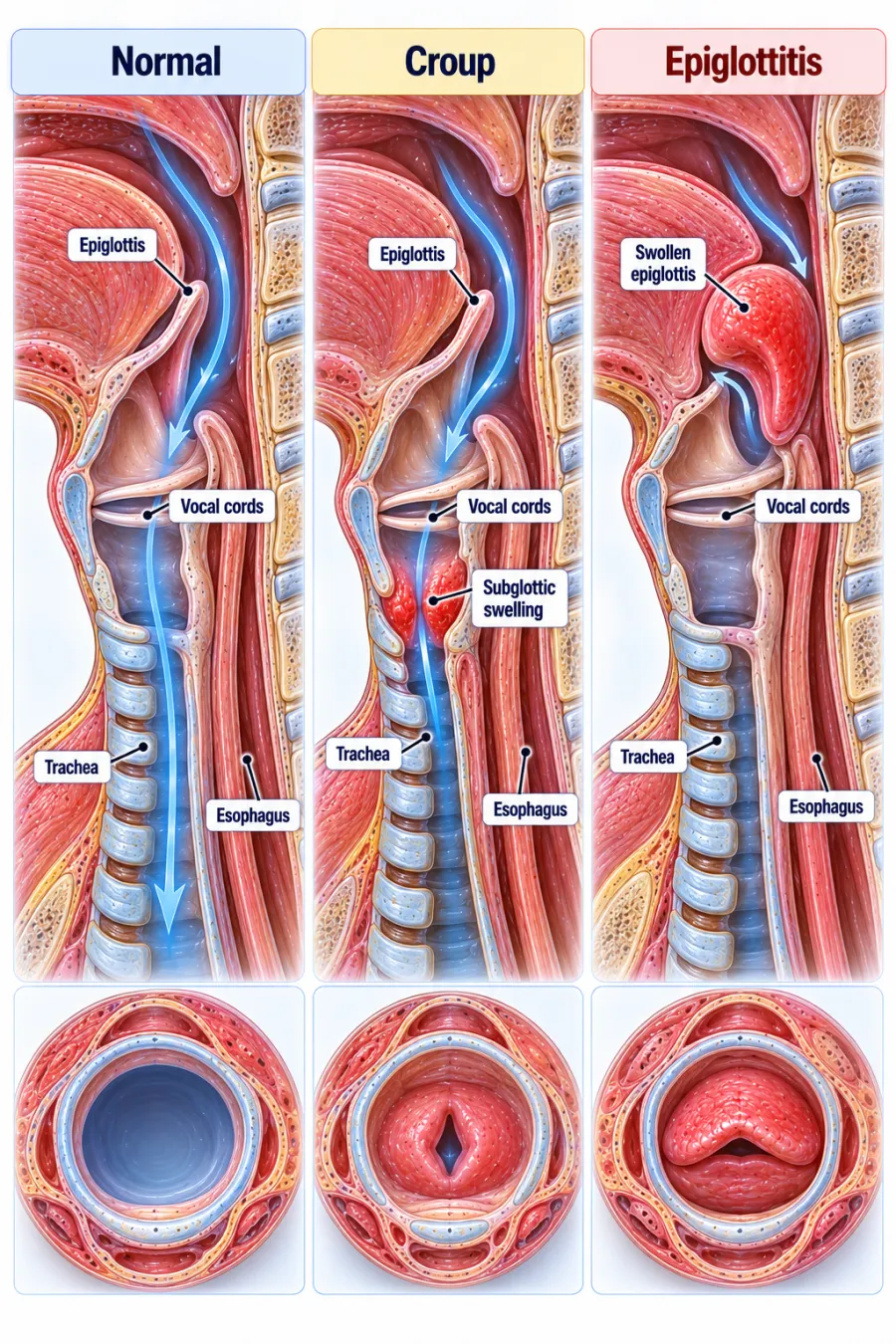
It mainly affects children 6 months to 3 years and is marked by a classic barking, seal-like cough and inspiratory stridor that worsen at night. It is usually self-limiting, but airway swelling can compromise breathing in young children whose airways are already narrow.
Croup illustrated
Key points to remember
- Hallmark signs are a harsh barking or seal-like cough, hoarseness, and inspiratory stridor.
- Symptoms classically worsen at night and with crying or agitation.
- Onset is gradual, often preceded by a low-grade fever and cold-like upper respiratory symptoms.
- The child appears nontoxic and can usually still drink, swallow, and lie flat.
- Steeple sign (subglottic narrowing) may appear on a neck X-ray.
- Stridor at rest, retractions, and restlessness indicate worsening airway obstruction.
Common causes
- Viral (parainfluenza), 6mo–3yr
- Subglottic airway swelling
Signs & symptoms
- Seal-bark cough, worse at night
- Inspiratory stridor, hoarse voice
- Low-grade fever, gradual onset
Nursing priorities
- Keep the child calm and on the parent's lap; agitation worsens airway obstruction.
- Provide cool humidified air or mist and encourage oral fluids to thin secretions.
- Administer corticosteroids (dexamethasone) as ordered to reduce airway edema.
- Give nebulized racemic epinephrine for moderate-to-severe stridor and monitor for rebound for at least 2-3 hours.
- Continuously monitor respiratory status, oxygen saturation, and for increasing stridor or fatigue.
Labs & values
Patient teaching
- Use cool night air or a cool-mist humidifier and sit with the child during episodes.
- Keep the child calm; offer small frequent sips of fluid to stay hydrated.
- Return to care immediately for stridor at rest, fast or labored breathing, drooling, or bluish color.
Red flags: report now
- Stridor at rest, increasing retractions, nasal flaring, or rising respiratory rate signal impending obstruction.
- Cyanosis, drooling, lethargy, or decreasing level of consciousness require immediate escalation.
- A child who becomes suddenly quiet with decreased breath sounds may be tiring and heading toward respiratory failure.
- Never leave a child with worsening stridor unattended or delay airway support.
References
Clinical references for this topic