DI: low ADH, polyuria (3-20 L/day) of dilute urine, intense thirst, dehydration, hypernatremia, and low urine specific gravity (<1.005).
Before you read
Test yourself first: 5 questions
Question 1 of 5
A client with diabetes insipidus produces large volumes of dilute urine. The nurse monitors for:
Answer: B. Diabetes insipidus causes excessive dilute urine → dehydration and hypernatremia. Monitor I&O, daily weight, and serum sodium; desmopressin may be given. (SIADH is the opposite.)
Question 2 of 5
A client with diabetes insipidus is at greatest risk for:
Answer: B. Diabetes insipidus causes massive output of dilute urine → dehydration, hypernatremia, and hypovolemia. Monitor I&O, daily weight, and replace fluids; desmopressin may be given.
Question 3 of 5
A client develops diabetes insipidus after neurosurgery. Which finding does the nurse expect?
Answer: A. Diabetes insipidus results from a deficiency of (or resistance to) ADH, causing the kidneys to excrete large volumes of dilute urine. Expected findings include polyuria with very low urine specific gravity, excessive thirst, hypernatremia, and risk of dehydration.
Question 4 of 5
A client has diabetes insipidus (DI) after pituitary surgery. Which assessment findings does the nurse expect?
Answer: A. In DI, a deficiency of ADH (or renal resistance) prevents water reabsorption, causing massive output of dilute urine (polyuria), intense thirst (polydipsia), very low urine specific gravity, dehydration, and hypernatremia with rising serum osmolality. This is the opposite of SIADH.
Question 5 of 5
A nurse is reviewing diagnostic criteria for diabetes mellitus. Which fasting plasma glucose value is diagnostic of diabetes?
Answer: B. A fasting plasma glucose of 126 mg/dL or higher (on more than one occasion or with confirmation) meets the diagnostic criterion for diabetes. A fasting value of 100 to 125 mg/dL indicates prediabetes (impaired fasting glucose), and values below 100 mg/dL are normal. An A1c of 6.5% or higher is also diagnostic.
Keep the streak going with more questions like these, each with a full rationale.
What is diabetes insipidus vs siadh?
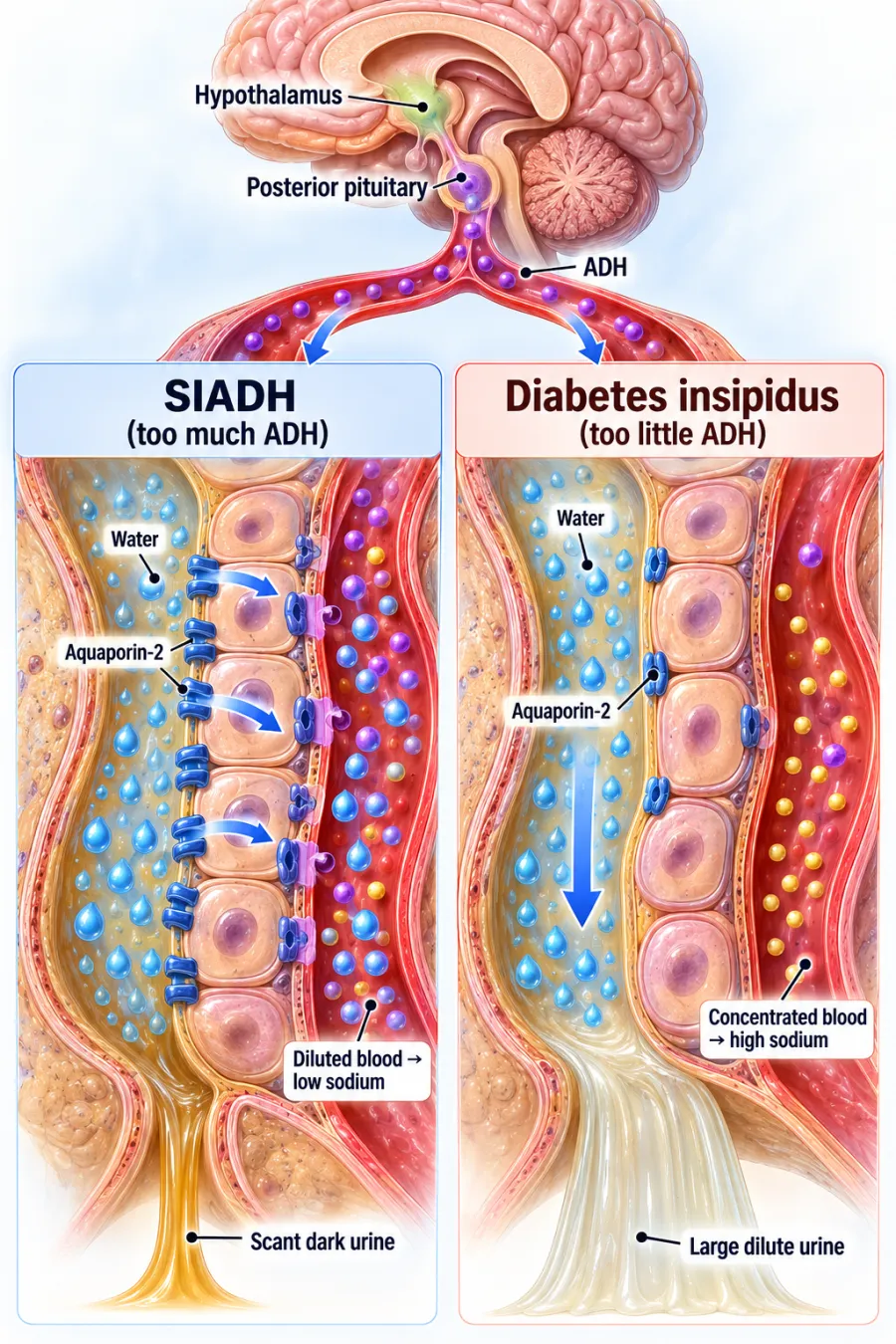
DI is too little ADH causing massive dilute urine and dehydration with high sodium; SIADH is too much ADH causing water retention and dilutional low sodium. Memory aid: DI = Diluted urine, Increased output; SIADH = Soaked Inside, retaining water.
Diabetes Insipidus vs SIADH illustrated
Key points to remember
- DI: low ADH, polyuria (3-20 L/day) of dilute urine, intense thirst, dehydration, hypernatremia, and low urine specific gravity (<1.005).
- SIADH: excess ADH, water retention, concentrated low-volume urine, dilutional hyponatremia, fluid overload, and high urine specific gravity (>1.030).
- DI is treated with desmopressin (DDAVP) and fluid replacement; causes include head trauma, pituitary surgery, and nephrogenic kidney problems.
- SIADH is treated with fluid restriction; causes include small-cell lung cancer, CNS disorders, and certain drugs (SSRIs, carbamazepine).
- Severe SIADH hyponatremia is corrected with hypertonic (3%) saline given slowly to avoid osmotic demyelination.
- Hyponatremia in SIADH causes neurologic symptoms (confusion, seizures), while hypernatremia in DI also alters mental status.
Nursing priorities
- Monitor strict intake and output, daily weights, urine specific gravity, and serum sodium for both disorders.
- DI: ensure access to fluids, replace losses, administer desmopressin, and watch for dehydration and hypovolemic shock.
- SIADH: enforce fluid restriction, implement seizure precautions, and provide a safe environment for confused patients.
- Assess neurologic status frequently as sodium shifts in either direction impair mentation.
- When giving hypertonic saline for SIADH, infuse slowly and monitor sodium closely to prevent overly rapid correction.
Labs & values
Patient teaching
- DI patients on desmopressin should weigh daily and report rapid weight gain (sign of water intoxication/overdose).
- SIADH patients must limit fluids as prescribed (often 500-1000 mL/day) and may use hard candy/ice chips for thirst.
- Report excessive thirst with frequent dilute urination (DI) or confusion and headache with low urine output (SIADH).
Red flags: report now
- Rapid weight loss, hypotension, and tachycardia in DI signal life-threatening dehydration.
- Seizures or decreasing level of consciousness from severe hyponatremia in SIADH — report immediately.
- Correcting sodium too quickly (>8-12 mEq/L in 24 hours) risks osmotic demyelination — never over-correct.
References
Clinical references for this topic