Unilateral lower abdominal or pelvic pain with a missed period is the classic presentation.
Before you read
Test yourself first: 3 questions
Question 1 of 3
A client at 7 weeks gestation reports sudden, sharp, one-sided lower abdominal pain and scant vaginal spotting. Her serum beta-hCG is lower than expected for gestational age. Which complication should the nurse suspect first?
Answer: B. Unilateral lower abdominal pain, spotting, and a lower-than-expected beta-hCG that does not rise appropriately are classic for ectopic pregnancy, most often tubal. This is an emergency because tubal rupture causes hemorrhage. The other conditions do not typically present this triad early in gestation.
Question 2 of 3
A client at 9 weeks gestation reports painless, bright red vaginal bleeding with no cramping; on examination the cervix is closed. Which type of spontaneous abortion does the nurse recognize?
Answer: A. A threatened abortion presents with vaginal bleeding and a closed cervical os; the pregnancy may continue. An inevitable abortion has a dilated cervix, an incomplete abortion has partial passage of products with bleeding, and a missed abortion involves fetal demise retained without bleeding.
Question 3 of 3
A nurse is differentiating placenta previa from placental abruption. Which finding is most characteristic of placenta previa?
Answer: A. Placenta previa classically presents with painless, bright red vaginal bleeding in the second half of pregnancy, because the placenta covers or lies near the cervical os. Abruption is typically painful with dark red bleeding and a rigid uterus.
Keep the streak going with more questions like these, each with a full rationale.
What is ectopic pregnancy?
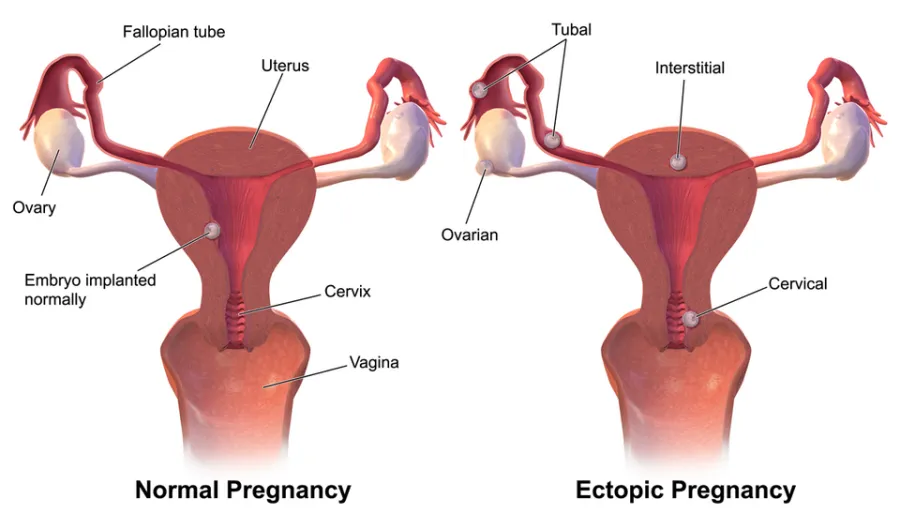
As the embryo grows, it can rupture the tube, causing life-threatening internal hemorrhage. Risk factors include prior pelvic inflammatory disease, tubal surgery, prior ectopic, and IUD use. The classic triad is unilateral lower abdominal pain, amenorrhea or a missed period, and vaginal bleeding (often scant and dark).
Ectopic Pregnancy illustrated
Key points to remember
- Unilateral lower abdominal or pelvic pain with a missed period is the classic presentation.
- Vaginal bleeding is often scant, dark, and intermittent rather than a normal period.
- Serum hCG levels rise more slowly than in a normal intrauterine pregnancy.
- Tubal rupture causes sudden, severe pain and signs of internal hemorrhage and shock.
- Referred shoulder pain (Kehr sign) can occur from blood irritating the diaphragm after rupture.
Signs & symptoms
- Unilateral lower abd pain
- Spotting, missed period, +hCG
Nursing priorities
- Assess pain, vaginal bleeding, and vital signs for signs of rupture and hypovolemic shock.
- Establish IV access and monitor for shock; prepare for fluid and blood replacement if rupture is suspected.
- Administer methotrexate as prescribed for an early, unruptured ectopic to dissolve the pregnancy.
- Prepare the patient for emergency surgery (salpingostomy or salpingectomy) if rupture occurs.
- Provide emotional support for pregnancy loss and explain the impact on future fertility.
Labs & values
Patient teaching
- Return immediately for sudden severe abdominal or shoulder pain, dizziness, or fainting.
- If treated with methotrexate, avoid alcohol, folic acid, and NSAIDs, and attend all follow-up hCG checks.
- Discuss future pregnancy plans, as one ectopic raises the risk of another.
Red flags: report now
- Sudden severe abdominal pain, shoulder pain, dizziness, or signs of shock indicate tubal rupture, a surgical emergency.
- Report falling blood pressure, rising heart rate, and pallor, which signal internal hemorrhage.
- If methotrexate is given, the patient must avoid folic acid supplements and alcohol, which interfere with the drug.
- Report a hCG level that plateaus or rises abnormally rather than declining after treatment.
References
Clinical references for this topic