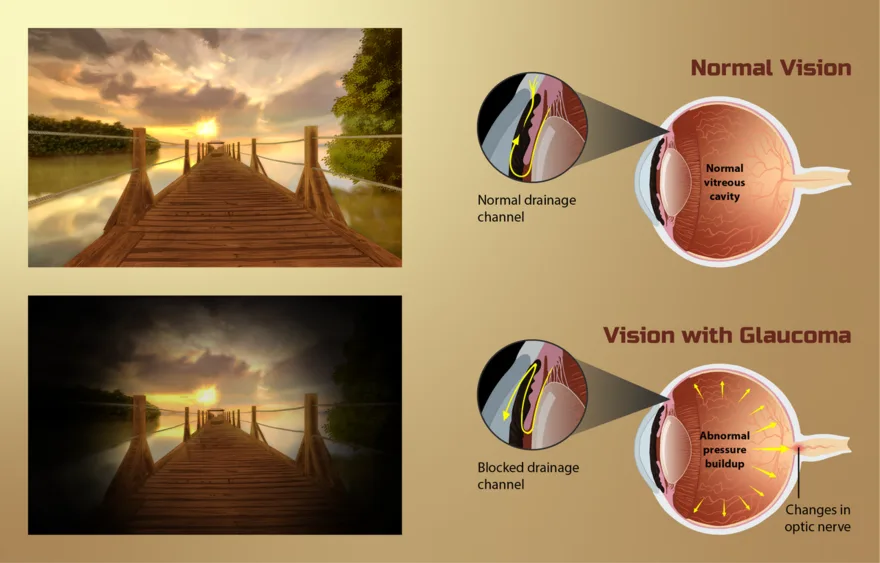
Normal intraocular pressure is about 10 to 21 mmHg; glaucoma involves elevated pressure damaging the optic nerve.
Before you read
Test yourself first: 1 question
Question 1 of 1
A nurse assesses an older adult for normal age-related vision changes. Which finding is an expected change of aging?
Answer: B. Presbyopia, the decreased ability to focus on near objects, is a normal age-related vision change. Sudden painless vision loss, halos with eye pain, and a curtain over the visual field are signs of pathology (such as retinal detachment or acute glaucoma), not normal aging.
Keep the streak going with more questions like these, each with a full rationale.
What is glaucoma?
Open-angle glaucoma is the common chronic form and is often symptomless until vision is lost ('silent thief of sight'). Angle-closure glaucoma is a sudden ophthalmic emergency with severe eye pain and rapidly rising pressure. Treatment lowers IOP to preserve remaining vision; lost vision cannot be restored.
Glaucoma illustrated
Key points to remember
- Normal intraocular pressure is about 10 to 21 mmHg; glaucoma involves elevated pressure damaging the optic nerve.
- Open-angle (chronic) glaucoma develops gradually with painless loss of peripheral vision and eventual tunnel vision.
- Acute angle-closure glaucoma causes sudden severe eye pain, headache, nausea, halos around lights, and a fixed mid-dilated pupil.
- Damage and vision loss from glaucoma are permanent, so early detection and ongoing treatment are essential.
- Risk factors include age, family history, African or Hispanic ancestry, and diabetes.
Signs & symptoms
- Peripheral vision loss first
- Tunnel vision, halos around lights
- Acute: severe pain, N/V, red eye
Nursing priorities
- Administer prescribed eye drops on schedule (beta-blockers, prostaglandins, alpha-agonists, carbonic anhydrase inhibitors) to lower IOP.
- Teach correct drop instillation and punctal occlusion (press inner corner 1 minute) to limit systemic absorption.
- For acute angle-closure, treat as an emergency: notify provider, give IOP-lowering drugs (acetazolamide, mannitol, miotics), prepare for laser iridotomy.
- Reinforce lifelong adherence to therapy and regular IOP and visual-field monitoring.
- Modify the environment for safety because of reduced peripheral vision.
Patient teaching
- Use eye drops exactly as prescribed every day, even without symptoms, because vision loss cannot be reversed.
- Press on the inner corner of the eye after drops to reduce systemic side effects.
- Avoid activities that raise eye pressure such as heavy lifting and straining, and keep all eye appointments.
Red flags: report now
- Sudden severe eye pain with nausea, halos, and blurred vision indicates acute angle-closure glaucoma; emergency referral.
- Avoid medications and activities that dilate the pupil (anticholinergics, atropine) in angle-closure-prone patients.
- Untreated rising IOP causes permanent blindness; report any new vision changes promptly.
- Do not abruptly stop glaucoma drops without provider guidance.
References
Clinical references for this topic