
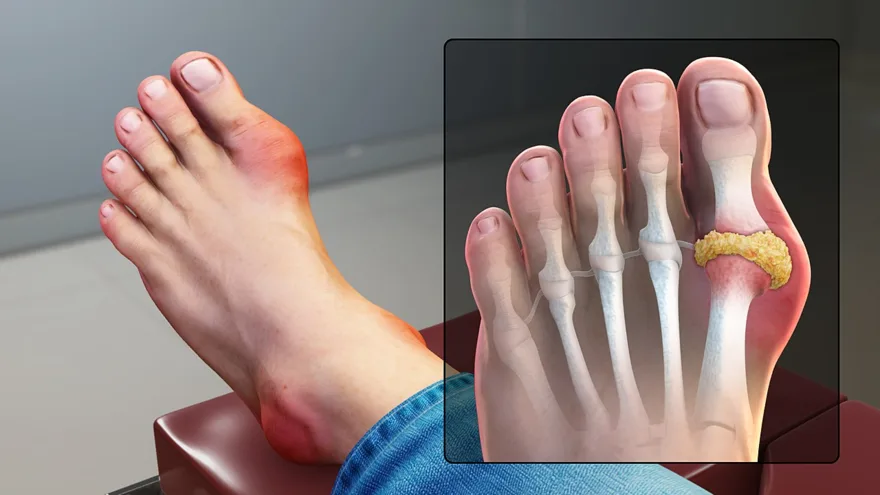
Acute attacks cause sudden, severe pain, redness, warmth, and swelling, classically in the great toe.
Before you read
Test yourself first: 1 question
Question 1 of 1
A client with gout is admitted with an acutely painful, red, swollen great toe. Which dietary instruction should the nurse provide to help prevent future attacks?
Answer: B. Gout results from hyperuricemia and urate crystal deposition. Clients should limit purine-rich foods such as organ meats, red meat, shellfish, and alcohol (especially beer), and increase fluid intake to promote uric acid excretion. High-purine diets worsen attacks.
Keep the streak going with more questions like these, each with a full rationale.
What is gout?
The classic site is the great toe (podagra). It results from overproduction or underexcretion of uric acid and is triggered by purine-rich foods, alcohol, and certain diuretics.
Gout illustrated
Key points to remember
- Acute attacks cause sudden, severe pain, redness, warmth, and swelling, classically in the great toe.
- The affected joint is so tender that even the weight of a bed sheet is intolerable.
- Tophi are hard, painless urate crystal deposits found in chronic gout under the skin and in joints.
- Triggers include purine-rich foods (organ meats, shellfish, red meat), alcohol (especially beer), and dehydration.
- Elevated serum uric acid supports the diagnosis, confirmed by urate crystals in joint fluid.
- Chronic gout can lead to joint damage and urate kidney stones.
Signs & symptoms
- Sudden severe pain great toe
- Red, hot, swollen joint, tophi
- ↑ uric acid > 6.8 mg/dL
Nursing priorities
- Administer NSAIDs, colchicine, or corticosteroids during an acute attack as ordered.
- Rest and immobilize the affected joint and protect it from pressure, including bed linens.
- Encourage increased fluid intake (2 to 3 liters daily) to flush uric acid and prevent stones.
- Administer urate-lowering drugs (allopurinol) for prevention, NOT during an acute attack.
- Apply cold to the inflamed joint to reduce pain and swelling.
Labs & values
Patient teaching
- Avoid high-purine foods such as organ meats, red meat, shellfish, and sardines, and limit alcohol.
- Drink 2 to 3 liters of fluid daily to prevent uric acid stones.
- Take allopurinol regularly for prevention but never to treat an active attack, and report any rash.
Red flags: report now
- Flank pain and hematuria suggest uric acid kidney stones and need prompt evaluation.
- A rash or signs of hypersensitivity with allopurinol can progress to severe skin reactions; stop and report.
- Never start allopurinol during an acute attack, as it can worsen and prolong the flare.
References
Clinical references for this topic

