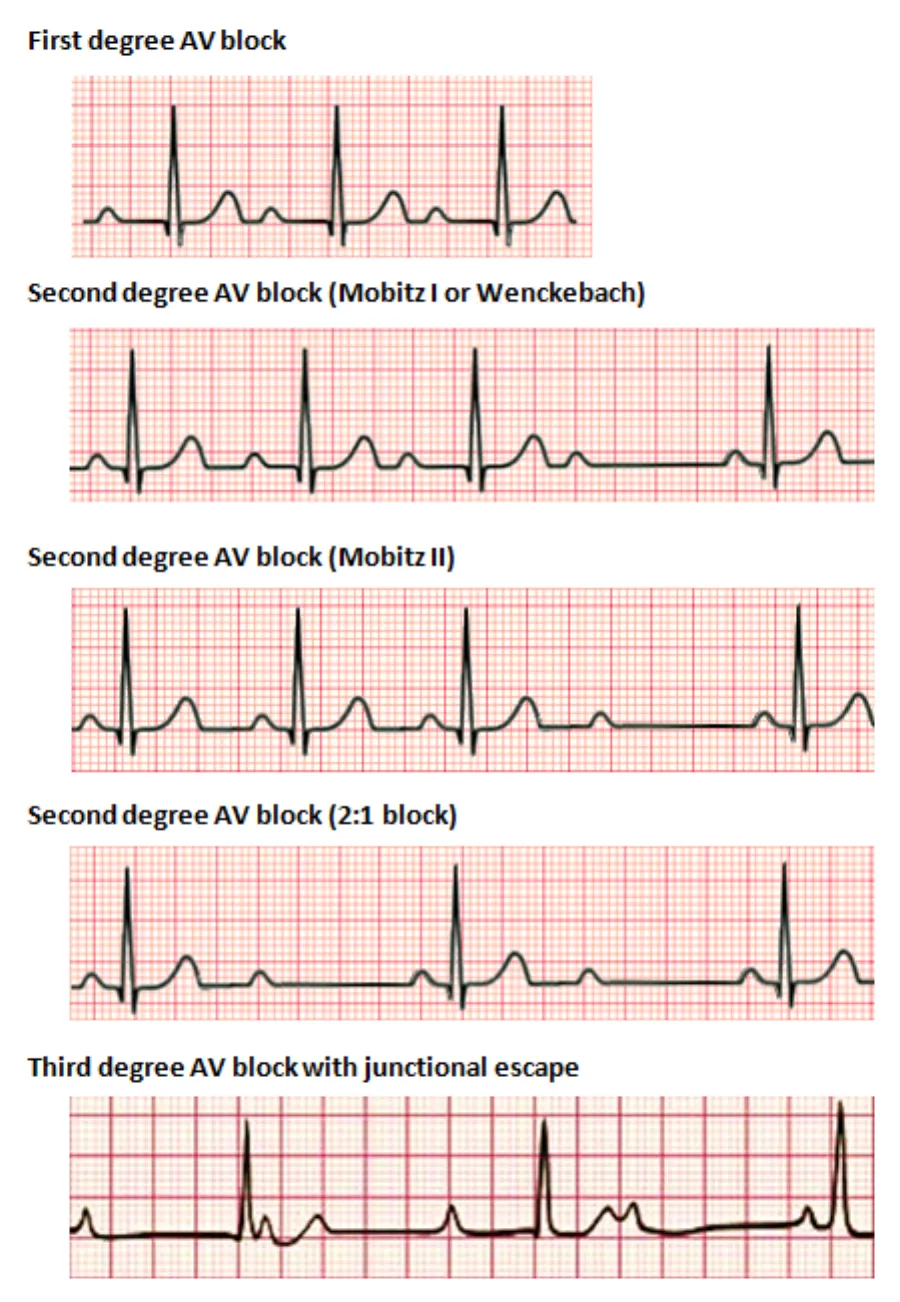
First-degree block shows a consistently prolonged PR interval greater than 0.20 seconds with every beat conducted.
Before you read
Test yourself first: 3 questions
Question 1 of 3
A monitor shows progressive lengthening of the PR interval until a QRS complex is dropped, then the cycle repeats. Which heart block does the nurse identify?
Answer: B. Second-degree AV block type I (Mobitz I, Wenckebach) is characterized by progressive prolongation of the PR interval until a beat is dropped, after which the cycle begins again. Type II has a constant PR with sudden dropped beats, first-degree has no dropped beats, and complete block has no relationship between P waves and QRS complexes.
Question 2 of 3
A client receiving an IV beta-blocker for a tachydysrhythmia has a known history of asthma. Why is this combination a concern for the nurse?
Answer: B. Nonselective beta blockers block beta-2 receptors in the bronchial smooth muscle, which can cause bronchospasm and worsen asthma or COPD. The nurse should monitor respiratory status closely and question a nonselective agent in a client with reactive airway disease. Beta blockers do not commonly cause severe hyperglycemia, increased clotting, or excessive diuresis as the primary concern in asthma.
Question 3 of 3
When measuring intervals on a rhythm strip, which statement about the normal QRS duration is correct?
Answer: A. A normal QRS complex represents ventricular depolarization and measures less than 0.12 seconds (under three small boxes). A QRS of 0.12 seconds or greater is considered wide and suggests a ventricular origin or a conduction delay such as bundle branch block. The PR interval (0.12-0.20 seconds) and QT interval are measured separately.
Keep the streak going with more questions like these, each with a full rationale.
What is heart blocks (av block)?
They range from a benign prolonged PR interval (first-degree) to complete dissociation of atria and ventricles (third-degree), which is life-threatening. Causes include myocardial ischemia, medications such as digoxin and beta-blockers, and conduction system disease.
Heart Blocks (AV block) illustrated
Key points to remember
- First-degree block shows a consistently prolonged PR interval greater than 0.20 seconds with every beat conducted.
- Second-degree Mobitz I (Wenckebach) shows a progressively lengthening PR interval until a QRS is dropped.
- Second-degree Mobitz II drops QRS complexes without PR lengthening and can progress to complete block.
- Third-degree (complete) block has atria and ventricles beating independently with no relationship between P waves and QRS.
- Higher-degree blocks cause bradycardia, decreased cardiac output, fatigue, dizziness, and syncope.
Signs & symptoms
- Bradycardia, dizzy, syncope
- Fatigue, hypotension, ↓ CO
Nursing priorities
- Assess heart rate, blood pressure, level of consciousness, and signs of decreased perfusion.
- Place the patient on continuous cardiac monitoring and obtain a 12-lead ECG.
- For symptomatic bradycardia, administer atropine and prepare for transcutaneous pacing.
- Hold and report rate-slowing medications such as digoxin, beta-blockers, and calcium channel blockers as appropriate.
- Prepare the patient for temporary or permanent pacemaker insertion for high-degree blocks.
Labs & values
Patient teaching
- Report dizziness, fainting, extreme fatigue, or a very slow pulse to the provider.
- After pacemaker placement, avoid lifting the arm above the shoulder on the insertion side until cleared and avoid strong magnetic fields.
- Check the pulse daily and carry pacemaker identification at all times.
Red flags: report now
- Third-degree block or symptomatic Mobitz II with hypotension or syncope is an emergency requiring immediate pacing.
- Sudden bradycardia with decreased level of consciousness, chest pain, or hypotension must be escalated now.
- Never delay transcutaneous pacing for a deteriorating, symptomatic high-degree block while waiting for medications to work.
References
Clinical references for this topic