Elevated serum ammonia is the underlying biochemical driver of the altered mental status.
Before you read
Test yourself first: 5 questions
Question 1 of 5
A client with cirrhosis develops increasing confusion, asterixis, and a fruity, musty breath odor. Which laboratory value should the nurse expect to be elevated and most directly linked to these findings?
Answer: B. These findings indicate hepatic encephalopathy, caused by the failing liver's inability to convert ammonia to urea. A rising serum ammonia level produces confusion and asterixis (flapping tremor) and fetor hepaticus. Albumin and platelets are typically low in cirrhosis, and bilirubin elevation causes jaundice rather than the neurologic picture described.
Question 2 of 5
A client with cirrhosis develops worsening confusion. The nurse anticipates the provider will order:
Answer: B. For hepatic encephalopathy (high ammonia), lactulose reduces ammonia by trapping it in the gut for excretion; monitor for the desired 2–3 soft stools/day and neuro status. A high-protein load can worsen it.
Question 3 of 5
A client with cirrhosis has rising ammonia and increasing confusion. Which medication does the nurse anticipate?
Answer: A. Lactulose lowers serum ammonia by trapping it in the gut for excretion; titrate to 2–3 soft stools daily. It treats hepatic encephalopathy.
Question 4 of 5
A client with advanced liver failure becomes confused and lethargic. The nurse correlates this with:
Answer: B. Hepatic encephalopathy results from elevated ammonia the failing liver can't clear. Lactulose is given to reduce ammonia (promotes its excretion in stool); monitor mental status.
Question 5 of 5
A client with cirrhosis develops asterixis and confusion. The nurse anticipates which laboratory value will be elevated?
Answer: A. Hepatic encephalopathy results from the liver's inability to convert ammonia to urea, so serum ammonia rises. Asterixis (flapping tremor) and altered mental status are classic signs. The other values are not the direct cause.
Keep the streak going with more questions like these, each with a full rationale.
What is hepatic encephalopathy?
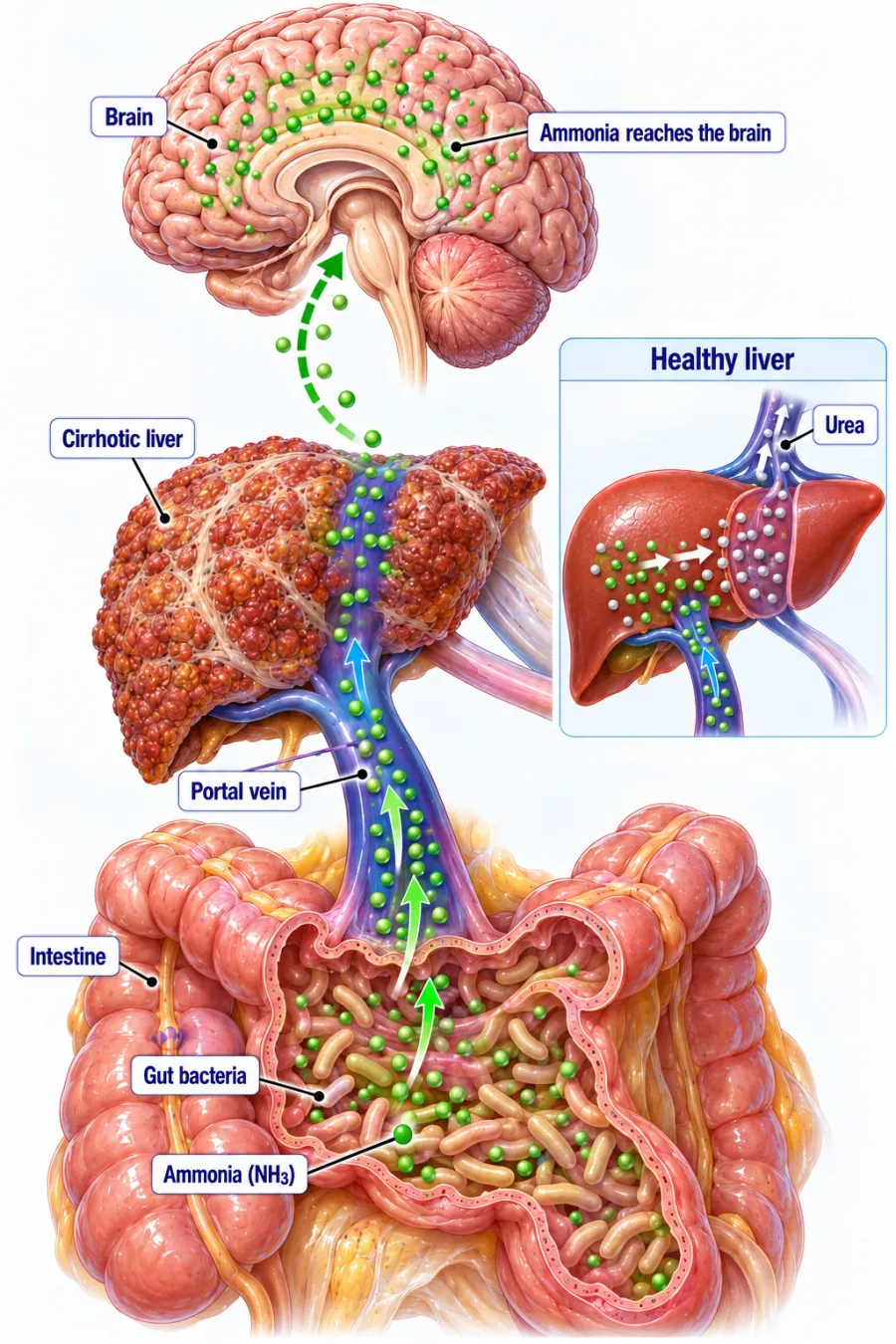
Ammonia, mostly from protein breakdown by gut bacteria, crosses the blood-brain barrier and impairs neurologic function. It is common in cirrhosis and may be triggered by GI bleeding, infection, constipation, or high protein intake. It progresses from subtle confusion to coma.
Hepatic Encephalopathy illustrated
Key points to remember
- Elevated serum ammonia is the underlying biochemical driver of the altered mental status.
- Asterixis (flapping tremor of the hands) is a classic early neurologic sign.
- Mental changes progress through confusion, disorientation, lethargy, stupor, and coma.
- Fetor hepaticus, a sweet musty breath odor, may be present.
- GI bleeding, constipation, infection, and dehydration are common precipitating factors.
- Early stages may show only personality changes, sleep disturbance, or difficulty with handwriting.
Signs & symptoms
- Asterixis = liver flap hands
- Confusion, ↓ LOC, fetor hepaticus
- Progresses to coma if untreated
Nursing priorities
- Administer lactulose to trap and excrete ammonia, titrating to 2-3 soft stools per day.
- Give rifaximin or neomycin as ordered to reduce ammonia-producing gut bacteria.
- Assess and document neurologic and mental status frequently, including asterixis and orientation.
- Identify and treat precipitating factors such as GI bleeding, infection, or constipation.
- Maintain safety measures and fall precautions for the confused patient.
Labs & values
Patient teaching
- Take lactulose as prescribed and expect several soft stools daily; do not stop it on your own.
- Report increasing confusion, drowsiness, or hand tremors to caregivers right away.
- Avoid constipation and follow provider guidance on protein intake.
Red flags: report now
- Decreasing level of consciousness or progression toward coma requires immediate provider notification.
- Holding lactulose because of loose stools is a mistake; the goal is several soft stools daily.
- New GI bleeding can sharply worsen encephalopathy and must be reported urgently.
References
Clinical references for this topic