Report severe hypercalcemia with cardiac dysrhythmias, marked confusion, or decreased level of consciousness.
Before you read
Test yourself first: 3 questions
Question 1 of 3
A client with hyperparathyroidism is most likely to have which electrolyte abnormality?
Answer: B. Hyperparathyroidism raises calcium (hypercalcemia) and lowers phosphate — monitor for bone pain, kidney stones, muscle weakness, and constipation. (Hypoparathyroidism causes hypocalcemia.)
Question 2 of 3
A client with chronic kidney disease has laboratory results. Which set of values reflects the bone-mineral imbalance commonly seen in CKD?
Answer: A. CKD impairs activation of vitamin D and phosphate excretion, leading to hyperphosphatemia and hypocalcemia. Low serum calcium with high phosphorus reflects the mineral-bone disorder; the parathyroid responds with secondary hyperparathyroidism.
Question 3 of 3
A client with chronic kidney disease (CKD) has a phosphate level of 6.5 mg/dL. The nurse anticipates which associated electrolyte abnormality?
Answer: A. Phosphate and calcium have an inverse relationship. In CKD, the failing kidney retains phosphate (hyperphosphatemia) and cannot activate vitamin D, so calcium falls (hypocalcemia). This drives secondary hyperparathyroidism and renal osteodystrophy. Phosphate binders are given to lower phosphate and protect calcium.
Keep the streak going with more questions like these, each with a full rationale.
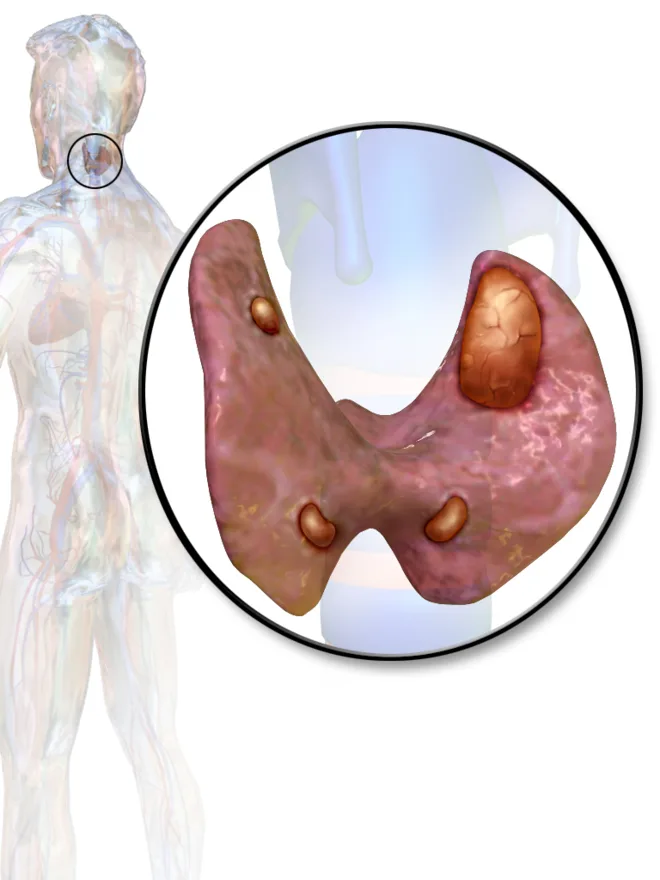
What is hyperparathyroidism?
It is most often caused by a parathyroid adenoma. High calcium weakens bones and can form kidney stones. Memory aid: 'bones, stones, abdominal groans, and psychiatric moans' summarizes the effects of hypercalcemia.
Hyperparathyroidism illustrated
Key points to remember
- PTH excess causes hypercalcemia and hypophosphatemia.
- Bone resorption leads to bone pain, osteoporosis, and increased fracture risk ('bones').
- Hypercalcemia promotes kidney stones, polyuria, and risk of renal damage ('stones').
- GI effects include anorexia, nausea, constipation, and abdominal pain ('abdominal groans').
- Neuromuscular and psychiatric effects include muscle weakness, fatigue, depression, and confusion ('psychiatric moans').
Signs & symptoms
- Bones, stones, groans, moans
- Fractures, kidney stones, ↓ DTR
- Constipation, weakness, fatigue
Nursing priorities
- Encourage increased fluid intake (often 3-4 L/day) to prevent kidney stones and promote calcium excretion.
- Monitor cardiac rhythm, as hypercalcemia can cause dysrhythmias.
- Promote mobility and weight-bearing activity to limit bone calcium loss, while preventing falls and fractures.
- Administer medications such as bisphosphonates, calcitonin, or IV fluids/loop diuretics as ordered to lower calcium.
- Prepare and care for the patient undergoing parathyroidectomy when indicated, monitoring for postoperative hypocalcemia.
Labs & values
Patient teaching
- Drink plenty of fluids to reduce the risk of kidney stones.
- Stay physically active and weight-bearing to protect bones, and use fall precautions.
- Report bone pain, flank pain, or symptoms of kidney stones to the provider.
Red flags: report now
- Report severe hypercalcemia with cardiac dysrhythmias, marked confusion, or decreased level of consciousness.
- Report signs of pathologic fracture or severe bone pain.
- After parathyroidectomy, watch for sudden hypocalcemia causing tetany, numbness, and tingling.
References
Clinical references for this topic