
Hypertension is most often asymptomatic, which is why routine screening and adherence are emphasized.
Before you read
Test yourself first: 3 questions
Question 1 of 3
A client is admitted with a thrombotic ischemic stroke. The provider orders permissive hypertension in the acute phase. The nurse understands the rationale is to:
Answer: A. In acute ischemic stroke not receiving thrombolytics, blood pressure is often allowed to remain elevated (permissive hypertension) to maintain cerebral perfusion to the ischemic penumbra; aggressive lowering can worsen ischemia. It is not done to prevent bleeding (that concern applies more to lowering pressure), to raise intracranial pressure, or to speed clot formation.
Question 2 of 3
A client with cirrhosis has caput medusae and internal hemorrhoids. The nurse understands that these findings are direct consequences of:
Answer: A. Caput medusae (dilated periumbilical veins) and hemorrhoids result from portal hypertension. When scarring obstructs blood flow through the cirrhotic liver, pressure rises in the portal system and blood is diverted through collateral vessels, engorging veins around the umbilicus, esophagus, and rectum. These are not caused by low ammonia, excess clotting factors, or pancreatic enzymes.
Question 3 of 3
A nurse measures a client's blood pressure during the acute phase of an ischemic stroke who did not receive tPA. The provider allows permissive hypertension. What is the rationale?
Answer: B. Permissive (mildly elevated) blood pressure helps maintain cerebral perfusion pressure to the ischemic penumbra. Aggressively lowering BP can extend the infarct, so moderate elevation is often tolerated.
Keep the streak going with more questions like these, each with a full rationale.
What is hypertension?
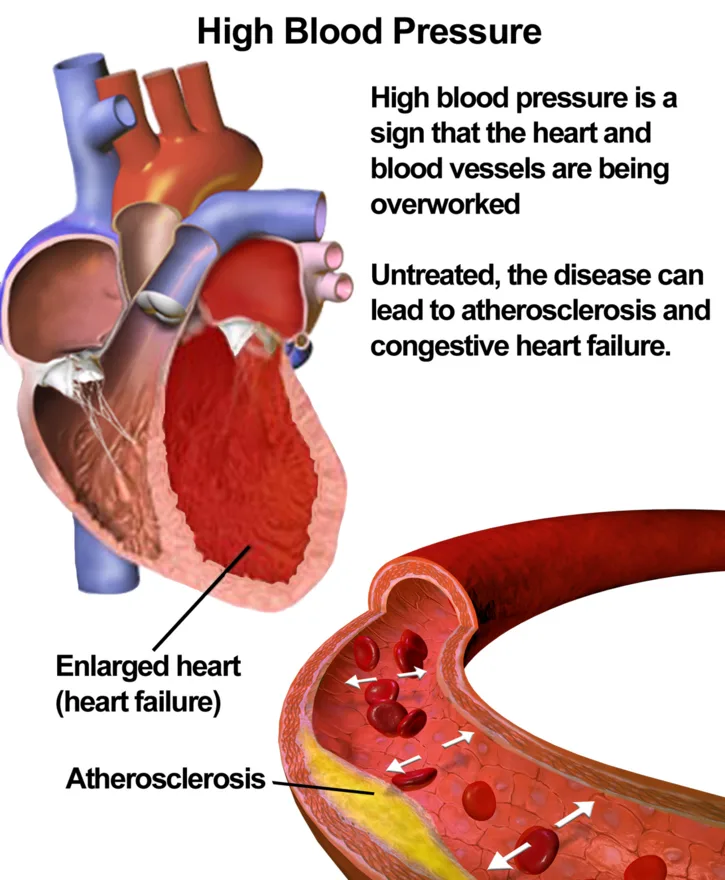
It is called the 'silent killer' because it is usually asymptomatic yet steadily damages the heart, brain, kidneys, and eyes, raising the risk of stroke, MI, and renal failure. Most cases are primary (essential) with no single cause; secondary hypertension results from another condition such as renal disease or endocrine disorders.
Hypertension illustrated
Key points to remember
- Hypertension is most often asymptomatic, which is why routine screening and adherence are emphasized.
- Target organ damage includes left ventricular hypertrophy, stroke, retinopathy, kidney damage, and coronary artery disease.
- Modifiable risk factors include obesity, high sodium intake, smoking, excess alcohol, stress, and physical inactivity.
- A hypertensive crisis is a systolic over 180 or diastolic over 120 mmHg and can cause encephalopathy, stroke, or MI.
- Orthostatic hypotension is a common side effect of many antihypertensive medications.
Signs & symptoms
- Often silent killer
- Headache, blurred vision, dizzy
Nursing priorities
- Measure blood pressure accurately using the correct cuff size with the patient seated and rested.
- Administer prescribed antihypertensives and monitor for therapeutic effect and side effects such as hypotension.
- Teach and reinforce lifestyle modification including the DASH diet and sodium restriction.
- Monitor for and educate about orthostatic hypotension, instructing slow position changes.
- Assess for target organ damage by monitoring renal function, vision changes, and neurologic status.
Labs & values
Patient teaching
- Take medications consistently every day even when feeling well, since hypertension usually has no symptoms.
- Follow a low-sodium DASH diet, limit alcohol, stop smoking, exercise regularly, and lose excess weight.
- Monitor blood pressure at home, keep a log, and change positions slowly to prevent dizziness and falls.
Red flags: report now
- Blood pressure over 180/120 mmHg with headache, blurred vision, chest pain, or neurologic changes is a hypertensive emergency requiring immediate intervention.
- Sudden severe headache, confusion, or focal weakness may signal stroke and must be escalated immediately.
- Abruptly stopping beta-blockers or clonidine can cause dangerous rebound hypertension.
References
Clinical references for this topic

