Report a sudden painful, firm, non-reducible bulge with nausea, vomiting, fever, or absent bowel sounds (strangulation/obstruction).
Before you read
Test yourself first: 3 questions
Question 1 of 3
A nurse checks pupillary response in a client with a head injury. The right pupil is fixed and dilated while the left reacts normally. What does this finding most likely indicate?
Answer: B. A unilateral fixed and dilated pupil suggests compression of the oculomotor nerve (CN III) on that side, often from an expanding mass or herniation, and warrants immediate notification of the provider.
Question 2 of 3
A client diagnosed with a lumbar herniated disc reports radiating pain down the posterior leg. Which finding is consistent with sciatic nerve (L5-S1) involvement?
Answer: A. A herniated lumbar disc compressing the nerve root produces radicular pain, numbness, or tingling radiating along the dermatome down the buttock and posterior leg, often with a positive straight-leg raise test and possible weakness. Pain confined to the upper arm reflects cervical, not lumbar, pathology.
Question 3 of 3
A nurse assesses a client with increased intracranial pressure. Which set of findings is consistent with Cushing's triad, a late sign of rising ICP?
Answer: A. Cushing's triad is the late, ominous combination of widening pulse pressure (rising systolic with bradycardia) and irregular respirations. It signals brainstem compression and impending herniation.
Keep the streak going with more questions like these, each with a full rationale.
What is inguinal hernia?
It is the most common hernia type and far more frequent in males. The key concern is whether the hernia is reducible, or has become incarcerated or strangulated.
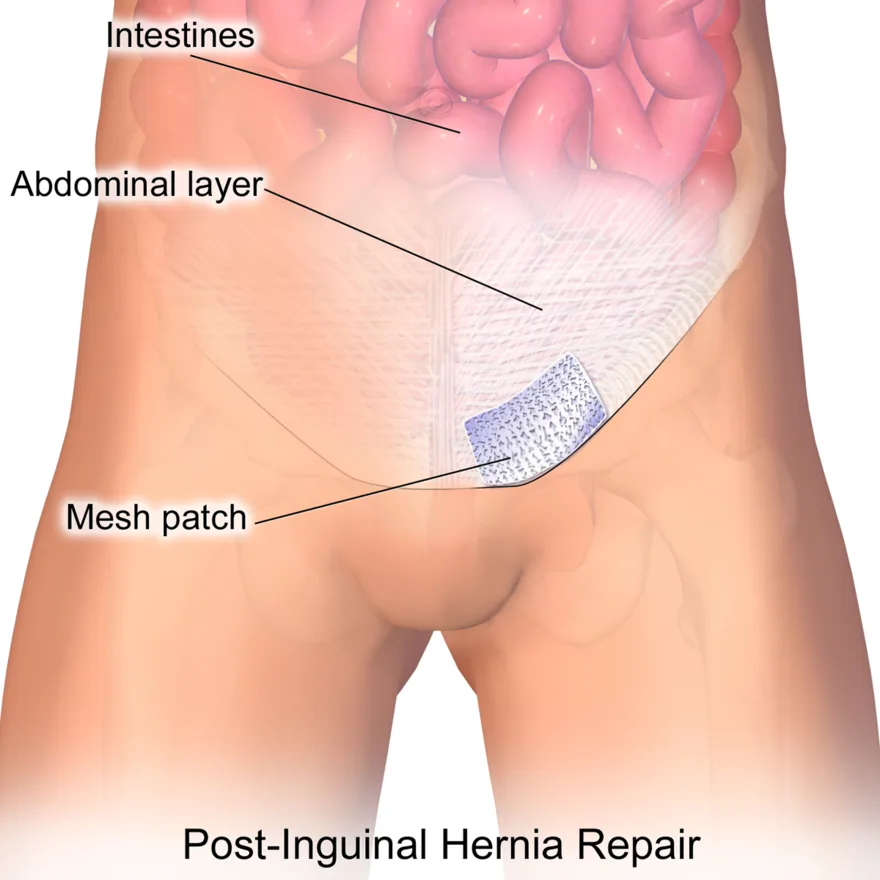
Inguinal Hernia illustrated
Key points to remember
- A reducible hernia can be pushed back into the abdomen; an incarcerated hernia cannot and an strangulated hernia has lost its blood supply, becoming a surgical emergency.
- The bulge typically increases with standing, lifting, coughing, or straining (increased intra-abdominal pressure) and may disappear when lying down.
- Strangulation signs include severe pain, a tender/firm non-reducible mass, nausea/vomiting, and bowel obstruction.
- Definitive treatment is surgical repair (herniorrhaphy/hernioplasty), often with mesh.
- Postoperatively, scrotal swelling and pain are common after inguinal repair; ice and a scrotal support help.
- Patients should avoid heavy lifting and straining for several weeks after repair.
Signs & symptoms
- Groin bulge, worse w/ Valsalva
- Reducible: pushes back in
Nursing priorities
- Assess the hernia for reducibility, tenderness, color change, and bowel sounds; never forcibly reduce an incarcerated hernia.
- Monitor for signs of incarceration/strangulation (increasing pain, vomiting, distention, absent bowel sounds).
- Postoperatively, manage pain, encourage early ambulation, and support coughing by splinting the incision.
- Apply ice and a scrotal support to reduce postoperative scrotal edema, and assess voiding.
- Teach the patient to avoid lifting, straining, and constipation during recovery.
Patient teaching
- Avoid heavy lifting and straining for 2-6 weeks after surgery as directed.
- Prevent constipation with fiber, fluids, and stool softeners to reduce straining.
- Splint the incision when coughing or sneezing.
- Report severe pain, increasing scrotal swelling, fever, redness, or inability to urinate.
Red flags: report now
- Report a sudden painful, firm, non-reducible bulge with nausea, vomiting, fever, or absent bowel sounds (strangulation/obstruction).
- Never force a strangulated or incarcerated hernia back into the abdomen.
- Report postoperative inability to void or signs of wound infection.
References
Clinical references for this topic